Snowflake is investing in making it easier for AI agents to reason over business concepts and relationships natively. This blog shows what's possible today for teams with existing ontologies. Many industries maintain formal ontologies that provide an additional layer of domain-specific reasoning which can add to semantic reasoning captured over tables, columns and joins. This can help AI agents reason over hierarchy, synonymy and domain-specific concepts that a semantic layer alone may not fully capture.Snowflake 正在致力于让 AI 智能体能够更轻松地对业务概念和关系进行原生推理。本博客展示了现有本体的团队目前可以实现的功能。许多行业维护着正式的本体,这些本体提供了额外的领域特定推理层,可以补充在表、列和连接上捕获的语义推理。这有助于 AI 智能体对仅靠语义层可能无法完全捕获的层级、同义词和领域特定概念进行推理。
Using a highly simplified biomedical data set, we compared a baseline semantic-view Cortex Agent with ontology-aware approaches built on knowledge graphs, GraphRAG and targeted terminology mappings. The results in this benchmark suggest that improved structural grounding may improve accuracy and reliability under the evaluated conditions, while also offering a practical blueprint for teams building enterprise AI agents that need to be more precise, explainable and trustworthy.我们使用一个高度简化的生物医学数据集,对比了基准语义视图 Cortex Agent 与基于知识图谱、GraphRAG 和目标术语映射的本体感知方法。该基准测试的结果表明,在评估条件下,改进结构基础可以提高准确性和可靠性,同时也为构建需要更精确、可解释且可信的企业级 AI 智能体的团队提供了一个实用的蓝图。
Incorporating Ontologies into Snowflake Cortex Agents将本体纳入 Snowflake Cortex 智能体
Enterprise data is full of meaning that never appears explicitly in a schema — inherent domain knowledge that must be captured to power reliable agentic systems.企业数据中充满了未在模式中显式呈现的含义——这些固有的领域知识必须被捕获,才能为可靠的智能体系统提供动力。
Across industries, organizations maintain formal ontologies, taxonomies and controlled vocabularies to encode class hierarchies, typed relationships, constraints and canonical identifiers. In healthcare and life sciences, these include resources such as SNOMED CT, UMLS, the Gene Ontology and the Cell Ontology; in supply chain and retail, standards such as GS1 define product and packaging semantics; in financial services, FIBO provides a shared model for instruments, entities and regulatory classifications. These industry assets are typically published in representation formats such as OWL, RDF or SKOS and often contain thousands of concepts, rich synonym sets and tens of thousands of hierarchical and associative edges. Yet most enterprise AI and analytics systems still operate primarily over relational abstractions — tables, columns, keys and joins — without native access to the layers that define concept inheritance, transitive relationships, equivalence mappings or domain constraints. The result is a potential gap between how organizations model real-world meaning and how AI systems retrieve and reason over operational data.在各行各业中,组织都维护着正式的本体、分类法和受控词表,以编码类层级、类型化关系、约束和规范标识符。在医疗保健和生命科学领域,这些资源包括 SNOMED CT、UMLS、基因本体 (Gene Ontology) 和细胞本体 (Cell Ontology);在供应链和零售业,GS1 等标准定义了产品和包装语义;在金融服务领域,FIBO 为工具、实体和监管分类提供了共享模型。这些行业资产通常以 OWL、RDF 或 SKOS 等表示格式发布,并且往往包含数千个概念、丰富的同义词集以及数以万计的层级和关联边。然而,大多数企业 AI 和分析系统仍然主要在关系抽象(表、列、键和连接)上运行,而无法原生访问定义概念继承、传递关系、等价映射或领域约束的层。其结果是,组织建模现实世界含义的方式与 AI 系统检索和推理操作数据的方式之间可能存在差距。
Consider a supply chain analyst asking: "Show total spend across all electronic components," where "electronic component" sits atop a taxonomy of capacitors, resistors, ICs and dozens of subcategories. Or a biomedical researcher asking: "Show drug efficacy for PD-1 inhibitors across epithelial-derived cancer cell lines," which requires expanding a parent concept across dozens of cell types and 13 tissue categories. In both cases, Snowflake's semantic view provides the foundation of relational constructs (entities, relations, metrics, dimensions). In addition, the Recursive CTE (SQL extension) provides a dynamic path length query mechanism to support hierarchical typing and relationship axioms like subclass-of, transitive and inverse properties.考虑一位供应链分析师提出的问题:“显示所有电子元件的总支出”,其中“电子元件”位于电容器、电阻器、集成电路和数十个子类别的分类法之上。或者一位生物医学研究人员问:“显示 PD-1 抑制剂在源自上皮细胞的癌细胞系中的药物疗效”,这需要将父概念扩展到数十种细胞类型和 13 个组织类别中。在这两种情况下,Snowflake 的语义视图都提供了关系构造(实体、关系、指标、维度)的基础。此外,递归 CTE(SQL 扩展)提供了一种动态路径长度查询机制,以支持层级类型化和关系公理,如子类、传递属性和逆属性。
In this post, we look at what happens when you bring that deeper layer of ontological meaning into Snowflake and use it to ground AI agents alongside your operational data. Specifically, we evaluated a baseline semantic-layer approach and three ontology-aware enhancements on a biomedical benchmark designed to test ontology-dependent reasoning in agentic data retrieval tasks.在这篇文章中,我们将探讨当您将这种更深层次的本体论含义引入 Snowflake,并将其与您的操作数据一起用于构建 AI 智能体的基础时会发生什么。具体来说,我们在一个旨在测试智能体数据检索任务中本体依赖推理的生物医学基准上,评估了一种基准语义层方法和三种本体感知增强方案。
A biomedical benchmark生物医学基准
In drug discovery, finding new therapeutic candidates means navigating gene-pathway-cell-disease-drug-outcome relationships encoded in multiple ontologies disconnected from experimental data to derive insights. Our goal was to build and test agent architectures that can perform ontology-enabled reasoning, resolve semantic ambiguities and extract insights from cancer-cell line drug screening viability data (a measure of drug efficacy based on surviving cell ratio).在药物研发中,寻找新的治疗候选药物意味着要梳理编码在多个与实验数据断开的本体中的基因-通路-细胞-疾病-药物-结果关系,从而得出见解。我们的目标是构建并测试能够执行本体赋能推理、解决语义歧义并从癌细胞系药物筛选活力数据(一种基于存活细胞比例的药物疗效衡量指标)中提取见解的智能体架构。
This benchmark is intended to show directional evidence. Its purpose was to measure incremental lift of ontology-aware techniques under controlled conditions by incorporating a single industry ontology for extracting insights in a complex data challenge. We combined two publicly available resources inside Snowflake:此基准旨在展示方向性证据。其目的是通过纳入单个行业本体来提取复杂数据挑战中的见解,从而衡量受控条件下本体感知技术的增量提升。我们在 Snowflake 内部结合了两个公开可用的资源:
- Cell ontology (CL): An ontology designed to classify and describe cell types encompassing 33,651 terms connected by ~50,000 hierarchical and relational edges.细胞本体 (CL):一种旨在分类和描述细胞类型的本体,包含 33,651 个术语,由约 50,000 条层级和关系边连接。
- PRISM (Profiling Relative Inhibition Simultaneously in Mixtures) drug repurposing data set: Contains growth inhibitory activity of 4,518 drugs tested across 578 human cancer cell lines producing 2.6M+ viability measurements.PRISM(混合物中相对抑制的同步分析)药物再利用数据集:包含在 578 种人类癌细胞系中测试的 4,518 种药物的生长抑制活性,产生了超过 260 万个活力测量值。
The bridging challenge is real: PRISM labels data by tissue (lung, breast), while the cell ontology organizes by lineage (epithelial cell, stromal cell). Agents must bridge this gap to answer analytical questions.桥接挑战是真实存在的:PRISM 按组织(肺、乳腺)标记数据,而细胞本体则按谱系(上皮细胞、基质细胞)进行组织。智能体必须弥合这一差距才能回答分析性问题。
We wrote 22 hard questions intentionally targeted to isolate a specific problem: how an ontology-grounded agent performs in tasks spanning term resolution, cohort comparison, cross-tissue analysis, drug ranking, distribution analysis and multi-class comparison. Each agent tested ran five times to measure consistency.我们编写了 22 个难题,旨在隔离一个特定问题:本体基础智能体在跨越术语解析、队列比较、跨组织分析、药物排序、分布分析和多类比较的任务中表现如何。每个测试的智能体都运行了五次以衡量一致性。
Starting point: Semantic View, Agentic Analyst起点:语义视图,智能体分析师
Our baseline agent is leveraging semantic view, and uses Cortex Analyst, which translates natural language into validated SQL against that semantic layer.我们的基准智能体利用语义视图,并使用 Cortex Analyst,它将自然语言转换为针对该语义层的已验证 SQL。
Semantic view introduces a governed semantic layer above physical tables, allowing AI systems to work with a clear, domain-friendly model instead of raw schemas. Within a semantic view, we have entity tables, relations, facts, dimensions and metrics.语义视图在物理表之上引入了一个受管语义层,允许 AI 系统使用清晰、领域友好的模型,而不是原始模式。在语义视图中,我们拥有实体表、关系、事实、维度和指标。
In the biomedical setting, that semantic layer can represent drugs, protein targets, cell lines and disease phenotypes as logical entities, use facts to capture measurable events such as drug-target interactions, use dimensions to provide analytic context such as tissue or disease state, and use metrics to encode derived measures such as potency or efficacy. This baseline provides a governed control point for measuring the incremental lift of ontology-aware techniques layered on top of the semantic model.在生物医学环境中,该语义层可以将药物、蛋白质靶点、细胞系和疾病表型表示为逻辑实体,使用事实捕获可测量事件(如药物-靶点相互作用),使用维度提供分析上下文(如组织或疾病状态),并使用指标编码派生度量(如效力或疗效)。该基准提供了一个受管控制点,用于衡量叠加在语义模型之上的本体感知技术的增量提升。
Our baseline agent serves as a control point to access the lift brought by other techniques.我们的基准智能体作为控制点,用于获取其他技术带来的提升。
Knowledge graph知识图谱
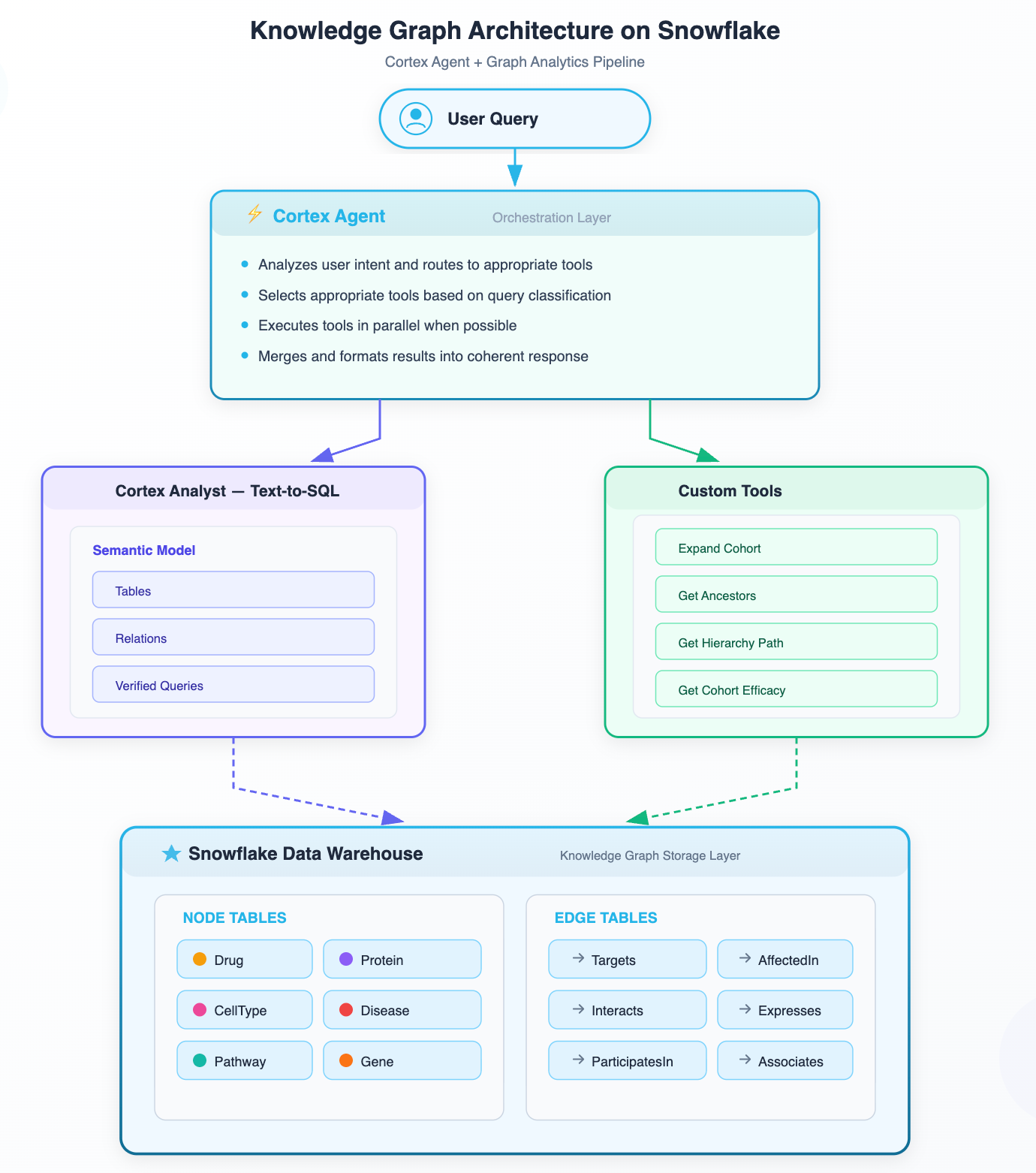
On top of the semantic view, we have implemented a simple knowledge graph using Snowflake tables to support graph traversal operation more naturally. A knowledge graph (KG), in this case, is a representation of knowledge as interconnected entities and typed relationships. (For a deeper dive on building knowledge graphs on Snowflake, see the Ontology on Snowflake blog series.)在语义视图之上,我们使用 Snowflake 表实现了一个简单的知识图谱,以更自然地支持图遍历操作。在这种情况下,知识图谱 (KG) 是将知识表示为互连实体和类型化关系的一种方式。(有关在 Snowflake 上构建知识图谱的深入探讨,请参阅“Snowflake 上的本体”系列博客。)
Knowledge graph traversal知识图谱遍历
The knowledge graph is stored directly inside Snowflake using a node-edge table model:知识图谱直接存储在 Snowflake 内部,使用节点-边表模型:
- The KG_NODE table stores all entities, including their unique identifiers, type (drug, disease, cell) and properties (often stored in a flexible
VARIANTcolumn).KG_NODE 表存储所有实体,包括它们的唯一标识符、类型(药物、疾病、细胞)和属性(通常存储在灵活的 VARIANT 列中)。 - The KG_EDGE table stores relationships, including source node ID, target node ID, edge type (for example, treats, targets, expressed_in) and optional metadata, such as timestamps or confidence scores.KG_EDGE 表存储关系,包括源节点 ID、目标节点 ID、边类型(例如,治疗、靶向、表达于)以及可选元数据,如时间戳或置信度分数。
The implementation leverages Snowflake's distributed storage, automatic scaling, query optimization, security and governance without requiring a separate graph database.该实现利用了 Snowflake 的分布式存储、自动扩展、查询优化、安全性和治理能力,而无需单独的图数据库。
Recursive CTE递归 CTE
A key capability of a knowledge graph is traversal — the ability to move from one entity to its connected neighbors across multiple hops, without knowing in advance how many steps are required. In Snowflake, this dynamic, variable-length traversal can be implemented using recursive common table expressions (CTEs). Recursive CTEs repeatedly join an edge table to itself, incrementally expanding the frontier of reachable nodes until no new nodes are found or a specified depth limit is reached or timeout. Unlike fixed self-joins, which require the number of hops to be hard-coded, recursive CTEs allow path length to remain data-driven and flexible.知识图谱的关键能力是遍历——即在不知道预先需要多少步的情况下,从一个实体移动到其跨越多个跳数的连接邻居的能力。在 Snowflake 中,这种动态、可变长度的遍历可以使用递归公用表表达式 (CTE) 来实现。递归 CTE 将边表反复与自身连接,逐步扩展可达节点的边界,直到找不到新节点或达到指定的深度限制或超时。与需要硬编码跳数的固定自连接不同,递归 CTE 允许路径长度保持数据驱动且灵活。
Suppose we want to identify diseases mechanistically connected to a drug through biological pathways. The simplistic graph may contain edges, such as:假设我们想识别通过生物通路与药物在机制上相关的疾病。简单的图可能包含如下边:
Drug →targets→ Protein药物 →靶向→ 蛋白质Protein →triggers→ Pathway蛋白质 →触发→ 通路Pathway → expressed in → Cell Type通路 →表达于→ 细胞类型Cell Type → affected in→ Disease细胞类型 →受影响于→ 疾病Disease →subClassOf→ Disease Category(ontology hierarchy)疾病 →子类→ 疾病类别(本体层级)
We may not know in advance whether a disease is reachable in two hops, three hops or via additional subclass expansions. A recursive CTE allows us to traverse this network dynamically.我们可能无法预先知道疾病是通过两跳、三跳还是通过额外的子类扩展可达的。递归 CTE 允许我们动态地遍历此网络。
On top of the baseline semantic view, the knowledge graph agent has additional access to four stored procedures (expand cohort, get ancestors, get hierarchy path, get cohort efficacy) plus two specialized Cortex Analyst semantic views, giving it seven tools total.在基准语义视图之上,知识图谱智能体还可以额外访问四个存储过程(扩展队列、获取祖先、获取层级路径、获取队列疗效)以及两个专门的 Cortex Analyst 语义视图,总共提供七个工具。
Example of such a tool:此类工具的示例:
Strength: Deterministic traversal across supported hierarchy depths. For "epithelial cell," this means all 693 descendants across 10+ hierarchy levels.优势:跨支持的层级深度的确定性遍历。对于“上皮细胞”,这意味着跨越 10 多个层级的所有 693 个后代。
Weakness: Seven tools create orchestration complexity. The agent must choose the right tool sequence, and procedures require exact concept names with no synonym resolution.劣势:七个工具造成了编排复杂性。智能体必须选择正确的工具序列,且过程需要精确的概念名称,没有同义词解析。
Flattened GraphRAG扁平化 GraphRAG
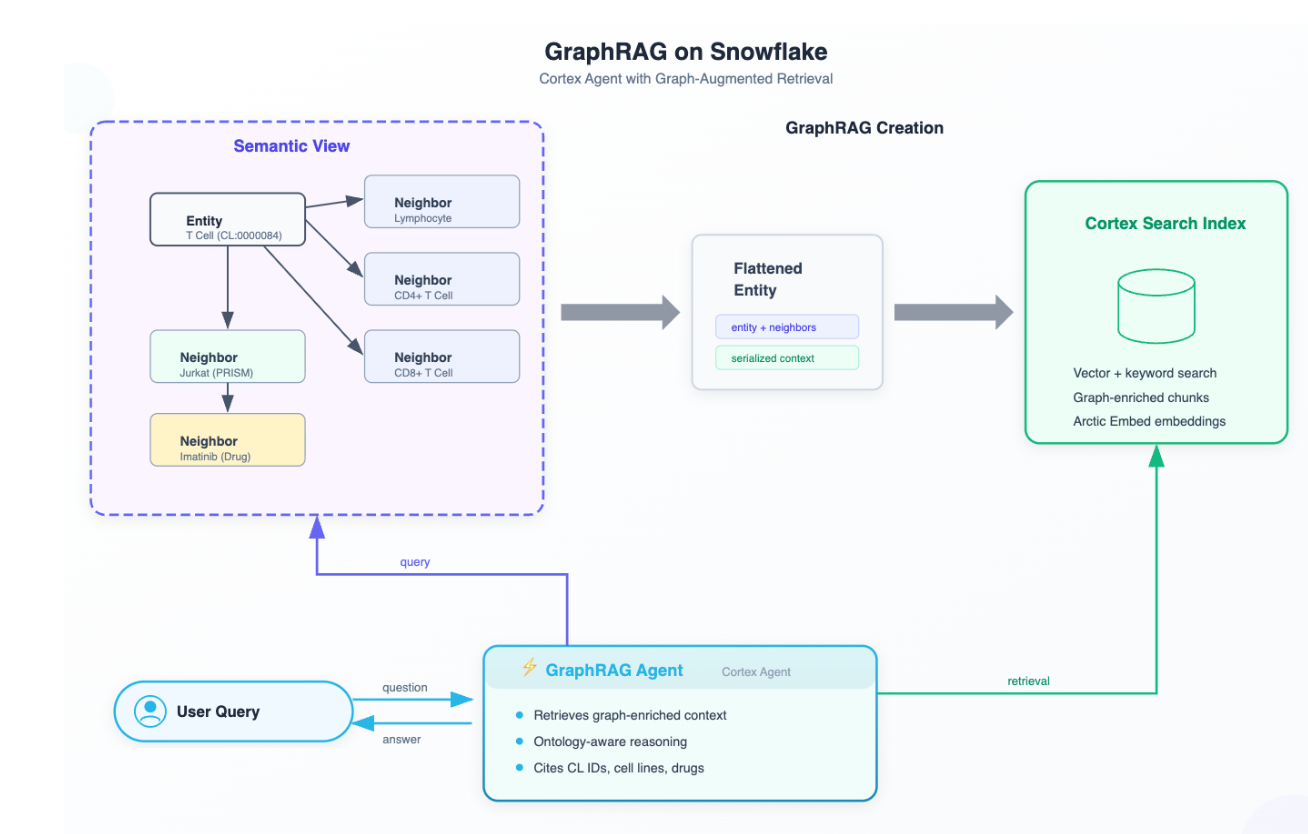
A complementary pattern is flattened GraphRAG. Instead of traversing an ontology or knowledge graph at query time, flattened GraphRAG precomputes a denormalized profile for each concept — combining its name, definition, synonyms, local neighborhood and attributes aggregated from descendants — and indexes those profiles in Cortex Search for hybrid keyword and vector retrieval.一种互补模式是扁平化 GraphRAG。扁平化 GraphRAG 不会在查询时遍历本体或知识图谱,而是为每个概念预先计算一个非规范化配置文件——结合其名称、定义、同义词、局部邻域以及从后代聚合的属性——并将这些配置文件索引到 Cortex Search 中,用于混合关键词和向量检索。
At runtime, the agent retrieves the most relevant concept profile, extracts the grounded business or scientific context, and passes that context into Cortex Analyst or downstream SQL generation.在运行时,智能体检索最相关的概念配置文件,提取基础业务或科学上下文,并将该上下文传递给 Cortex Analyst 或下游 SQL 生成。
In Snowflake, the implementation pattern is straightforward: store the ontology in relational tables, use recursive CTEs or preprocessing pipelines to build one enriched profile per node, index those profiles with a Cortex Search service, and use the retrieved profile as the semantic grounding layer for analysis.在 Snowflake 中,实现模式很简单:将本体存储在关系表中,使用递归 CTE 或预处理流水线为每个节点构建一个丰富的配置文件,使用 Cortex Search 服务索引这些配置文件,并使用检索到的配置文件作为分析的语义基础层。
The advantage is a simpler retrieval architecture designed to improve consistency with strong synonym handling and no runtime graph traversal; the tradeoff is that the quality of the system depends heavily on how well the flattened profiles are constructed and refreshed.其优势在于一种更简单的检索架构,旨在通过强大的同义词处理和无运行时图遍历来提高一致性;代价是系统质量在很大程度上取决于扁平化配置文件的构建和刷新效果。
Index construction索引构建
A preprocessing pipeline builds a neighborhood profile document for every ontology node. A recursive CTE traverses the full hierarchy (up to 15 levels via subClassOf edges), and for every node, collects descendant attributes and aggregates them upward. The result: Ancestor nodes contain aggregated tissue lists derived from their descendant trees.预处理流水线为每个本体节点构建一个邻域配置文件文档。递归 CTE 遍历完整层级(通过 subClassOf 边最多 15 层),并为每个节点收集后代属性并向上聚合。结果:祖先节点包含从其后代树派生的聚合组织列表。
Each document in the index contains:索引中的每个文档包含:
- The node's formal name, definition and all known synonyms节点的正式名称、定义和所有已知同义词
- Immediate parents and children (first-order neighbors)直接父级和子级(一阶邻居)
- Sample of grandparents and grandchildren (second-order neighbors)祖父母和孙辈样本(二阶邻居)
- Aggregated domain data categories from all descendants来自所有后代的聚合领域数据类别
These profiles are indexed in a Cortex Search service with both keyword and vector embeddings.这些配置文件被索引在具有关键词和向量嵌入的 Cortex Search 服务中。
On top of the baseline semantic view, the GraphRAG agent has just two tools: one search tool and one Cortex Analyst SQL tool. When a query arrives, the agent searches for the relevant entity profile, extracts the relevant categories and passes them explicitly to the SQL tool.在基准语义视图之上,GraphRAG 智能体仅有两个工具:一个搜索工具和一个 Cortex Analyst SQL 工具。当查询到达时,智能体搜索相关的实体配置文件,提取相关类别,并将它们显式传递给 SQL 工具。
Strength: Synonym resolution via semantic search ("flat epithelial" resolves to "squamous epithelial cell"). Simpler two-tool architecture. No runtime graph traversal.优势:通过语义搜索实现同义词解析(“扁平上皮”解析为“鳞状上皮细胞”)。更简单的双工具架构。无运行时图遍历。
Weakness: Cannot resolve composite terms, such as "internal organ lining" that map to unions of multiple cell type categories. Requires periodic index rebuilds.劣势:无法解析复合术语,例如映射到多个细胞类型类别并集的“内脏内衬”。需要定期重建索引。
Adding terminology mapping instructions添加术语映射指令
Based on the GraphRAG agent, we enhanced the agent instructions by embedding hand-curated mappings directly in the agent's system prompt. For example, eight authoritative cell-type-to-tissue mappings and composite term definitions in our biomedical challenge act as overrides when they apply. For example, Squamous Epithelial Cell (CL:0000076) -> Skin, Lung, Esophagus, Bladder, Cervix hardcodes the relevant PRISM tissue mappings to any of the cell descendants in the cell ontology.在 GraphRAG 智能体的基础上,我们通过将人工策划的映射直接嵌入智能体的系统提示词中,增强了智能体指令。例如,在我们的生物医学挑战中,八个权威的细胞类型到组织的映射和复合术语定义在适用时作为覆盖项。例如,鳞状上皮细胞 (CL:0000076) -> 皮肤、肺、食管、膀胱、宫颈,将相关的 PRISM 组织映射硬编码到细胞本体中的任何细胞后代。
Strength: Eliminates the "last mile" error by collapsing multi-step lookups into a deterministic table.优势:通过将多步查找压缩为确定性表,消除了“最后一英里”错误。
Weakness: Static knowledge that must be manually maintained. Only covers mapped concepts; unmapped ones fall back to dynamic search.劣势:必须手动维护的静态知识。仅涵盖已映射的概念;未映射的概念回退到动态搜索。
Optimizing agents with Cortex Code使用 Cortex Code 优化智能体
Building each agent configuration is only half the work. Tuning the system prompts, tool descriptions and selection heuristics to maximize accuracy is the other half. We used Cortex Code's agent optimization skills to iteratively refine all four agents. Cortex Code's optimization workflow made it straightforward to:构建每个智能体配置只是工作的一半。调整系统提示词、工具描述和选择启发式算法以最大限度地提高准确性是另一半。我们利用 Cortex Code 的智能体优化技能对所有四个智能体进行了迭代优化。Cortex Code 的优化工作流使以下操作变得简单:
- Run the 22-question eval suite against each agent configuration针对每个智能体配置运行 22 个问题的评估套件
- Analyze failure patterns across runs分析运行中的失败模式
- Propose and apply prompt refinements (for example, the explicit tissue passthrough instruction for GraphRAG)提出并应用提示词优化(例如,GraphRAG 的显式组织传递指令)
- Re-evaluate and compare results重新评估并比较结果
This tight optimize-evaluate loop was critical. Several of the design choices that drove accuracy gains (search text enrichment with tissue keywords, the tissue passthrough mandate, shared statistical threshold rules) emerged directly from Cortex Code optimization iterations.这种紧密的优化-评估循环至关重要。推动准确性提升的几个设计选择(带有组织关键词的搜索文本丰富化、组织传递指令、共享统计阈值规则)都是直接从 Cortex Code 优化迭代中产生的。
Results结果
The following table summarizes the findings from our benchmark evaluation.下表总结了我们基准评估的发现。
| Agent Setup | Tool Count | Mean Score (/2.0) | Success Percentage |
|---|---|---|---|
| Standard Semantic View (Baseline) | 1 | 0.93 | 50.0% |
| Baseline with Knowledge Graph | 7 | 1.14 | 60.0% |
| Baseline with GraphRAG | 2 | 1.38 | 70.0% |
| Baseline with GraphRAG and Term Mappings | 2 | 1.55 | 78.2% |
Each enhancement showed improved benchmark performance within this evaluation framework. The knowledge graph approach produced an approximately 10 percentage point improvement in evaluated accuracy through exhaustive hierarchy expansion, while GraphRAG provided an additional approximate 10 percentage point improvement which may reflect the effects of simplified architecture and preintegrated descendant data. The terminology-mapping approach produced an additional improvement in evaluated accuracy within this benchmark by helping resolve complex domain aliases and composite terms.每种增强方案在此评估框架内都显示出基准性能的提高。知识图谱方法通过详尽的层级扩展,使评估准确率提高了约 10 个百分点;而 GraphRAG 则额外提供了约 10 个百分点的提升,这可能反映了简化架构和预集成后代数据的影响。术语映射方法在此基准测试中进一步提高了评估准确率,因为它有助于解析复杂的领域别名和复合术语。
Key Takeaway: In this benchmark, the observed improvements appeared to correlate more strongly with structural context than with increased computational reasoning.关键结论:在此基准测试中,观察到的改进似乎与结构上下文的相关性比与计算推理增加的相关性更强。
Observations观察结果
1. Fix the data layer first. GraphRAG with aggregated descendant attributes captured a substantial portion of roughly 80% of the observed gain over baseline in this benchmark with no static mappings. Precomputing tissue lists appeared to be one of the most impactful interventions in this benchmark. Before investing in hand-curated rules, ensure the index provides complete data for every concept.1. 首先修复数据层。在此基准测试中,具有聚合后代属性的 GraphRAG 在没有静态映射的情况下,捕获了相对于基准约 80% 的观察增益。预计算组织列表似乎是此基准测试中最具影响力的干预措施之一。在投入人工策划规则之前,确保索引为每个概念提供了完整的数据。
2. Fewer tools can also give good results. Within this benchmark, the flattened GraphRAG agent produced comparable results to the seven-tool knowledge graph agent. More tools give more raw capability but also more orchestration surface area for errors. GraphRAG's simplicity (one search tool, one SQL tool) reduces the agent's decision space and produces the lowest observed variance in this benchmark. Within this benchmark, the GraphRAG agent showed the lowest observed run-to-run variance, while the hardcoded-mapping variant, despite higher peak accuracy, showed the highest variance.2. 更少的工具也能带来良好的结果。在此基准测试中,扁平化 GraphRAG 智能体产生了与七工具知识图谱智能体相当的结果。更多的工具提供了更多的原始能力,但也为错误提供了更多的编排面。GraphRAG 的简洁性(一个搜索工具,一个 SQL 工具)减少了智能体的决策空间,并在此基准测试中产生了最低的观察方差。在此基准测试中,GraphRAG 智能体显示出最低的运行间方差,而硬编码映射变体尽管峰值准确率较高,但显示出最高的方差。
3. Targeted hardcoding closes the last gap. The terminology mapping agent's advantage over baseline GraphRAG configuration is concentrated on composite terms ("internal organ lining," "carcinoma-like models") that cannot be derived from hierarchy traversal alone. For a known, finite vocabulary of such terms, embedding curated mappings in the agent prompt is effective. This layer should stay thin: Supplement the index, do not replace it.3. 针对性硬编码填补了最后的空白。术语映射智能体相对于基准 GraphRAG 配置的优势集中在无法仅从层级遍历中导出的复合术语(“内脏内衬”、“癌样模型”)上。对于此类术语的已知有限词汇表,在智能体提示词中嵌入策划的映射是有效的。该层应保持精简:补充索引,而不是替换它。
4. Cortex Code optimization skills make this workflow repeatable. Building an ontology-aware agent is an iterative process. Cortex Code's agent optimization skills provide the eval-refine-compare loop that turns architectural choices into measurable accuracy gains. The design decisions that mattered most in our results (search text enrichment, tissue passthrough, threshold rules) all emerged from this optimization process. Any team ingesting an ontology into Snowflake can follow the same workflow: Load the ontology; build the index; create an agent; and optimize with Cortex Code.4. Cortex Code 优化技能使此工作流可重复。构建本体感知智能体是一个迭代过程。Cortex Code 的智能体优化技能提供了评估-优化-比较循环,将架构选择转化为可衡量的准确性提升。在我们的结果中最重要的设计决策(搜索文本丰富化、组织传递、阈值规则)都是从这个优化过程中产生的。任何将本体摄入 Snowflake 的团队都可以遵循相同的工作流:加载本体;构建索引;创建智能体;并使用 Cortex Code 进行优化。
Biomedical nuance生物医学细微差别
This benchmark is best read as a comparative evaluation of ontology techniques, not as an attempt to maximize performance on the full scope of real-world biomedical reasoning. Our goal is not to claim coverage of the full biomedical reasoning stack, but to understand the relative contribution of different ontology-aware approaches under a simplified, controlled setting, and under what trade-offs in complexity, consistency and maintainability.此基准最好被视为本体技术的比较评估,而不是试图最大限度地提高现实世界生物医学推理全范围内的性能。我们的目标不是声称涵盖完整的生物医学推理堆栈,而是了解不同本体感知方法在简化、受控设置下的相对贡献,以及在复杂性、一致性和可维护性方面的权衡。
A production biomedical system would naturally extend beyond this setup. Real deployments often span multiple ontologies and multiple relation types at once, including cell types, anatomy, disease, pathway, compound identity, target biology and assay context. Over time, such systems should incorporate additional ontologies and controlled vocabularies, along with explicit provenance and uncertainty handling for each mapping step. But those are follow-on architecture concerns. The purpose of this benchmark is narrower: to compare ontology techniques on a simplified shared problem by looking at their relative performance.生产级生物医学系统自然会超出此设置。实际部署通常同时跨越多个本体和多种关系类型,包括细胞类型、解剖学、疾病、通路、化合物身份、靶点生物学和测定上下文。随着时间的推移,此类系统应纳入额外的本体和受控词表,并为每个映射步骤提供明确的来源和不确定性处理。但这些是后续的架构问题。此基准的目的更窄:通过观察它们的相对性能,在简化的共享问题上比较本体技术。
Appendix A: Example of Recursive CTE附录 A:递归 CTE 示例
Here is an example of how recursive CTE can be used.以下是递归 CTE 如何使用的一个示例。
Natural language
Find all descendant cell types of EpithelialCell (follow subClassOf one or more hops), and return the full path(s) from EpithelialCell down to each descendant (For example, EpithelialCell → SquamousEpithelialCell → Keratinocyte).自然语言
查找 EpithelialCell(上皮细胞)的所有后代细胞类型(沿 subClassOf 跟踪一跳或多跳),并返回从 EpithelialCell 向下到每个后代的完整路径(例如,EpithelialCell → SquamousEpithelialCell → Keratinocyte)。
SPARQL
Recursive CTE递归 CTE
References参考文献
- Complete knowledge graph on SnowflakeSnowflake 上的完整知识图谱
- GraphRAGGraphRAG
- Cortex AnalystCortex Analyst
- Cortex SearchCortex Search
- Cortex AgentCortex Agent
- Semantic View语义视图