Feb 26, 2026/9 min readGen AI
Snowflake’s Blueprint for Parsing Complex, Real-World Documents


Modern enterprises ingest documents in every imaginable form: born-digital PDFs, scanned contracts, financial statements packed with tables and multilingual reports. Extracting reliable structure and content from diverse documents is a foundational requirement for analytics, search and AI-driven workflows.现代企业需要处理各种形式的文档:原生数字 PDF、扫描合同、包含大量表格的财务报表以及多语言报告。从这些多样化的文档中提取可靠的结构和内容,是实现分析、搜索和 AI 驱动工作流的基础需求。
At enterprise scale, document intelligence must also be cost effective, predictable and robust under real-world conditions. Small differences in price performance compound dramatically when processing millions of pages per year. 在企业规模下,文档智能还必须具备成本效益、可预测性,并能在现实条件下保持稳健。当每年处理数百万页文档时,性价比上的细微差异会产生巨大的累积影响。
Many solutions in the market optimize for benchmarks using “ideal data sets,” which do not reflect the messy, heterogeneous documents that organizations actually encounter. This is why we built the AI Parse Document, engineered for this operating reality. It reconstructs logical reading order, preserves document hierarchy, extracts tables with structural precision and maintains visual context. The output is not merely text; it is a structured representation designed for deterministic downstream processing.市场上许多解决方案针对“理想数据集”进行了基准测试优化,但这并不能反映组织实际遇到的混乱、异构文档。因此,我们构建了 AI Parse Document,专为这种现实应用场景而设计。它能重构逻辑阅读顺序,保留文档层级,以结构化精度提取表格,并维护视觉上下文。其输出的不仅仅是文本,更是专为确定性下游处理而设计的结构化表示。
Our evaluations prioritize realistic enterprise conditions and measure performance based on usability: table reconstruction fidelity, structured extraction accuracy, OCR (Optical Character Recognition) robustness and LLM readiness. The results demonstrate top-tier accuracy combined with compelling price efficiency, positioning Snowflake in the enterprise sweet spot for scalable document AI.我们的评估优先考虑现实的企业环境,并基于可用性衡量性能:表格重构保真度、结构化提取准确性、OCR(光学字符识别)稳健性以及对 LLM 的就绪程度。结果表明,Snowflake 兼具顶尖的准确性和卓越的性价比,使其在可扩展文档 AI 领域处于企业级应用的最佳平衡点。
Real-world evaluation under complex document conditions复杂文档条件下的现实评估
To evaluate how well AI Parse Document handles the messiness of real-world enterprise documents and images, we assembled a deliberately challenging, multilingual data set. The goal was not to optimize for ideal conditions but to reflect the high-variance reality our customers encounter at scale.为了评估 AI Parse Document 处理现实企业文档和图像混乱程度的能力,我们汇编了一个特意设计的、具有挑战性的多语言数据集。我们的目标不是针对理想条件进行优化,而是反映客户在大规模应用中遇到的高差异性现实。
The data set included documents with:该数据集包含以下文档:
Dense text split across multiple columns分布在多列中的密集文本
Embedded tables and charts interleaved with narrative text与叙述性文本交织的嵌入式表格和图表
Extremely small font sizes极小的字号
Sideways slides and rotated pages侧向放置的幻灯片和旋转页面
Scans containing multiple pages merged into a single image (“two pages in one”)将多个页面合并为单张图像的扫描件(“一页两面”)
Other artifacts commonly introduced during digitization数字化过程中常见的其他伪影
Each document was manually reviewed by comparing the original source document with the extracted output. Reviewers scored performance across the following four dimensions that directly affect downstream usability:每份文档都经过人工审查,通过对比原始源文档与提取出的输出结果进行评分。审查人员从以下四个直接影响下游可用性的维度对性能进行了评分:
OCR quality: Accuracy of text transcription relative to the source
OCR 质量:文本转录相对于源文档的准确性Reading order: Correctness of the logical sequence compared to the original layout
阅读顺序:逻辑顺序相对于原始布局的正确性Document structure: Fidelity of reconstructed headers, sections and paragraphs
文档结构:重构后的标题、章节和段落的保真度Image handling: Accuracy of detecting and positioning nontext elements图像处理:检测和定位非文本元素的准确性
Across these scenarios, AI Parse Document layout mode consistently produced well-structured outputs. Even for the documents with heavy rotation, multicolumn layouts or mixed visual content, the output text flowed in the expected order, and structural boundaries were preserved. It also correctly identified images in their proper context rather than flattening them into noise.在这些场景中,AI Parse Document 的布局模式始终能产生结构良好的输出。即使对于大幅旋转、多列布局或混合视觉内容的文档,输出文本也能按预期顺序流动,并保留了结构边界。它还能正确识别图像并将其置于适当的上下文中,而不是将其平铺为噪声。
This qualitative robustness is critical as layout errors compound exponentially once documents are fed into search indexes, retrieval pipelines or LLM-based reasoning systems. The results demonstrate that AI Parse Document layout mode provides a reliable structural foundation before any higher-level analysis begins.这种定性的稳健性至关重要,因为一旦文档进入搜索索引、检索管线或基于 LLM 的推理系统,布局错误就会呈指数级累积。结果表明,AI Parse Document 的布局模式在任何更高级别的分析开始之前,就提供了一个可靠的结构基础。
Industry-leading table extraction行业领先的表格提取
Tables remain one of the hardest problems in document understanding, as even subtle differences in row alignment, merged cells or header placement can break downstream logic regardless of OCR accuracy. To rigorously assess table extraction quality, we ran a controlled benchmark across multiple document intelligence systems.表格仍然是文档理解中最难解决的问题之一,因为行对齐、合并单元格或标题位置的细微差异,都可能破坏下游逻辑,无论 OCR 准确率如何。为了严格评估表格提取质量,我们在多个文档智能系统上进行了受控基准测试。
Benchmark design基准测试设计
The evaluation used a set of PDF documents with complex financial tables. Ground truth was established by manually annotating 50 financial documents, all normalized into markdown format to enable consistent comparison.此次评估使用了一组包含复杂财务表格的 PDF 文档。通过手动标注 50 份财务文档建立基准事实(Ground Truth),并将其全部规范化为 Markdown 格式,以实现一致的比较。
Rather than relying on a single metric, the benchmark applied a three-layer evaluation strategy:基准测试没有依赖单一指标,而是应用了三层评估策略:
Exact structural and content matches, measured by converting extracted tables into pandas DataFrames and checking for perfect equivalence精确的结构和内容匹配:通过将提取的表格转换为 pandas DataFrame 并检查是否完全等效来衡量
Shape-level matches, comparing table dimensions (row and column counts) even when cell content differed形状级匹配:比较表格维度(行数和列数),即使单元格内容不同
Cell-level similarity, using the Ratcliff-Obershelp algorithm to align partially mismatched tables and quantify textual overlap单元格级相似度:使用 Ratcliff-Obershelp 算法对齐部分不匹配的表格,并量化文本重叠度
Standardized plaintext normalization was applied across all systems to avoid penalizing formatting differences unrelated to extraction quality.所有系统均应用了标准化的纯文本规范化,以避免因与提取质量无关的格式差异而受到惩罚。
Table extraction results表格提取结果
The first table in the results section summarizes exact matches and shape matches across evaluated systems. In this table, Snowflake’s AI Parse Document layout mode shows the highest number of exact matches, correctly reconstructing nearly 40% of tables end to end. While shape matches are more forgiving, layout mode also performs strongly here, matching table dimensions in over 70% of cases.结果部分的第一张表总结了各评估系统中的精确匹配和形状匹配情况。在此表中,Snowflake 的 AI Parse Document 布局模式显示了最高的精确匹配数,端到端正确重构了近 40% 的表格。虽然形状匹配的容错度较高,但布局模式在此项表现依然强劲,在超过 70% 的案例中匹配了表格维度。
The second table drills deeper into cell-level match quality, reporting average similarity as well as distribution percentiles (25th, median and 75th). These statistics are especially important for understanding consistency, not just peak performance.第二张表深入分析了单元格级的匹配质量,报告了平均相似度以及分布百分位数(第 25 百分位、中位数和第 75 百分位)。这些统计数据对于理解一致性(而非仅仅是峰值性能)尤为重要。
Across all reported percentiles, Snowflake maintains high and stable cell-level accuracy, with median similarity approaching near-perfect alignment. This indicates that even when tables are not reconstructed perfectly, the extracted content remains highly usable for analytics and downstream processing.在所有报告的百分位数中,Snowflake 都保持了高且稳定的单元格级准确性,中位数相似度接近完美对齐。这表明,即使表格未能完美重构,提取的内容对于分析和下游处理而言仍具有极高的可用性。
Taken together, these results highlight that layout mode is not merely identifying tables — it is reconstructing them with a level of structural fidelity that holds up under strict, datacentric evaluation.综上所述,这些结果凸显了布局模式不仅仅是在识别表格,而是在以一种经得起严格、数据中心化评估的结构保真度水平对其进行重构。
| Metric | Snowflake | Databricks | AWS Textract | Azure Document Intelligence | GCP Document AI |
|---|---|---|---|---|---|
| Evaluated settings | AI_PARSE_DOCUMENT layout mode | FeatureTypes= ['TABLES', "LAYOUT", "FORMS"] |
prebuilt-layout | pretrained-layout-parser-v1.0-2024-06-03 | |
| Exact matches | 39.58% | 4.17% | 32.00% | 4.00% | 8.00% |
| Shape matches | 70.83% | 62.50% | 68% | 54.00% | 26.00% |
CELL MATCHES |
|||||
| Average | 95.84% | 85.68% | 91.95% | 88.07% | 70.70% |
| 25th percentile | 92.14% | 80.25% | 89.62% | 83.33% | 44.81% |
| Median | 97.96% | 92.19% | 97.16% | 94.24% | 83.67% |
| 75th percentile | 100.00% | 96.43% | 100.00% | 97.71% | 94.44% |
Industry-leading OCR performance行业领先的 OCR 性能
While layout and structure are essential, they rest on a foundation of reliable text recognition. To evaluate OCR performance independently, we measured layout mode using the chrF (CHaRacter-level F-score) metric, which captures character-level similarity and is well suited for multilingual evaluations.虽然布局和结构至关重要,但它们建立在可靠的文本识别基础之上。为了独立评估 OCR 性能,我们使用 chrF(字符级 F 分数)指标衡量了布局模式,该指标捕捉字符级相似度,非常适合多语言评估。
Evaluation data sets评估数据集
OCR was evaluated across three distinct document categories, each designed to stress a different failure mode:OCR 在三个不同的文档类别中进行了评估,每一类都旨在强调不同的故障模式:
Synthetic born-digital documents: Automatically generated using OSCAR-derived lexicons and the SynthTiger and text_renderer frameworks. These documents simulate high-quality digital sources while preserving linguistic diversity through curated fonts, layouts and backgrounds.合成原生数字文档:使用源自 OSCAR 的词典以及 SynthTiger 和 text_renderer 框架自动生成。这些文档模拟高质量的数字源,同时通过精心挑选的字体、布局和背景保持语言多样性。
Nonstandard documents: A collection of visually complex real-world assets such as posters, book covers and presentation slides. These emphasize unconventional typography, decorative layouts and irregular spacing.非标准文档:一系列视觉复杂的现实资产,如海报、书籍封面和演示幻灯片。这些文档强调非常规排版、装饰性布局和不规则间距。
Scanned and distorted documents: Documents augmented with realistic degradation effects, including ink bleed, broken strokes, paper textures, brightness variation, geometric distortion, JPEG artifacts, shadows, bleed-through and folding. The goal was to replicate the failure modes seen in real scanning pipelines.扫描和失真文档:添加了现实退化效果的文档,包括油墨渗出、笔画断裂、纸张纹理、亮度变化、几何畸变、JPEG 伪影、阴影、透背和折痕。其目标是复制真实扫描管线中出现的故障模式。
OCR results overviewOCR 结果概述
The OCR results are summarized in a single comparative table that reports CHRF scores across all three data set types. Snowflake’s layout mode demonstrates consistently strong performance, particularly on synthetic and distorted documents, where character-level accuracy remains high despite noise and degradation.OCR 结果汇总在一张对比表中,报告了所有三种数据集类型的 CHRF 分数。Snowflake 的布局模式表现出始终如一的强劲性能,特别是在合成文档和失真文档上,尽管存在噪声和退化,字符级准确率依然保持在高位。
While different systems show strengths in specific subsets, layout mode maintains a balanced profile across all categories, reinforcing its suitability for heterogeneous enterprise document collections rather than narrow, single-format use cases.虽然不同系统在特定子集上表现出各自的优势,但布局模式在所有类别中均保持了均衡的配置,这进一步证明了它适用于异构企业文档集合,而非仅限于狭窄的单一格式用例。
| Type | Model | Synthetic documents | Nonstandard documents (en) | Distorted documents |
|---|---|---|---|---|
| AI_PARSE_DOCUMENT layout mode |
Snowflake | 0.9684 | 0.8685 | 0.9045 |
| Databricks | 0.9168 | 0.868 | 0.8527 |
Best-in-class LLM extraction capabilities同类最佳的 LLM 提取能力
High-quality LLM extraction is ultimately constrained by the quality and structure of the input it receives. In enterprise document workflows, failures in OCR, reading order or layout reconstruction propagate directly into downstream extraction errors such as missing fields, misattributed values or hallucinated structure. Hence, LLM extraction performance should be evaluated not in isolation but in the context of the document understanding pipeline that precedes it.高质量的 LLM 提取最终受限于其接收到的输入质量和结构。在企业文档工作流中,OCR、阅读顺序或布局重构方面的失败会直接导致下游提取错误,例如字段缺失、值归属错误或结构幻觉。因此,LLM 提取性能不应孤立评估,而应在先前的文档理解管线背景下进行评估。
AI Parse Document in layout mode preserves logical reading order and section boundaries and serves as a reliable substrate for LLM-based extraction. By preserving logical reading order, section boundaries and table structure, the model produces representations that closely match how humans interpret documents, reducing the need for complex prompt engineering or postprocessing heuristics.AI Parse Document 在布局模式下保留了逻辑阅读顺序和章节边界,并作为基于 LLM 提取的可靠基底。通过保留逻辑阅读顺序、章节边界和表格结构,该模型生成的表示与人类解读文档的方式高度吻合,从而减少了对复杂提示工程或后处理启发式规则的需求。
This design principle aligns with recent industry benchmarks that evaluate OCR systems based on their impact on structured extraction accuracy rather than raw text similarity alone. In the OmniAI OCR benchmark, OCR outputs are fed into a structured extraction pipeline, and the final extracted JSON is compared against ground truth, with accuracy judged holistically rather than character by character. This methodology reflects real enterprise usage, where the objective is not perfect transcription in isolation but correct, machine-usable structure downstream.这一设计原则与近期的行业基准测试保持一致,即根据 OCR 系统对结构化提取准确性的影响(而非仅凭原始文本相似度)来评估它们。在 OmniAI OCR 基准测试中,OCR 输出被输入到结构化提取管线中,最终提取出的 JSON 与基准事实进行比较,准确性是整体评估的,而不是逐个字符评估的。这种方法反映了真实的企业使用场景,即目标不是孤立的完美转录,而是下游正确、机器可用的结构。
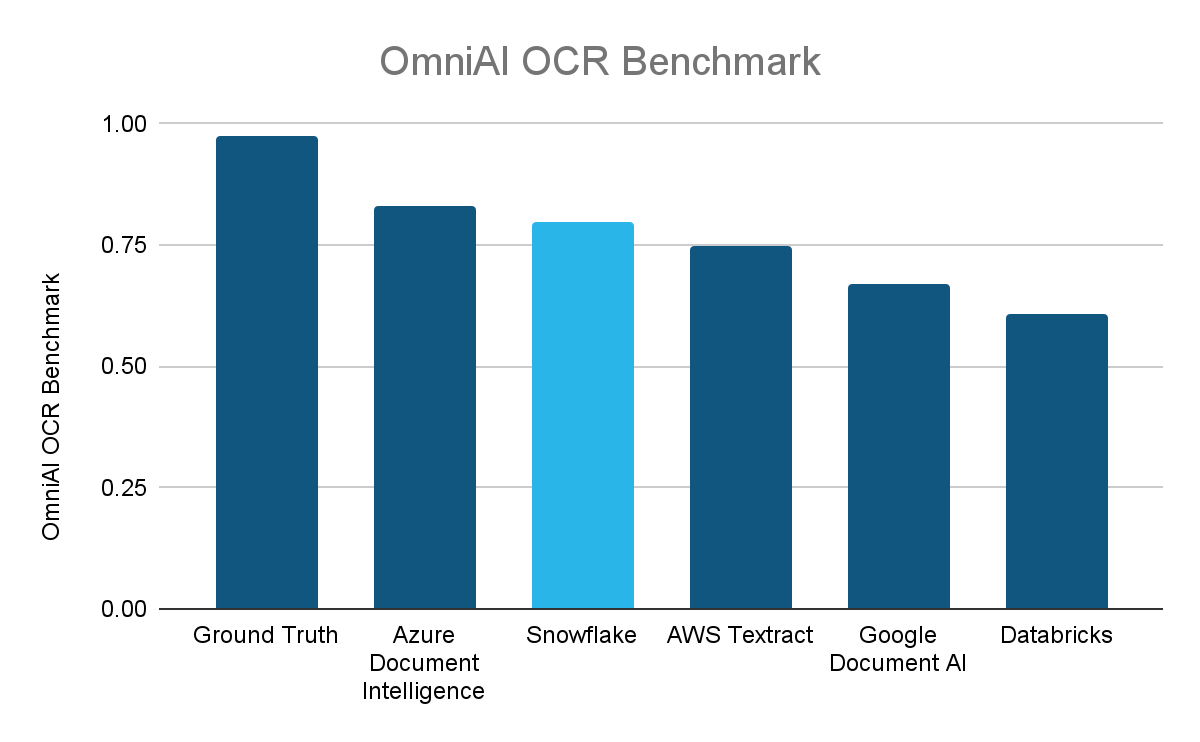
The benchmark’s results, visualized in the accompanying chart (Figure 1), show Snowflake performing in the top tier of evaluated systems on structured extraction accuracy. While no OCR system reaches the theoretical maximum — partly due to judge variability and the inherent ambiguity of real documents — Snowflake’s results indicate strong alignment between layout-aware extraction and LLM consumption. The gap between perfect ground truth and real-world systems underscores the importance of preserving structure and context early in the pipeline.基准测试结果(如图 1 所示)显示,Snowflake 在结构化提取准确性方面处于被评估系统的顶层。虽然没有 OCR 系统能达到理论上的最大值——部分原因是评判者的差异性和现实文档固有的模糊性——但 Snowflake 的结果表明,布局感知提取与 LLM 消费之间具有高度的一致性。完美基准事实与现实系统之间的差距,凸显了在管线早期阶段保留结构和上下文的重要性。
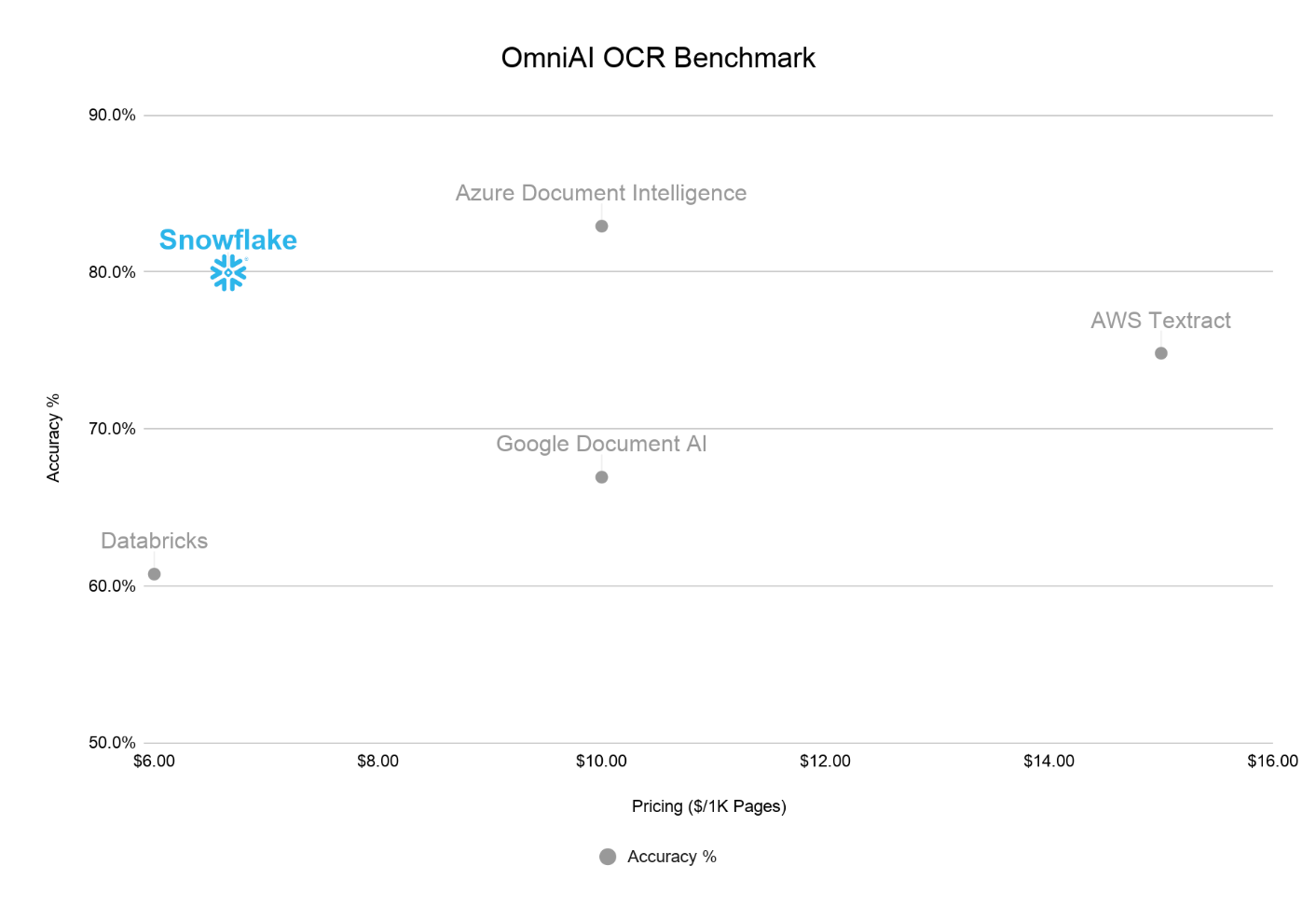
Snowflake is in the enterprise sweet spot (as seen in Figure 2): high, production-grade accuracy without premium pricing. Snowflake delivers top-tier structured extraction accuracy (~80%) while operating at a lower price point (~$6.66 per 1,000 pages assuming Standard Edition) than several long-established leading systems from Azure Document Intelligence, AWS Textract and Google Document AI. More emerging document systems are trying to differentiate on price but at materially lower extraction accuracy. For organizations processing millions of pages annually, this balance translates directly into lower total cost of ownership while preserving downstream LLM extraction quality.Snowflake 处于企业应用的最佳平衡点(如图 2 所示):无需高昂定价即可实现高水平的生产级准确性。Snowflake 提供了顶尖的结构化提取准确性(约 80%),同时运营价格(假设为标准版,每 1,000 页约 6.66 美元)低于 Azure Document Intelligence、AWS Textract 和 Google Document AI 等多个长期领先的系统。更多新兴的文档系统试图通过价格进行差异化竞争,但提取准确性明显较低。对于每年处理数百万页文档的组织而言,这种平衡直接转化为更低的总拥有成本,同时保留了下游 LLM 的提取质量。
For builders, this means LLMs operating on Snowflake’s AI Parse Document output can focus on semantic reasoning rather than compensating for broken layout, interleaved columns or malformed tables. Section-level extraction, field normalization and table-to-JSON conversion become more deterministic, more auditable and easier to scale across heterogeneous document collections.对于开发人员而言,这意味着在 Snowflake AI Parse Document 输出上运行的 LLM 可以专注于语义推理,而不必去弥补破碎的布局、交错的列或格式错误的表格。章节级提取、字段规范化和表格转 JSON 变得更加确定、可审计,并且更容易在异构文档集合中扩展。
As LLMs increasingly power enterprise document workflows, the role of layout-aware document understanding becomes foundational. Reliable LLM extraction is not achieved by prompting alone — it depends on a document representation that is already structured, ordered and faithful to the original source.随着 LLM 越来越多地驱动企业文档工作流,布局感知文档理解的作用变得至关重要。可靠的 LLM 提取不仅仅依靠提示词,它依赖于一种已经结构化、有序且忠实于原始来源的文档表示。
Industry-leading accuracy, engineered for the real world行业领先的准确性,专为现实世界打造
Document intelligence is a multilayer system. OCR accuracy influences layout reconstruction. Layout fidelity determines table integrity. Structural correctness governs downstream LLM extraction reliability.文档智能是一个多层系统。OCR 准确性影响布局重构。布局保真度决定表格完整性。结构正确性决定下游 LLM 提取的可靠性。
The evaluations presented here show that AI Parse Document layout mode demonstrates consistently strong performance. Qualitative evaluations confirm robustness under complex, real-world document conditions. Quantitative benchmarks show high exact-match rates in table reconstruction, strong cell-level similarity metrics and competitive CHRF OCR scores across synthetic, nonstandard and distorted data sets. Independent structured extraction benchmarking further validates near top-tier accuracy under realistic enterprise evaluation conditions.此处展示的评估结果表明,AI Parse Document 布局模式表现出始终如一的强劲性能。定性评估证实了其在复杂、现实文档条件下的稳健性。定量基准测试显示,在表格重构方面具有很高的精确匹配率,单元格级相似度指标表现优异,并在合成、非标准和失真数据集上获得了具有竞争力的 CHRF OCR 分数。独立的结构化提取基准测试进一步验证了其在现实企业评估条件下接近顶尖的准确性。
Importantly, these results are measured on heterogeneous, layout-intensive documents rather than optimized academic subsets. Performance is assessed based on structural correctness and downstream usability, not text similarity alone.重要的是,这些结果是在异构、布局密集的文档上测得的,而不是在优化的学术子集上。性能评估基于结构正确性和下游可用性,而非仅凭文本相似度。
The outcome is a document understanding layer that combines leading accuracy with scalable price efficiency and production-grade enterprise deployment.其成果是一个文档理解层,它结合了领先的准确性、可扩展的成本效益以及生产级的企业部署能力。