With fall upon us, it’s time to pumpkin spice up your life with the tasty results of the 2026 Developer Survey. Over seven weeks, more than 30,000 people took the survey and answered questions about their work, technologies, learning strategies, and, yes, AI use. We diligently worked in our data mines to harvest insights that you can use to build better software and engineering teams. We’ll be releasing the full data set SoonTM so you can find data to back your own hot takes.金秋时节,是时候用 2026 年开发者调查的丰硕成果来点缀你的生活了。在七周的时间里,超过 30,000 名参与者完成了问卷,回答了关于工作、技术、学习策略,当然还有 AI 使用情况的问题。我们通过深入挖掘数据,提取出了有助于你打造更优秀软件和工程团队的洞察。我们将很快发布完整数据集,以便你获取数据来支撑自己的独到见解。
Below, we’ll highlight some of the results we found interesting. If you want to skip ahead to the results themselves, check out the Survey overview then dive into the results.以下是我们认为值得关注的一些结果。如果你想直接查看结果,请浏览调查概览,然后深入了解各项数据。
This is the 16th Developer Survey, which means it’s old enough to drive in the US. Hand the keys over to us, and let’s get rolling!这是第 16 届开发者调查,意味着它在美国已经到了可以考驾照的年纪了。把钥匙交给我们,让我们出发吧!
Work工作
Work for developers has certainly changed, and only some of that is due to AI. Only a small fraction (18%) of devs go into offices every day to work. Those that do probably aren’t going into offices with the ping pong tables, endless snack cabinets, and tactical bean bag chairs. AI and layoffs have changed the calculus between software developers and employers. Before 2020, you could walk to the corner store and trip over a job offer. Now LinkedIn profiles declare, “Open to Work!” for months on end.开发者的工作方式确实发生了变化,其中只有部分原因是 AI 导致的。只有一小部分(18%)的开发者每天去办公室工作。而那些去办公室的人,可能面对的也不是配有乒乓球桌、零食柜和战术懒人沙发的环境。AI 和裁员潮改变了软件开发者与雇主之间的博弈。2020 年之前,你随便走出门就能撞见一个工作机会;而现在,LinkedIn 个人资料上挂着“求职中!”状态的人比比皆是。
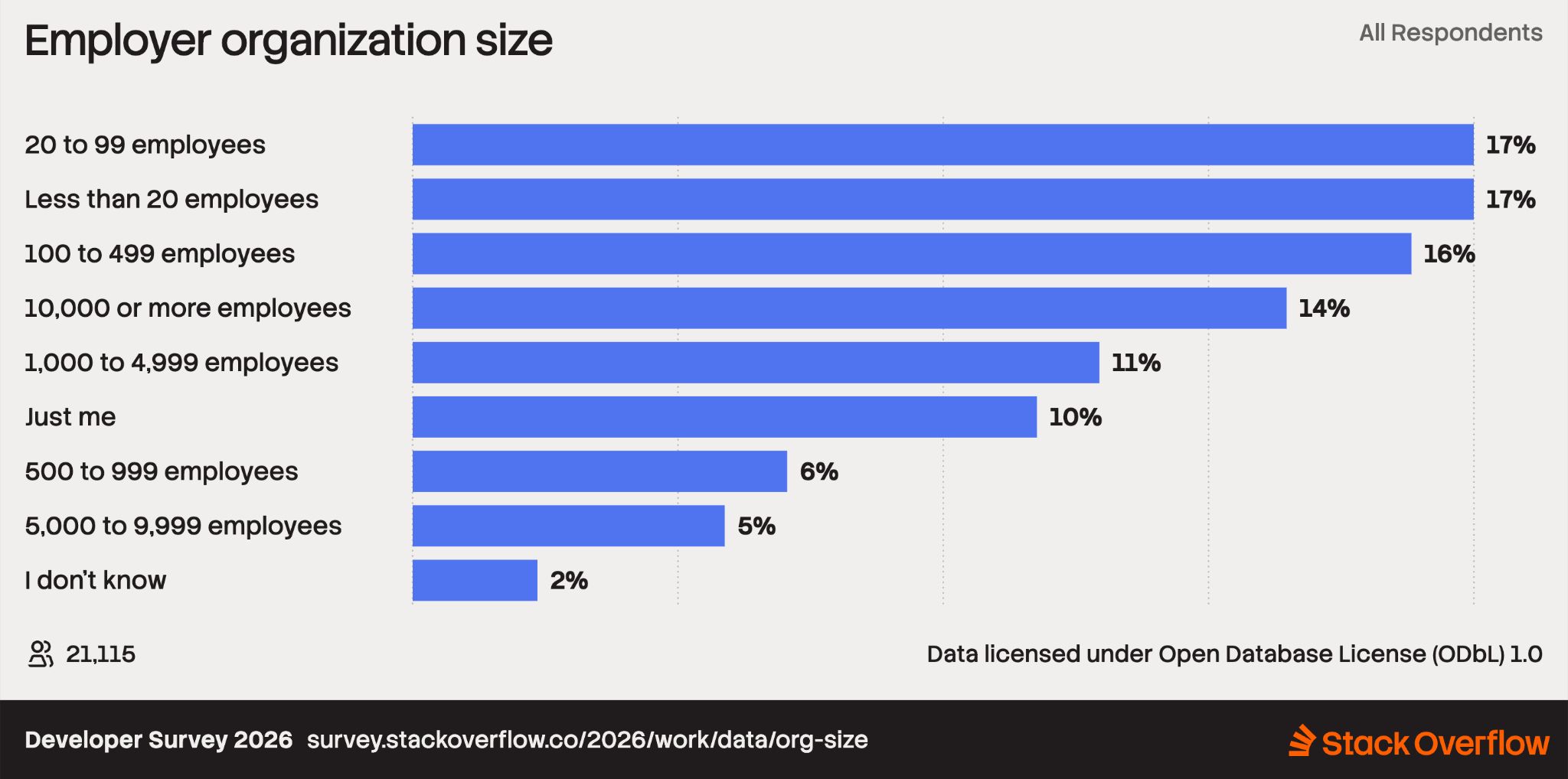
But if companies won’t hire you, maybe you can hire yourself. While about the same percentage of respondents said they were freelancers, contractors, or self-employed, those that said they worked in an organization of one jumped from 4% to 10%. We’ve heard anecdotally about how some folks are using AI agents to soloprenuer their way to a viable company, so this may be the data to back it up.但如果公司不雇佣你,或许你可以雇佣自己。虽然受访者中自由职业者、合同工或自雇人士的比例大致相同,但表示在“一人公司”工作的人数比例从 4% 跃升至 10%。我们曾听到一些传闻,说有人利用 AI 代理开启个人创业之路并建立起可行的公司,这或许就是支撑这一现象的数据。
See more results about how developers work today.查看更多关于开发者当前工作方式的结果。
Technology技术
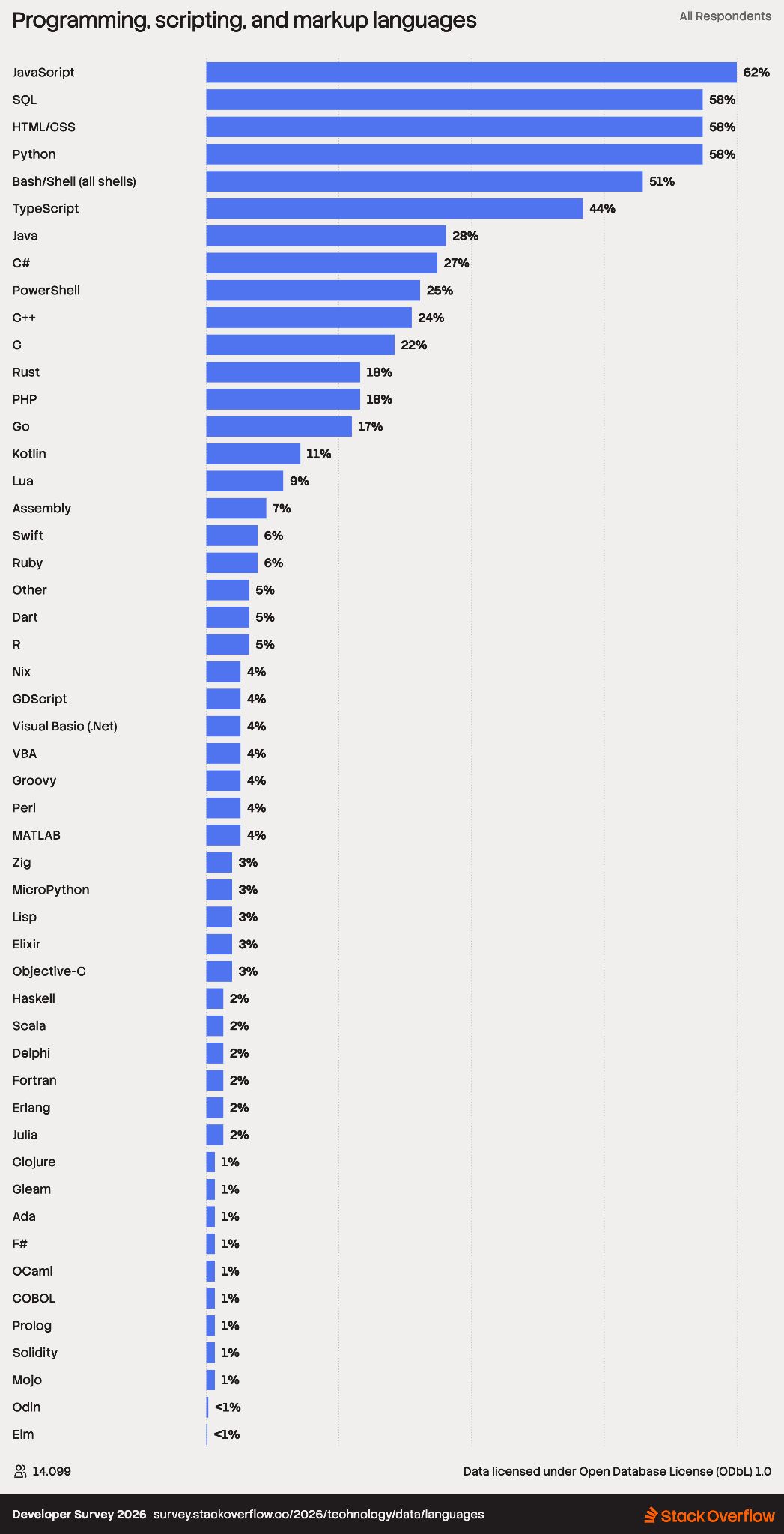
For plenty of you, the technology rankings are the meat of the survey. There’s not a ton of movement among the leaders—the top ten is mostly the same, though SQL passed HTML/CSS to take the number two spot. Meanwhile, Rust increased its standings by moving up to the 12th most used language. Perhaps that White House memo about memory safety made an impact?对于你们许多人来说,技术排名是调查的核心。领跑者阵营变动不大——前十名基本保持不变,不过 SQL 超越了 HTML/CSS 占据了第二名的位置。与此同时,Rust 的地位有所提升,成为第 12 大常用语言。这或许是受了白宫那份关于内存安全备忘录的影响?
For AI fans, the top model providers, Anthropic and OpenAI, are neck and neck, with Google a distant third. Similar levels of usage don’t translate to similar levels of admiration: more respondents want to keep using Anthropic models than OpenAI models, though not by much.对于 AI 爱好者来说,顶级模型提供商 Anthropic 和 OpenAI 旗鼓相当,Google 位居第三,差距较大。使用水平的相似并不代表赞赏程度的相同:更多的受访者倾向于继续使用 Anthropic 的模型而非 OpenAI 的模型,尽管差距并不悬殊。
AI
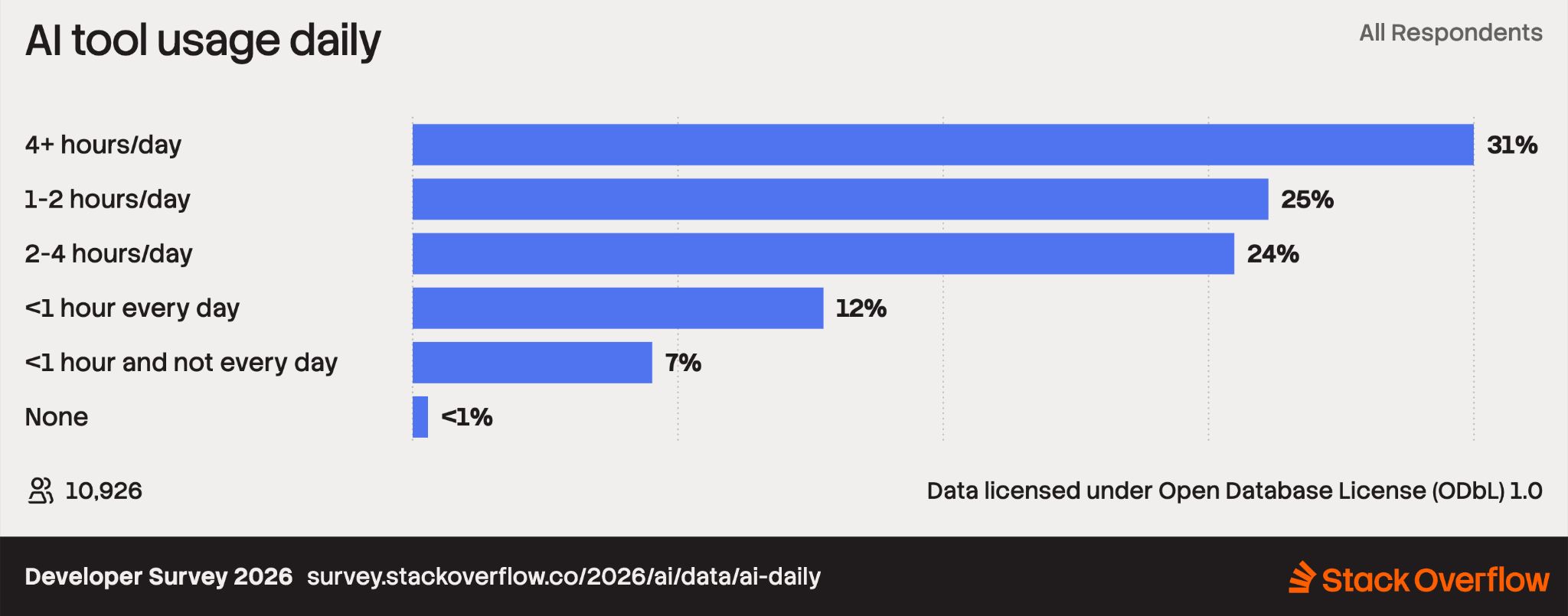
There’s no question that AI has become prevalent in the software industry—even if that prevalence has some folks feeling frustrated. 73% of respondents who indicate using AI coding assistants/agents use them daily, and a third of daily users using any AI tools use AI four or more hours per day. With that increased use has come greater positive sentiment—62% of all respondents view AI at least somewhat positively, while that jumps to 71% for daily users .毫无疑问,AI 已在软件行业普及——尽管这种普及让一些人感到沮丧。73% 表示使用 AI 编码助手/代理的受访者每天都会使用,而三分之一的 AI 工具日常用户每天使用时长在四小时或以上。随着使用量的增加,积极情绪也在增长——62% 的所有受访者对 AI 持至少某种程度的正面看法,而在日常用户中,这一比例跃升至 71%。
Many of those AI users live in coding agents (66%) and chatbots (63%). No surprise; developers use the tools that are best for developing. The agents of choice are Claude Code (66%) and GitHub Copilot (59%). When they develop with AI, it’s primarily generating code in familiar areas (67%) and debugging (61%), not deploying, operating, or troubleshooting production systems (20%). AI gets to muck about with familiar code, but once that code reaches prod server, it gets shown the door.许多 AI 用户主要使用编码代理(66%)和聊天机器人(63%)。这并不奇怪;开发者会使用最适合开发的工具。首选的代理是 Claude Code(66%)和 GitHub Copilot(59%)。当他们使用 AI 进行开发时,主要是为了在熟悉的领域生成代码(67%)和调试(61%),而不是用于部署、运维或排查生产系统问题(20%)。AI 可以处理熟悉的旧代码,但一旦代码进入生产服务器,就会被拒之门外。
Community社区
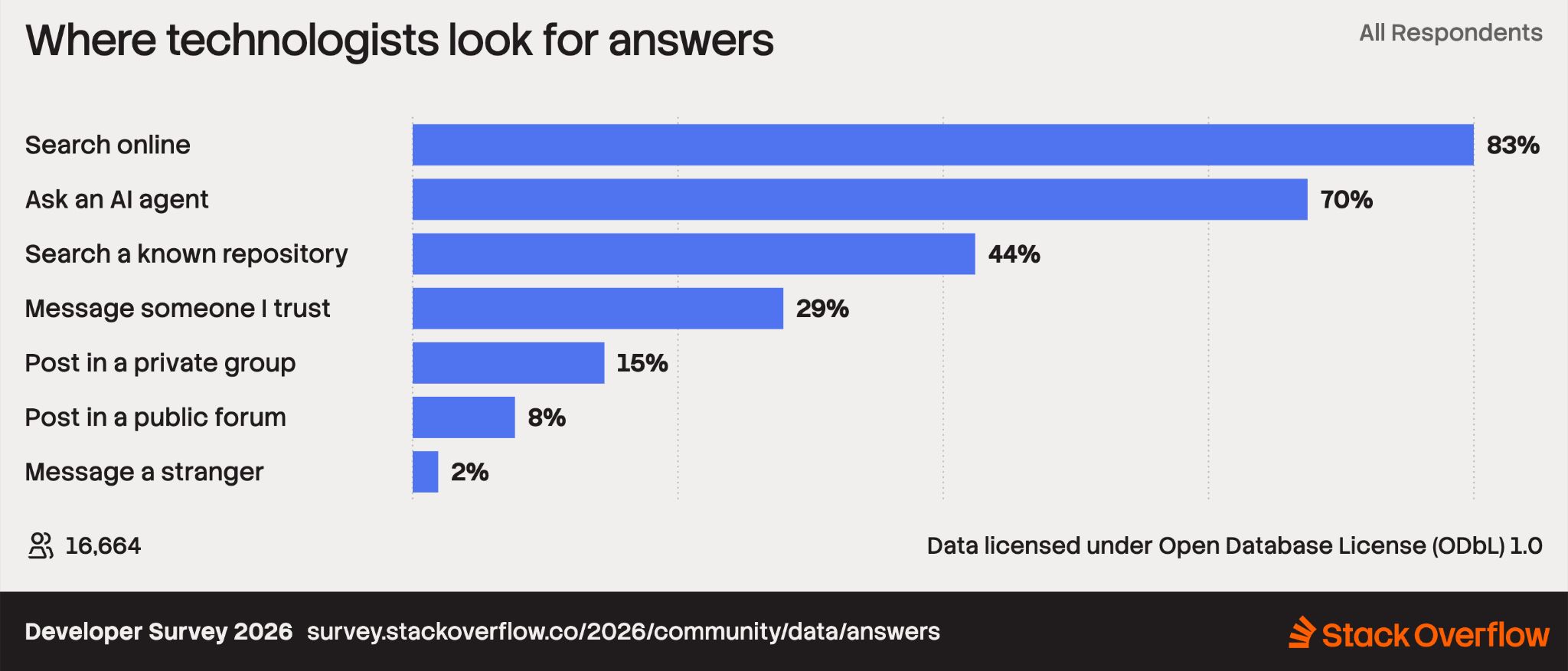
AI has definitely changed how people find answers to their questions: 83% still ask a search engine for answers, but 70% hit up their AI. Those search engines used to bring folks to a Stack Overflow question, but AI overviews and chatbots don’t. They still use our answers, but they don’t always give the person who answered the credit that they deserve. People are visiting less for simple questions (64%), but many are visiting more just to check the source of information for those AI answers (16%). While that’s less than last year, it still indicates that there are people increasing how much they visit even when using AI.AI 确实改变了人们寻找问题答案的方式:83% 的人仍然会询问搜索引擎,但 70% 的人也会求助于 AI。过去,搜索引擎会将用户引导至 Stack Overflow 的问题页面,但 AI 概览和聊天机器人则不会。它们虽然使用了我们的答案,却并不总是给予答题者应有的认可。人们因简单问题而访问网站的频率降低了(64%),但许多人访问网站只是为了核实 AI 给出的答案来源(16%)。虽然这比去年有所减少,但仍表明即使在使用 AI 时,也有人在增加访问频率。
When developers are looking to learn something new, what skills are they learning? No surprise, but a large majority (79%) want to upskill their AI game. It’s the new hotness. Everybody is being asked to get onboard or get left behind, so these are skills that need attention. But that doesn’t mean your standard programming skills gather rust and dust: 52% of people are still learning new coding skills.当开发者想要学习新事物时,他们在学习什么技能?不出所料,绝大多数(79%)的人希望提升自己的 AI 能力。这是新的热点。每个人都被要求跟上步伐,否则就会被淘汰,因此这些技能需要重点关注。但这并不意味着标准的编程技能会荒废:52% 的人仍在学习新的编程技能。
Knowledge, trust, and context知识、信任与上下文
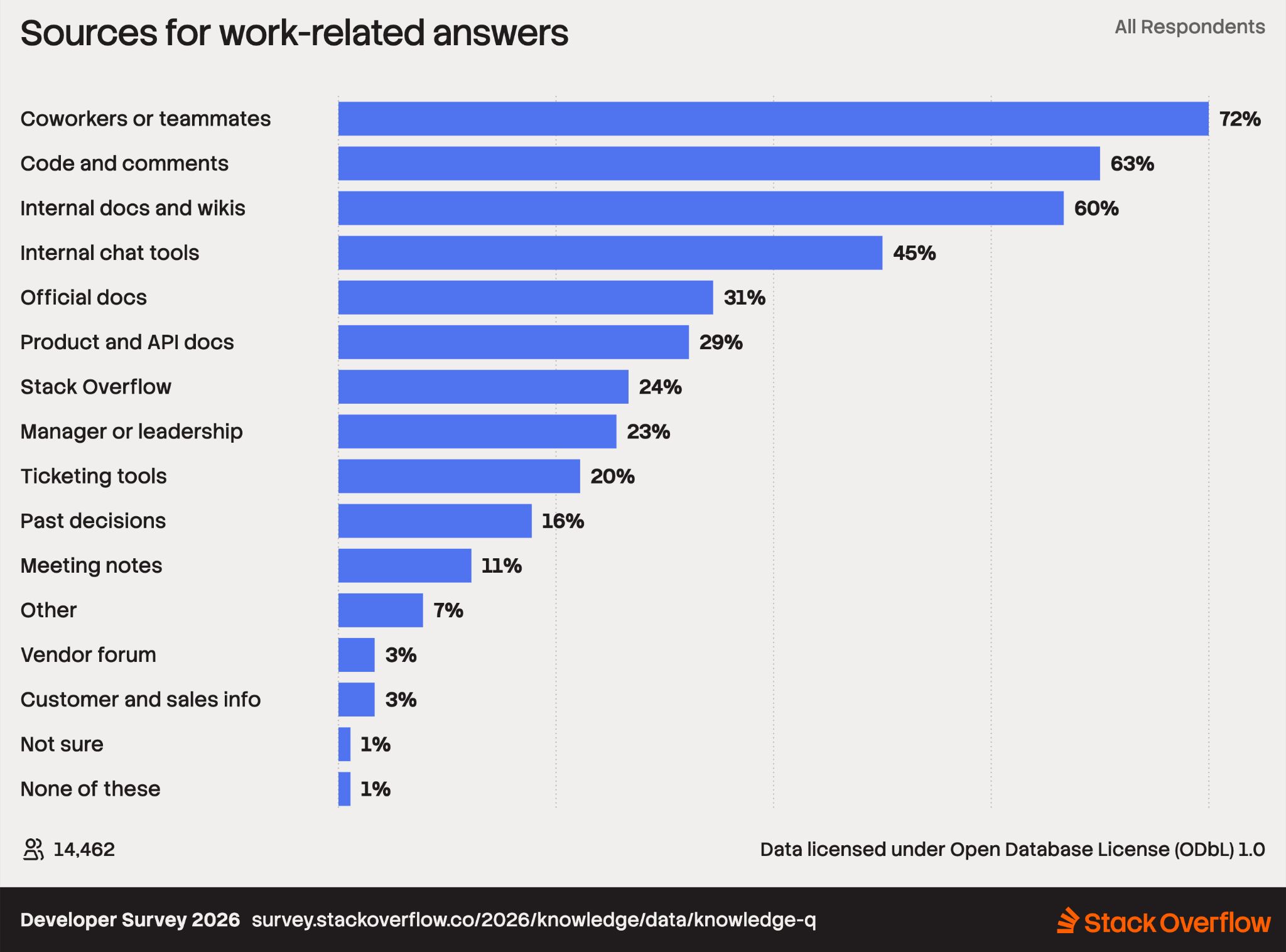
Context is the big buzzword in agentic engineering right now, and we wanted to know what that means for everyone. We’ve seen that good context is trusted context, and to trust what the AI gives requires source attribution (93%). The best sources of trusted context are project goals and requirements (85%) and code and docs (73%). The places to look for specific answers are the people you work with (72%), the code (63%), and documentation (60%). That explains why senior devs spend half their day answering DMs.“上下文”是当前代理式工程领域的热门词汇,我们想知道这对大家意味着什么。我们发现,良好的上下文即是可信的上下文,而要信任 AI 提供的内容,就需要来源归属(93%)。最受信任的上下文来源是项目目标和需求(85%)以及代码和文档(73%)。寻找具体答案的地方依次是:与你共事的人(72%)、代码(63%)和文档(60%)。这就解释了为什么资深开发者每天有一半时间都在回复私信。
Developers and their employers have started to pay attention to token costs as AI use rises. We’ve seen model routing and usage limits emerge as solutions. But developers care more about quality (75%) over cost (38%) when it comes to shaping prompts and picking models. Their organizations (and their CFOs no doubt) have placed some sort of cost-control measures in place: 38% set limits on usage, 28% reviewed spending data, 27% use different models for different work, and 25% set limits on who gets to use AI. But some orgs take the developer’s side: 21% said their organizations are spending more.随着 AI 使用量的增加,开发者及其雇主已开始关注 Token 成本。我们看到模型路由和使用限制已成为解决方案。但当涉及编写提示词和选择模型时,开发者更关心质量(75%)而非成本(38%)。他们的组织(毫无疑问,还有他们的首席财务官)已经采取了一些成本控制措施:38% 设置了使用限制,28% 审查了支出数据,27% 对不同工作使用不同模型,25% 限制了 AI 使用权限。但也有一些组织站在开发者一边:21% 的人表示他们的组织正在增加投入。
Check the full results yourself亲自查看完整结果
This is just a little sample of what the survey results contain, so please do go over to the survey site and browse the full details yourself. We’re taking a more editorial approach this year, doing what we can to highlight more of the data points that we think show interesting trends in the industry. If you want to skip over the chat and hit the numbers directly, feel free. In a few weeks, we’ll have the full data set available for download so you can comb through the numbers yourself.这只是调查结果的一小部分样本,请务必前往调查网站浏览完整详情。今年我们采用了更具编辑性的方法,尽力突出我们认为展示了行业有趣趋势的数据点。如果你想跳过闲聊直接看数据,请随意。几周后,我们将提供完整的数据集供下载,以便你亲自深入研究。
If you find anything interesting or have alternate, complimentary, or disagreeable takes off of what you see, let us know. We’re always interested in what the community thinks.如果你发现了什么有趣的内容,或者对所见的结果有不同的、补充的或反对的看法,请告诉我们。我们一直很关注社区的想法。
If you want to check how we’re looking to solve the context and knowledge issues found above, check out Stack Internal. 如果你想了解我们如何解决上述提到的上下文和知识问题,请查看 Stack Internal。