We have become quite used to pronouncements of doom, from scientists predicting the sixth mass extinction due to the measurable effects of climate change, and from religionists declaring the apocalypse due to a surfeit of sin. It’s almost impossible to imagine these two groups of people agreeing on anything other than the ominous portent of their respective messages. But in the early days of the scientific revolution—the days of Shakespeare’s contemporary Francis Bacon, and later 17th century Descartes—it was not at all unusual to find both kinds of reasoning, or unreasoning, in the same person, along with beliefs in magic, divination, astrology, etc.我们已经对各种末日预言习以为常,从科学家因气候变化带来的可衡量影响而预言的第六次大灭绝,到宗教人士因罪孽深重而宣称的世界末日。除了各自信息中蕴含的凶兆外,几乎无法想象这两类人会在任何事情上达成共识。但在科学革命初期——即莎士比亚的同时代人弗朗西斯·培根,以及后来的17世纪哲学家笛卡尔所处的时代——在同一个人身上同时发现这两类推理(或非理性),以及对魔法、占卜、占星术等的信仰,一点也不罕见。
Yet even in this maelstrom of heterodox thought and practices, Sir Isaac Newton stood out as a particularly odd co-existence of esoteric biblical prophecy, occult beliefs, and a rigid, formal mathematics that not only adhered to the inductive scientific method, but also expanded its potential by applying general axioms to specific cases.然而,即使在那个异端思想与实践纷乱的漩涡中,艾萨克·牛顿爵士依然显得格外独特,他身上奇特地并存着深奥的圣经预言、神秘学信仰,以及严谨、形式化的数学体系。这套数学体系不仅遵循归纳科学方法,还通过将一般公理应用于具体案例,扩展了其潜力。
Yet many of Newton’s general principles would seem totally inimical to the naturalism of most physicists today. As he was formulating the principles of gravity and three laws of motion, for example, Newton also sought the legendary Philosopher’s Stone and attempted to turn metal to gold. Moreover, the devoutly religious Newton wrote theological treatises interpreting Biblical prophecies and predicting the end of the world. The date he arrived at? 2060.尽管如此,牛顿的许多一般性原则在今天大多数物理学家看来,似乎与自然主义格格不入。例如,在制定引力原理和三大运动定律的同时,牛顿也在寻找传说中的“哲人石”,并试图将金属炼成黄金。此外,虔诚的牛顿还撰写了神学论文,解读圣经预言并预测世界末日。他得出的日期是哪一年?2060年。
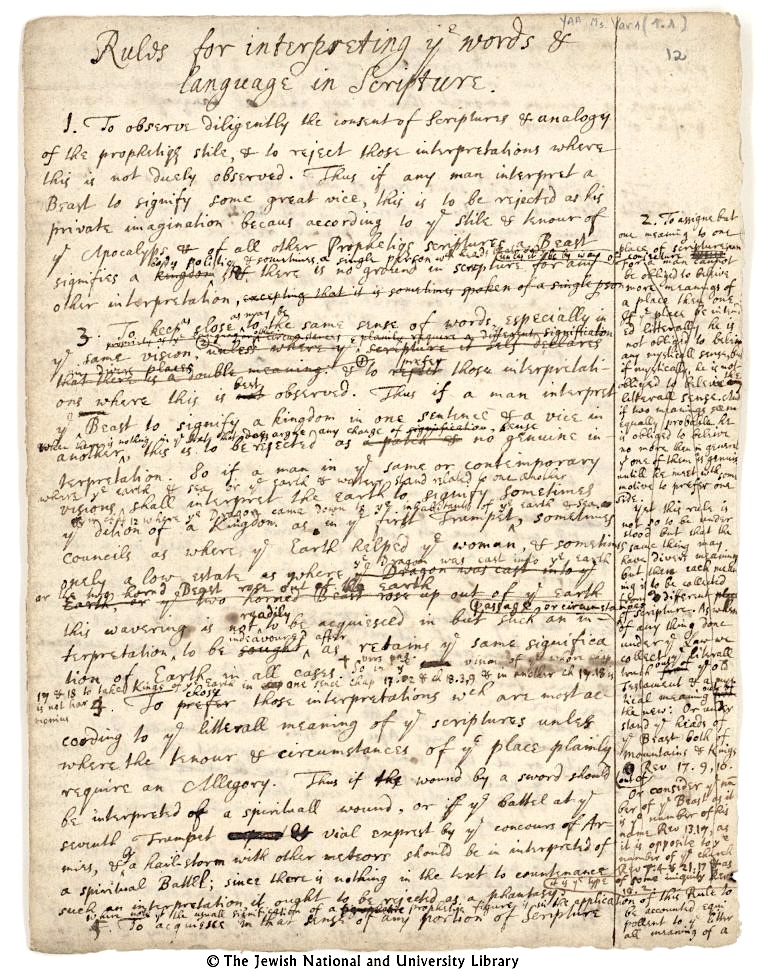
Newton seems, writes science blog Another Pale Blue Dot, “as confident of his predictions in this realm as he was in the rational world of science.” In a 1704 letter exhibited at Jerusalem’s Hebrew University, above, Newton describes his “recconing”:科学博客“Another Pale Blue Dot”写道,牛顿“在这一领域表现出的自信,与他在科学理性世界中的自信如出一辙”。在耶路撒冷希伯来大学展出的一封1704年的信件中(见上图),牛顿描述了他的“推算”过程:
So then the time times & half a time are 42 months or 1260 days or three years & an half, recconing twelve months to a yeare & 30 days to a month as was done in the Calendar of the primitive year. And the days of short lived Beasts being put for the years of lived [sic] kingdoms, the period of 1260 days, if dated from the complete conquest of the three kings A.C. 800, will end A.C. 2060. It may end later, but I see no reason for its ending sooner.因此,“时间、时期和半个时期”即为42个月,或1260天,或三年半,按照原始历法一年十二个月、一月三十天来计算。如果将短命的“兽”之日数代入长寿王国的年数,那么从公元800年三个国王被彻底征服之日起算,1260天的周期将在公元2060年结束。它可能会更晚结束,但我没看到它会提前结束的理由。
Newton further demonstrates his confidence in the next sentence, writing that his intent, “though not to assert” an answer, should in any event “put a stop the rash conjectures of fancifull men who are frequently predicting the time of the end.” Indeed. So how did he arrive at this number? Newton applied a rigorous method, that is to be sure.牛顿在接下来的句子中进一步展现了他的自信,他写道,他的意图“虽然不是要断言”一个答案,但无论如何都应该“阻止那些经常预测末日时间的狂想之徒的鲁莽猜测”。的确如此。那么他是如何得出这个数字的呢?可以肯定的是,牛顿确实运用了一套严谨的方法。
If you have the patience for an exhaustive description of how he worked out his prediction using the Book of Daniel, you may read one here by historian of science Stephen Snobelen, who also points out how widespread the interest in Newton’s odd beliefs has become, reaching across every continent, though scholars have known about this side of the Enlightenment giant for a long time.如果你有耐心阅读关于他如何利用《但以理书》得出预测的详尽描述,可以在此阅读科学史学家斯蒂芬·斯诺伯伦(Stephen Snobelen)的文章。他还指出,人们对牛顿这些奇特信仰的兴趣已变得多么广泛,跨越了每一个大洲,尽管学者们很早以前就知道这位启蒙运动巨人的这一面。
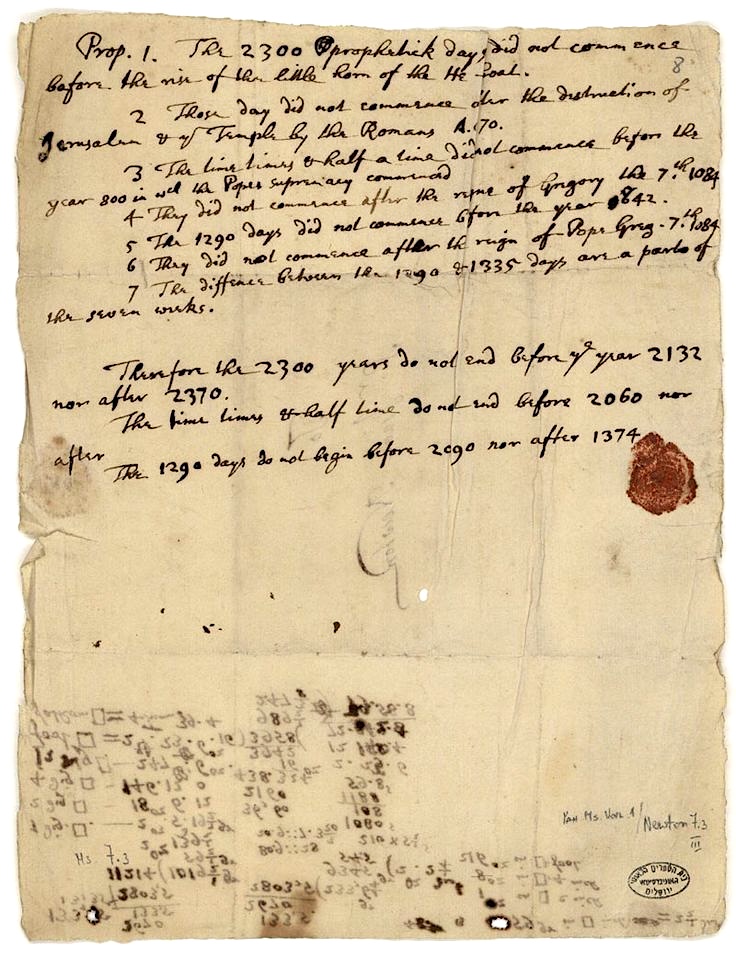
For a sense of the exacting, yet completely bizarre flavor of Newton’s prophetic calculations, see another Newton letter at the top of the post, transcribed below.若想感受牛顿预言式计算那种既严谨又极其怪异的风格,请参阅文章顶部另一封牛顿的信件,其转录内容如下。
Prop. 1. The 2300 prophetick days did not commence before the rise of the little horn of the He Goat.命题1:2300个预言日并未在公山羊的小角兴起之前开始。
2 Those day [sic] did not commence a[f]ter the destruction of Jerusalem & ye Temple by the Romans A.[D.] 70.2:这些日子并未在罗马人于公元70年摧毁耶路撒冷和圣殿之后开始。
3 The time times & half a time did not commence before the year 800 in wch the Popes supremacy commenced3:“时间、时期和半个时期”并未在教皇权威开始的公元800年之前开始。
4 They did not commence after the re[ig]ne of Gregory the 7th. 10844:它们并未在格列高利七世(1084年)统治之后开始。
5 The 1290 days did not commence b[e]fore the year 842.5:1290天并未在公元842年之前开始。
6 They did not commence after the reigne of Pope Greg. 7th. 10846:它们并未在教皇格列高利七世(1084年)统治之后开始。
7 The diffence [sic] between the 1290 & 1335 days are a parts of the seven weeks.7:1290天和1335天之间的差值是七个七年的一部分。
Therefore the 2300 years do not end before ye year 2132 nor after 2370.因此,2300年不会在2132年之前结束,也不会在2370年之后结束。
The time times & half time do n[o]t end before 2060 nor after [2344]“时间、时期和半个时期”不会在2060年之前结束,也不会在2344年之后结束。
The 1290 days do not begin [this should read: end] before 2090 [Newton might mean: 2132] nor after 1374 [sic; Newton probably means 2374]1290天不会在2090年(此处应读作:结束)之前开始(牛顿可能指的是:2132年),也不会在1374年之后开始(原文如此;牛顿可能指的是2374年)。
The editorial insertions are Professor Snobelen’s, who thinks the letter dates “from after 1705,” and that “the shaky handwriting suggests a date of composition late in Newton’s life.” Whatever the exact date, we see him much less certain here; Newton pushes around some other dates—2344, 2090 (or 2132), 2374. All of them seem arbitrary, but “given the nice roundness of the number,” writes Motherboard, “and the fact that it appears in more than one letter,” 2060 has become his most memorable dating for the apocalypse.文中的编辑插入语出自斯诺伯伦教授,他认为这封信“写于1705年之后”,并且“颤抖的笔迹表明这是牛顿晚年的作品”。无论具体日期为何,我们在这里看到他显得没那么确定;牛顿推敲了一些其他日期——2344年、2090年(或2132年)、2374年。所有这些似乎都很随意,但正如《Motherboard》所写,“鉴于这个数字的圆满,以及它出现在不止一封信件中的事实”,2060年已成为他关于世界末日最令人难忘的预言。
It’s important to note that Newton didn’t believe the world would “end” in the sense of cease to exist or burn up in holy flames. His end times philosophy resembles that of a surprising number of current day evangelicals: Christ would return and reign for a millennium, the Jewish diaspora would return to Israel and would, he wrote, set up “a flourishing and everlasting Kingdom.” We hear such statements often from televangelists, school boards, governors, and presidential candidates.值得注意的是,牛顿并不认为世界会“终结”,即停止存在或在神圣的火焰中燃尽。他的末世哲学与当今相当一部分福音派教徒的观点相似:基督将回归并统治一千年,犹太侨民将返回以色列,并如他所写,建立“一个繁荣且永恒的王国”。我们经常从电视布道者、学校董事会成员、州长和总统候选人那里听到此类言论。
As many people have argued, despite Newton’s conception of his scientific work as a bulwark against other theologies, it ultimately became a foundation for Deism and Naturalism, and has allowed scientists to make accurate predictions for hundreds of years. 20th century physics may have shown us a much more radically unstable universe than Newton ever imagined, but his theories are, as Isaac Asimov would put it, “not so much wrong as incomplete,” and still essential to our understanding of certain fundamental phenomena. But as fascinating and curious as Newton’s other interests may be, there’s no more reason to credit his prophetic calculations than those of the Millerites, Harold Camping, or any other apocalyptic doomsday sect.正如许多人所论证的那样,尽管牛顿将自己的科学工作视为抵御其他神学的堡垒,但它最终成为了自然神论和自然主义的基石,并使科学家们能够进行数百年的准确预测。20世纪的物理学可能向我们展示了一个比牛顿想象中更为激进、不稳定的宇宙,但正如艾萨克·阿西莫夫所言,他的理论“与其说是错误,不如说是不完整”,并且对于我们理解某些基本现象仍然至关重要。然而,尽管牛顿的其他兴趣引人入胜且充满好奇,但我们没有理由相信他的预言计算,就像我们没有理由相信米勒派、哈罗德·康平或其他任何末日邪教的预言一样。
Note: An earlier version of this post appeared on our site in 2015.注:本文的早期版本曾于2015年在我们网站上发布。
Related Content:相关内容:
M.I.T. Computer Program Predicts in 1973 That Civilization Will End by 2040麻省理工学院计算机程序在1973年预测文明将在2040年终结
Isaac Newton Creates a List of His 57 Sins (Circa 1662)艾萨克·牛顿列出的57条罪状(约1662年)
Isaac Newton Conceived of His Most Groundbreaking Ideas During the Great Plague of 1665艾萨克·牛顿在1665年大瘟疫期间构思了他最具开创性的思想
Videos Recreate Isaac Newton’s Neat Alchemy Experiments: Watch Silver Get Turned Into Gold视频重现艾萨克·牛顿的炼金术实验:观看白银如何被转化为黄金
The Iconic Design of the Doomsday Clock Was Created 75 Years Ago: It Now Says We’re 100 Seconds to Midnight“末日时钟”的标志性设计诞生于75年前:现在它显示距离午夜还有100秒
Josh Jones is a writer and musician based in Durham, NC. 乔什·琼斯(Josh Jones)是一位居住在北卡罗来纳州达勒姆市的作家和音乐家。




Leave a Reply