


Want to dig deeper into the Top 100 Consumer AI Apps? Watch the companion podcast here, and see the full list here.想要深入了解百大消费级 AI 应用?请点击此处观看配套播客,并在此处查看完整榜单。

Three years into tracking consumer AI, the leaderboard is becoming familiar. This is the seventh edition of our Top 100 AI Consumer Apps, where we rank the top web and mobile AI products by monthly traffic. (You can read our previous ones - I, II, III, IV, V, VI - to see how these have evolved over time.) Just 11 products make their first-ever appearance in this edition - the smallest number of debuts across our seven lists so far.在追踪消费级 AI 领域的三年里,这份排行榜已逐渐为人们所熟知。这是我们第七版“百大消费级 AI 应用”榜单,旨在根据月度流量对顶尖的网页及移动端 AI 产品进行排名。(您可以阅读我们往期的榜单——I、II、III、IV、V、VI——以了解这些产品随时间演变的过程。)本期榜单中仅有 11 款产品首次上榜,这是我们七次发布榜单以来新面孔最少的一次。
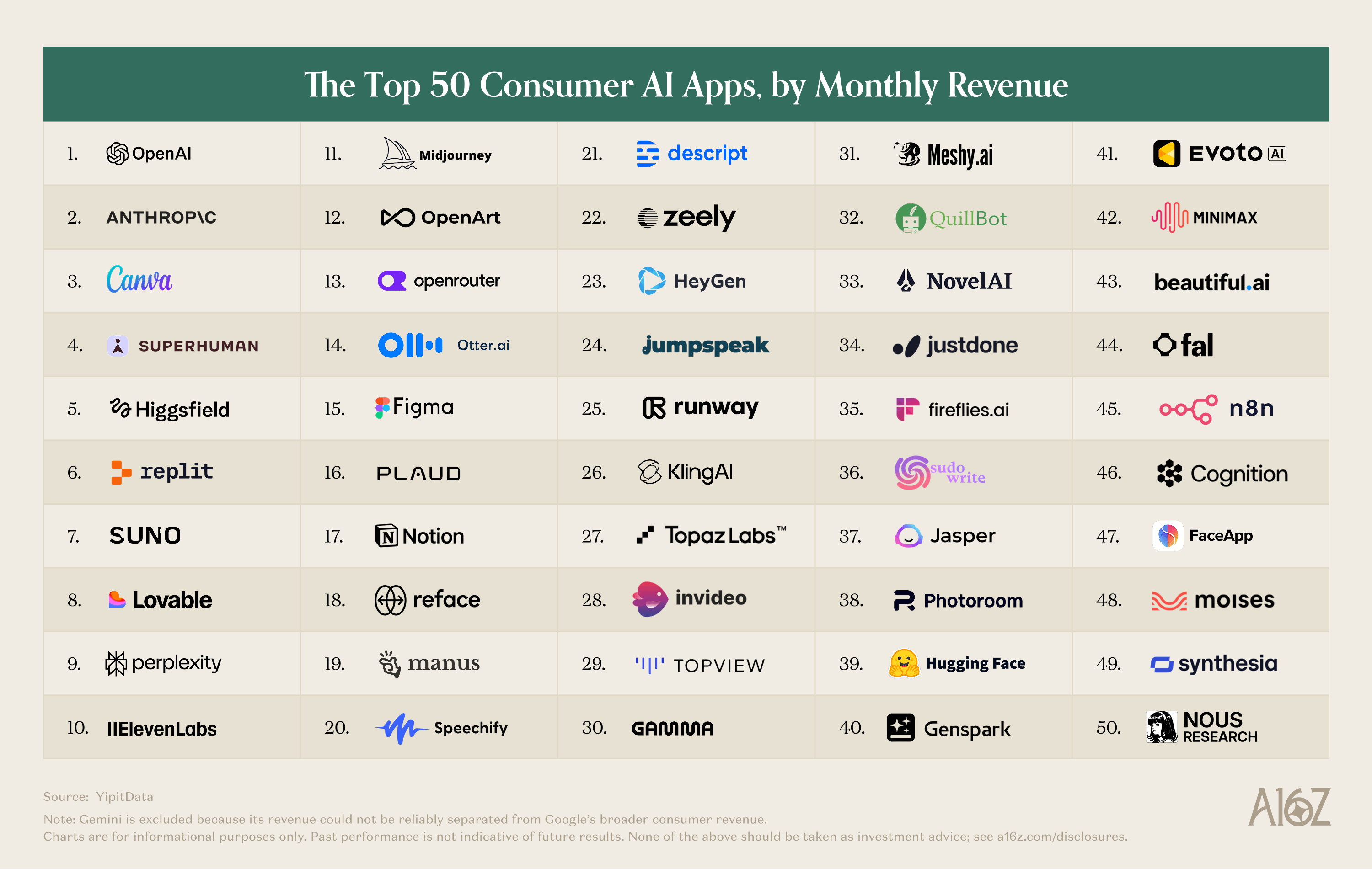
But traffic data alone increasingly conceals the real trends in consumer AI. For the first time, we’re adding a ranking by observed spending on U.S. consumer cards, thanks to YipitData. This gives us another way to see the market, including dozens of vendors absent from our web and mobile lists - like desktop apps, and agents inside existing messaging platforms.然而,单凭流量数据已越来越难以揭示消费级 AI 的真实趋势。得益于 YipitData 的支持,我们首次加入了基于美国消费者银行卡实际消费额的排名。这为我们观察市场提供了另一个视角,涵盖了数十家未出现在我们网页和移动端榜单上的供应商,例如桌面应用以及现有消息平台内的智能体。
The biggest takeaway from this new data? Consumer AI usage is wide, but not very deep…for almost everyone. While nearly half of U.S. consumers now report using AI, only 25% are engaged with it daily. And as of August, just 4.5% of U.S. consumers had an active paid personal subscription to ChatGPT, Gemini, or Claude. You can get more data on broad AI adoption in our State of Markets presentation we shared last week.这份新数据带来的最大启示是什么?消费级 AI 的使用范围虽广,但对绝大多数人而言,其使用深度并不深。尽管近半数美国消费者表示自己正在使用 AI,但只有 25% 的用户会每天使用。截至 8 月,仅有 4.5% 的美国消费者为 ChatGPT、Gemini 或 Claude 支付了个人订阅费用。您可以在我们上周分享的“市场状况”演示文稿中获取更多关于 AI 普及程度的数据。
However, AI’s consumer power users are extremely engaged - and highly monetizable. The top 10% of spenders account for roughly half of all observed spending. These high spenders disproportionately buy coding, productivity, and creative tools.不过,消费级 AI 的超级用户群体参与度极高,且具有极高的变现价值。消费额排名前 10% 的用户贡献了约一半的观测消费总额。这些高消费用户在编程、生产力及创作工具上的购买比例远高于平均水平。
In these users, consumer AI has found its first real market: people who pay - often a lot - for tools that help them build, create, and get work done. Reaching everyone else will likely take different products. We’re seeing glimmers of this now with the launch of personal assistants that, unlike their ancestor OpenClaw, are usable by non-developers - and free.消费级 AI 在这些用户身上找到了真正的首个市场:那些愿意为帮助自己构建、创作和完成工作的工具支付高昂费用的人。要触达其余的大众用户,可能需要不同的产品。我们现在已经看到了曙光,一些个人助理产品开始涌现,与它们的先驱 OpenClaw 不同,这些产品不仅面向非开发者,而且是免费的。
Alongside these product capability improvements, consumer AI likely needs a new business model - or possibly, an old one. Essentially all AI revenue has come from direct subscriptions or usage charges, unlike prior eras where consumers were monetized indirectly via ads or transactional revenue. This has likely been a limiting factor in deeper consumer adoption.除了产品能力的提升,消费级 AI 可能还需要一种新的商业模式——或者,借鉴一种旧模式。与以往通过广告或交易收入间接实现消费者变现的时代不同,目前的 AI 收入几乎全部来自直接订阅或使用费。这很可能成为了限制消费级 AI 更深层普及的一个因素。
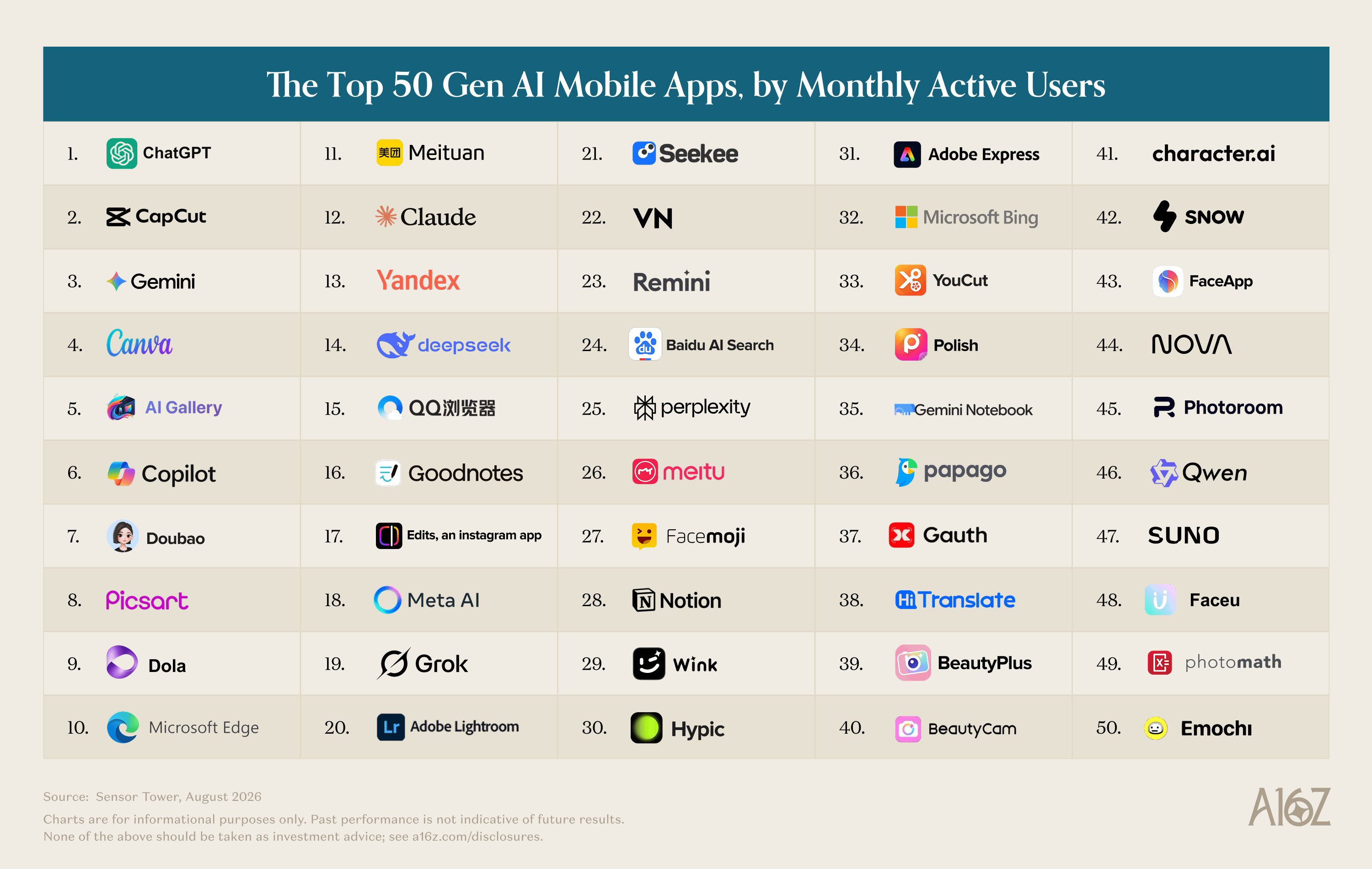
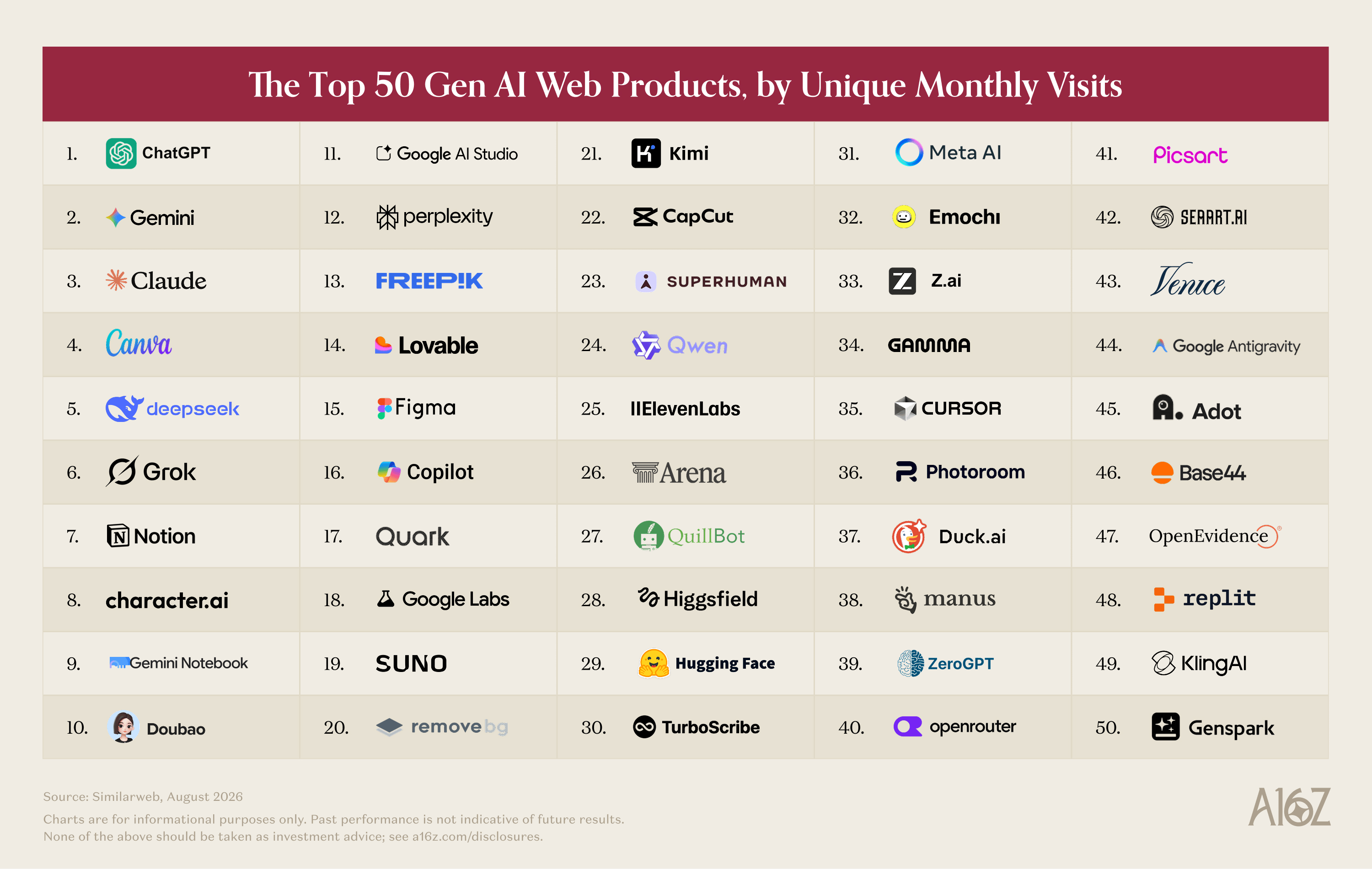
As in our previous editions, we rank the top 50 web products by monthly visits, using Similarweb, and the top 50 mobile apps by monthly active users, using Sensor Tower. Generative AI must be central to the product experience; both AI-native companies and established products can qualify.与往期一样,我们使用 Similarweb 的数据对月访问量排名前 50 的网页产品进行排名,并使用 Sensor Tower 的数据对月活跃用户数排名前 50 的移动应用进行排名。生成式 AI 必须是产品体验的核心;无论是 AI 原生公司还是成熟产品,均有资格入选。
We’re making one change to eligibility from this list forward: products primarily designed for NSFW use cases will be excluded. This should not be interpreted as a decrease in demand for these products - we’re treating them as a distinct category rather than ranking them alongside SFW products.从本期榜单开始,我们对入选资格做了一项调整:主要为 NSFW(非适龄内容)用例设计的产品将被排除在外。这不应被解读为对这些产品需求的下降——我们只是将其视为一个独立的类别,而非将其与适龄(SFW)产品放在一起排名。
1. Three LLMs, three different games1. 三大 LLM,三种不同的博弈
Consumer AI’s headline is the same as our very first report in September 2023 - ChatGPT was the pioneer, and remains the leader. It has a roughly 2x lead on Gemini in August web visits and an even wider lead over Claude (6x). This gap is more significant on mobile, where ChatGPT has a 2.5x lead on Gemini and a 14x lead on Claude in monthly active users.消费级 AI 的头条与我们在 2023 年 9 月发布的第一份报告时并无二致——ChatGPT 是先行者,且依然保持领先地位。在 8 月的网页访问量中,它对 Gemini 保持着约 2 倍的领先优势,对 Claude 的领先优势则更为显著(6 倍)。这种差距在移动端更为明显,ChatGPT 的月活跃用户数是 Gemini 的 2.5 倍,是 Claude 的 14 倍。
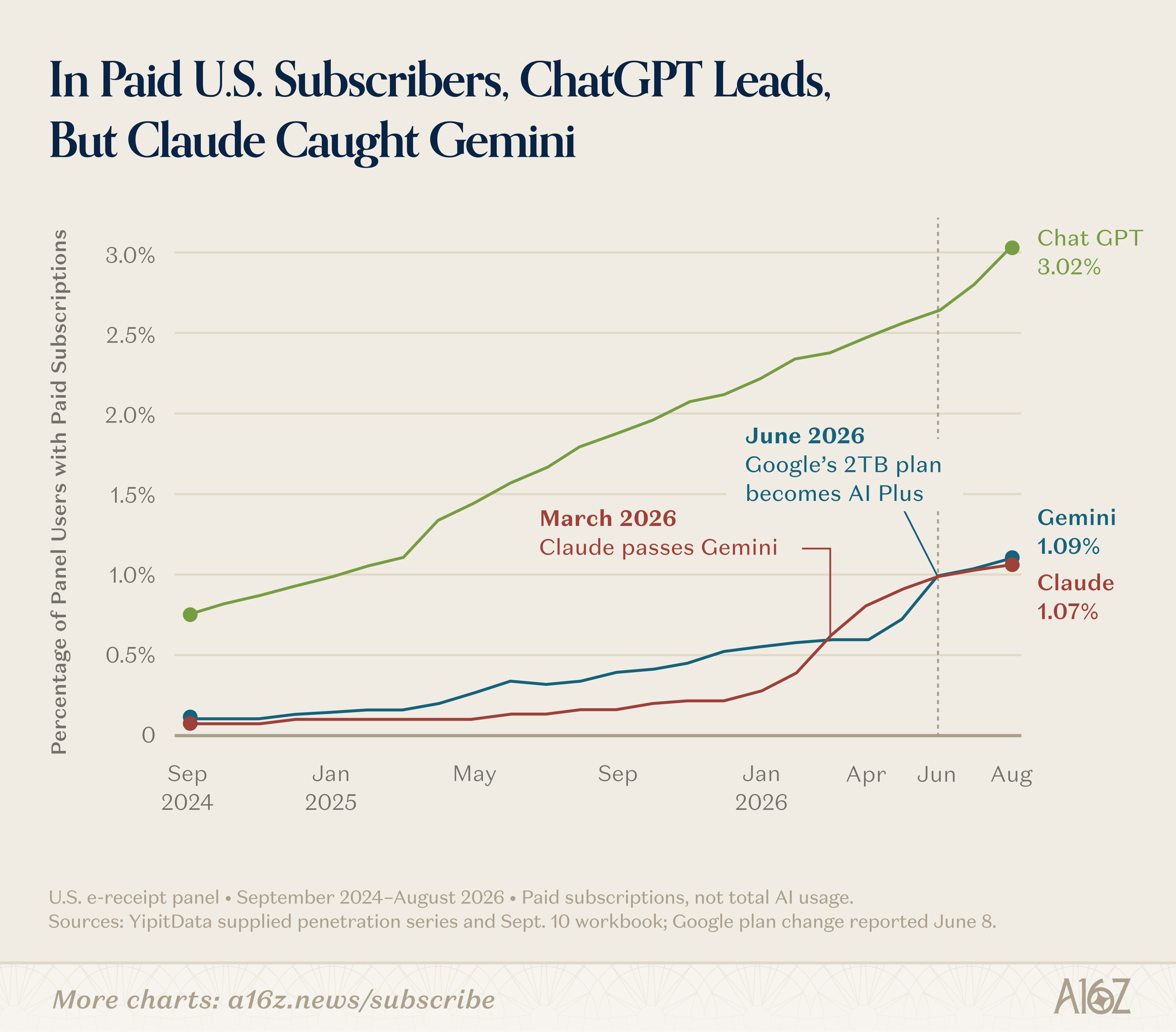
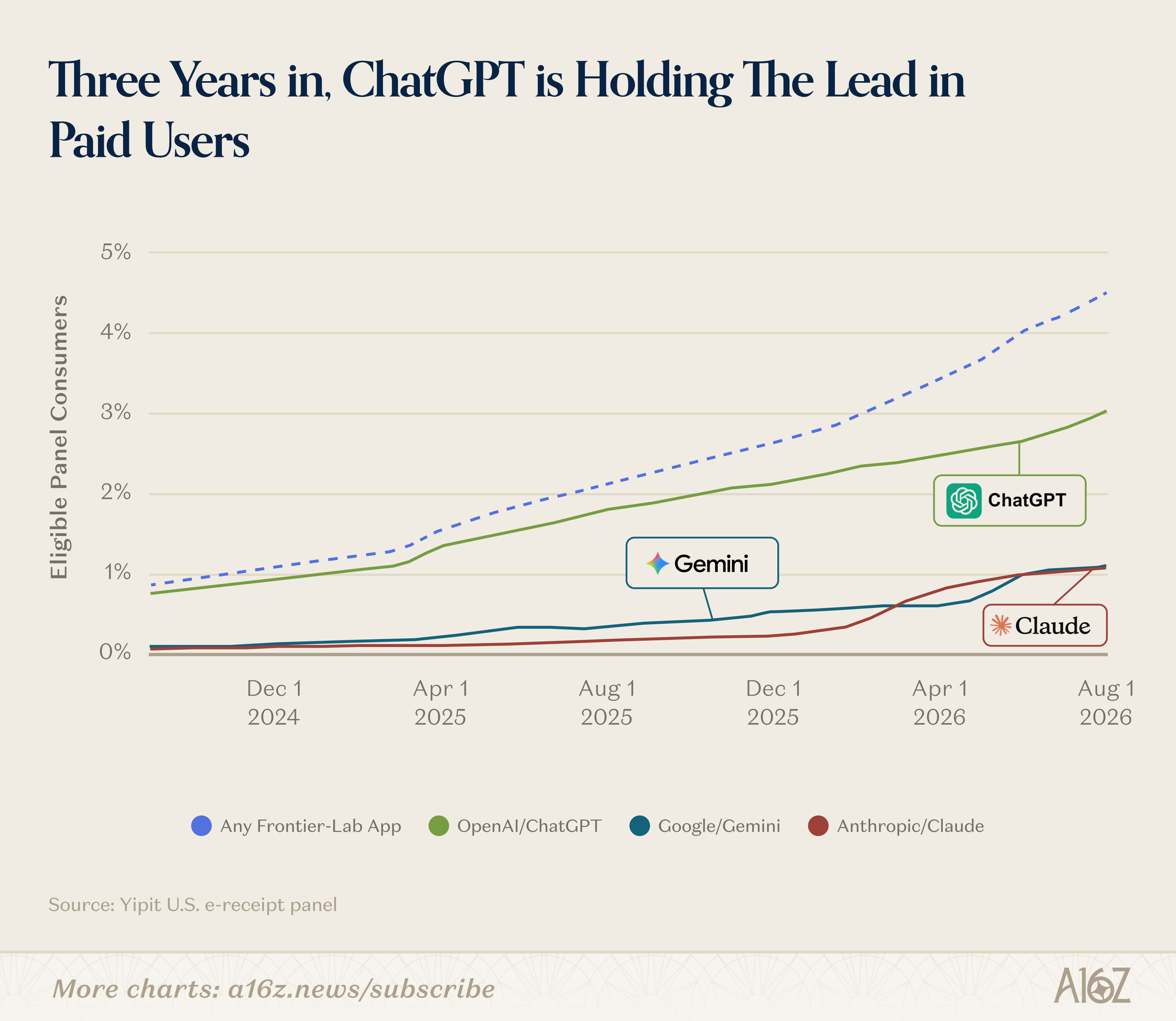
Our new revenue data tells a similar story. Per YipitData’s panel, ChatGPT has 3x more U.S. consumer paid subscribers than Claude or Gemini.我们新的收入数据也印证了这一点。根据 YipitData 的统计,ChatGPT 的美国个人付费订阅用户数是 Claude 或 Gemini 的 3 倍。
The most significant shift in this landscape has been Claude emerging as the clear #3. Claude did not even rank on our first web list in September 2023, but has now passed competitors like DeepSeek and Perplexity in traffic. Even more significantly, Claude passed Gemini on U.S. consumer subscribers earlier this year. Even after Google migrated legacy paid users over to the AI plan (inorganically inflating subscriber count), Gemini and Claude are neck and neck.这一格局中最重要的变化是 Claude 明确成为了第三名。Claude 在 2023 年 9 月我们的首份网页榜单中甚至未上榜,但如今在流量上已超过了 DeepSeek 和 Perplexity 等竞争对手。更重要的是,Claude 今年早些时候在美国消费者订阅用户数上超过了 Gemini。即便在谷歌将存量付费用户迁移至 AI 计划(非自然地推高了订阅数)之后,Gemini 和 Claude 依然难分伯仲。
Claude’s run came on the back of new products (Cowork in January, Claude Design in April), new models (Fable 5 in June), and a burst of public attention. Amid Anthropic’s late-February dispute with the Pentagon, Claude hit #1 among free U.S. mobile apps for the first time.Claude 的崛起得益于新产品(1 月的 Cowork,4 月的 Claude Design)、新模型(6 月的 Fable 5)以及一波公众关注度。在 Anthropic 与五角大楼 2 月下旬发生争执期间,Claude 首次登上了美国免费移动应用榜首。
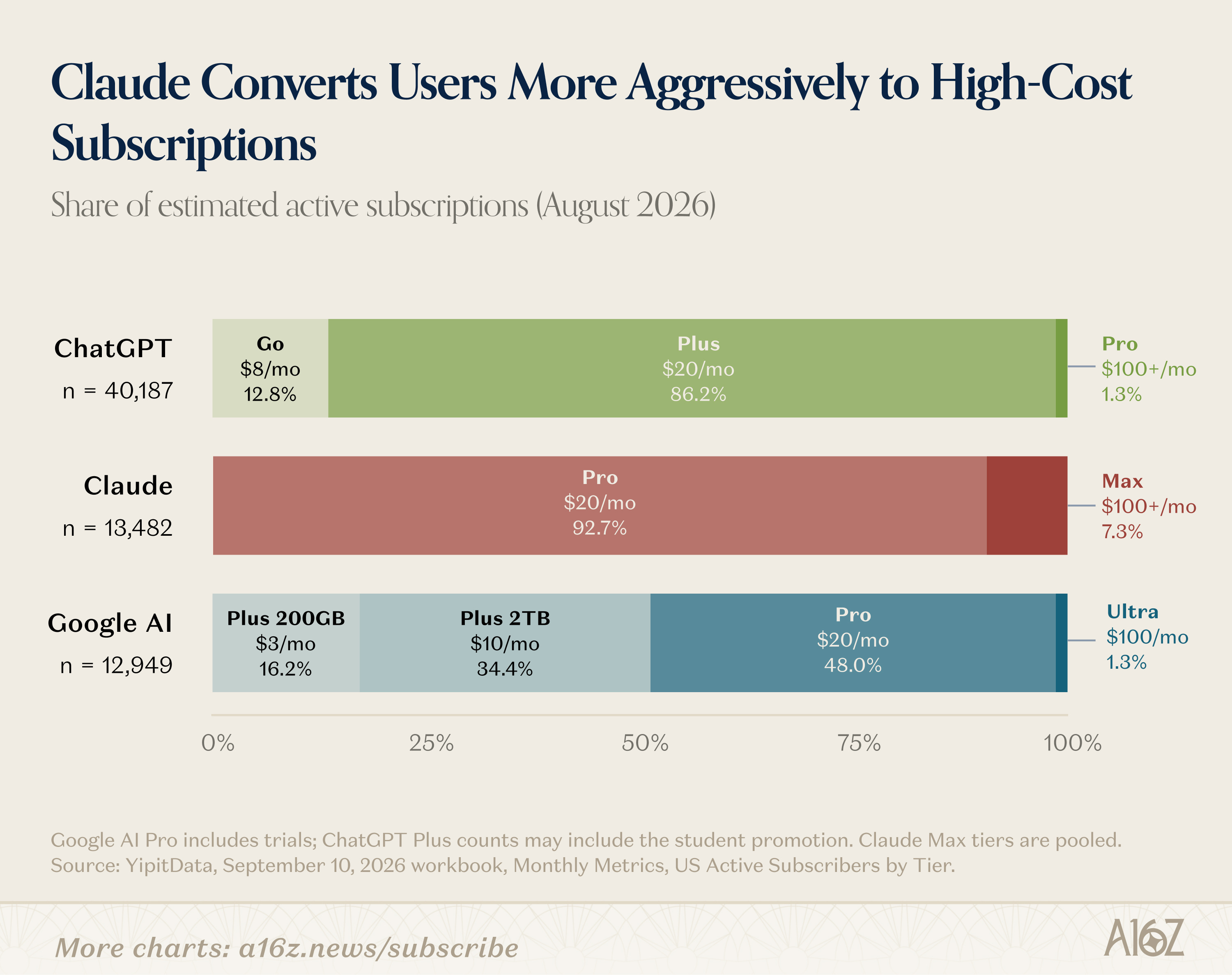
Unlike OpenAI and Google, Anthropic has been clear that they will not run ads in Claude, and instead monetize users via subscription. They have been doing so aggressively. Claude has 7.3% of consumer payers on their most expensive individual plan, Max - which starts at $100/month. This compares to 1.3% for Google and 1.1% for ChatGPT on their corresponding $100/month subscriptions.与 OpenAI 和 Google 不同,Anthropic 已明确表示不会在 Claude 中投放广告,而是通过订阅实现用户变现。他们一直在积极推进这一策略。在 Claude 的个人用户中,有 7.3% 选择了其最昂贵的 Max 计划,该计划起价为每月 100 美元。相比之下,Google 和 ChatGPT 对应每月 100 美元订阅计划的比例分别为 1.3% 和 1.1%。
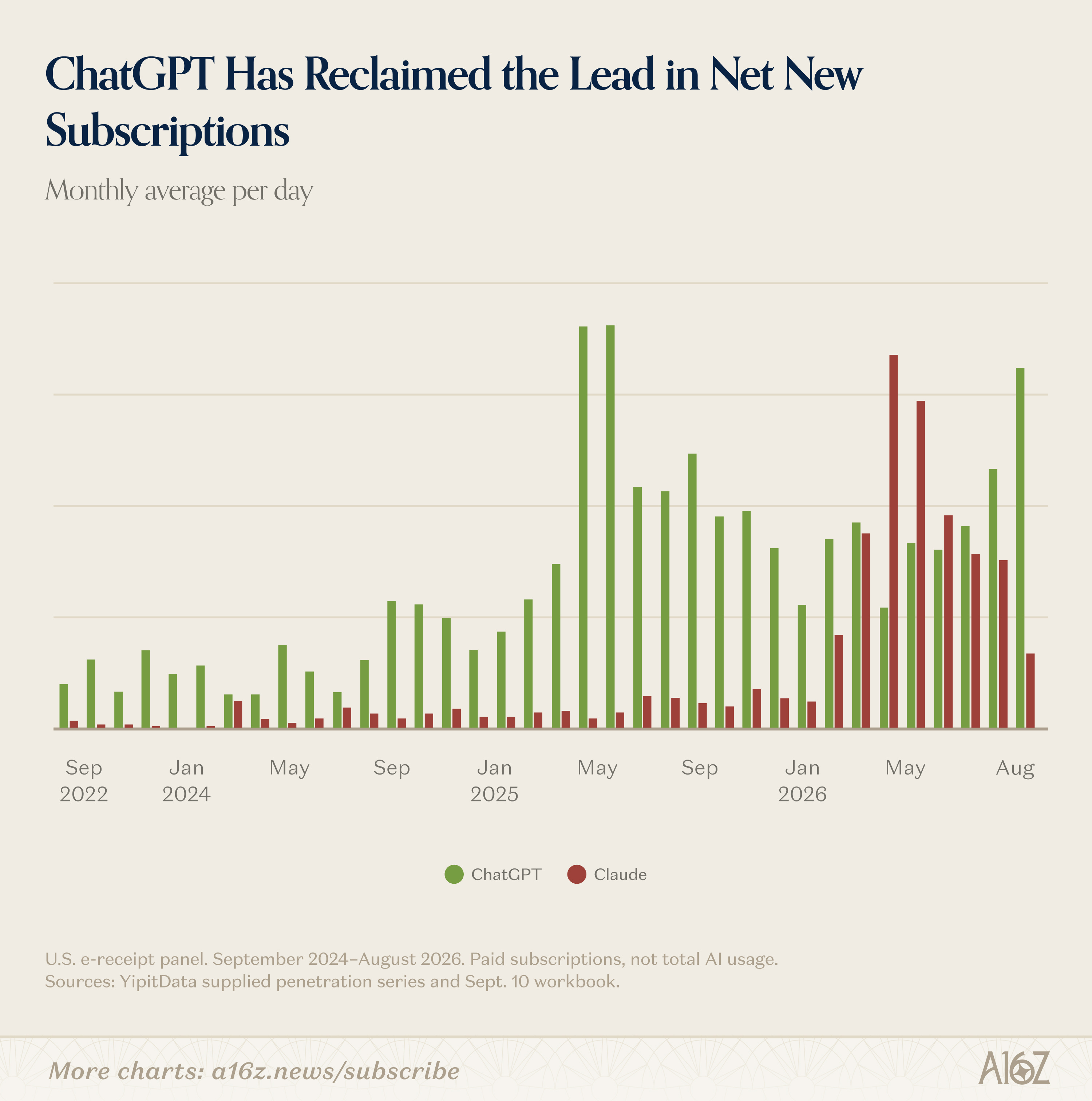
By mid-summer, the winds had shifted. YipitData’s global desktop panel recorded declines in Claude’s average daily sessions in July and August, while its U.S. e-receipt panel showed gross additions slowing and churn rising. ChatGPT, meanwhile, re-accelerated with the July launch of GPT-5.6 Sol, Terra, and Luna and the debut of ChatGPT Work.到了仲夏,风向发生了变化。YipitData 的全球桌面端面板显示,Claude 的平均每日会话数在 7 月和 8 月出现下滑,而其美国电子收据面板显示,总新增用户放缓,流失率上升。与此同时,ChatGPT 凭借 7 月推出的 GPT-5.6 Sol、Terra 和 Luna 以及 ChatGPT Work 的发布,重新加速增长。
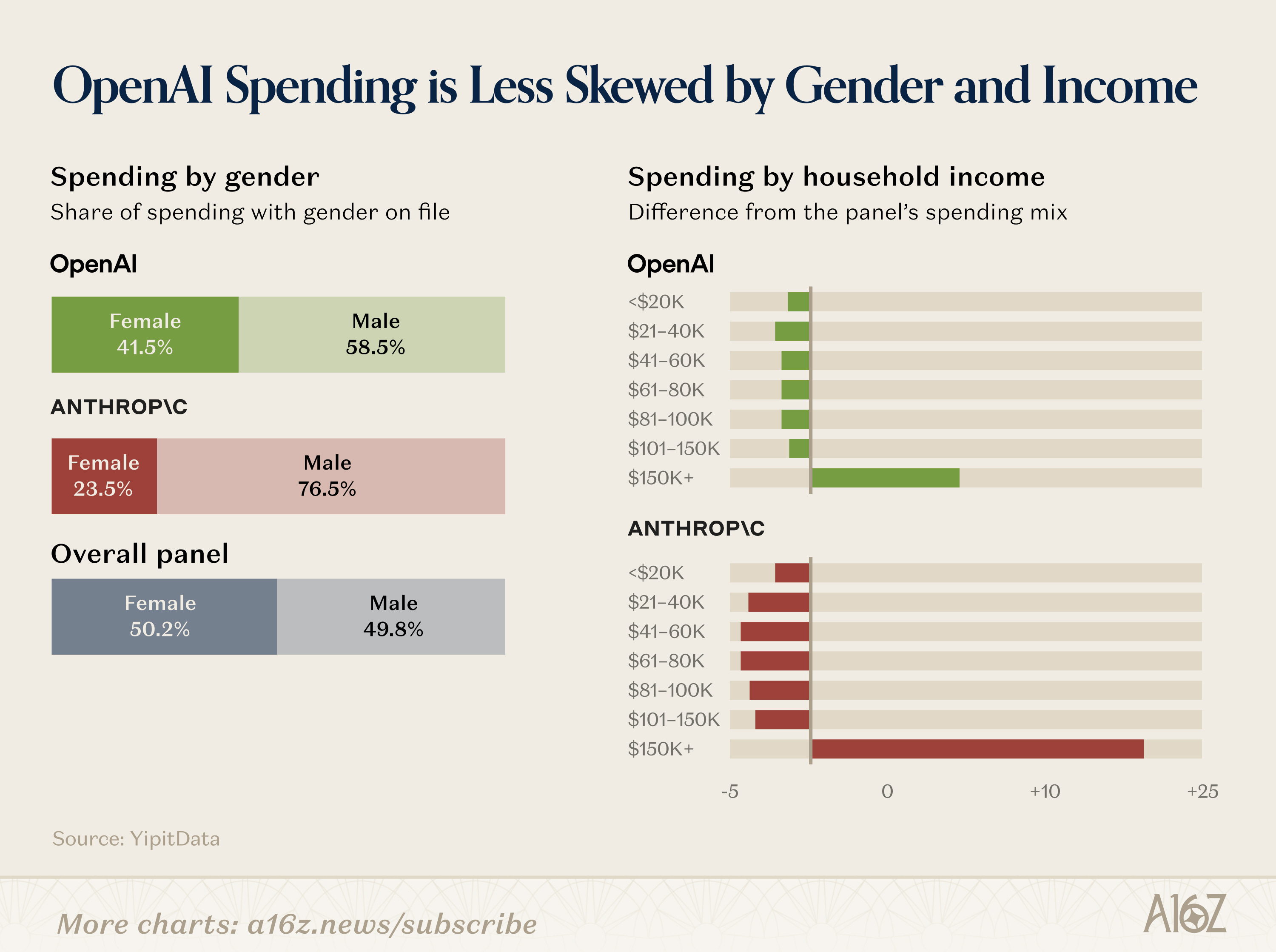
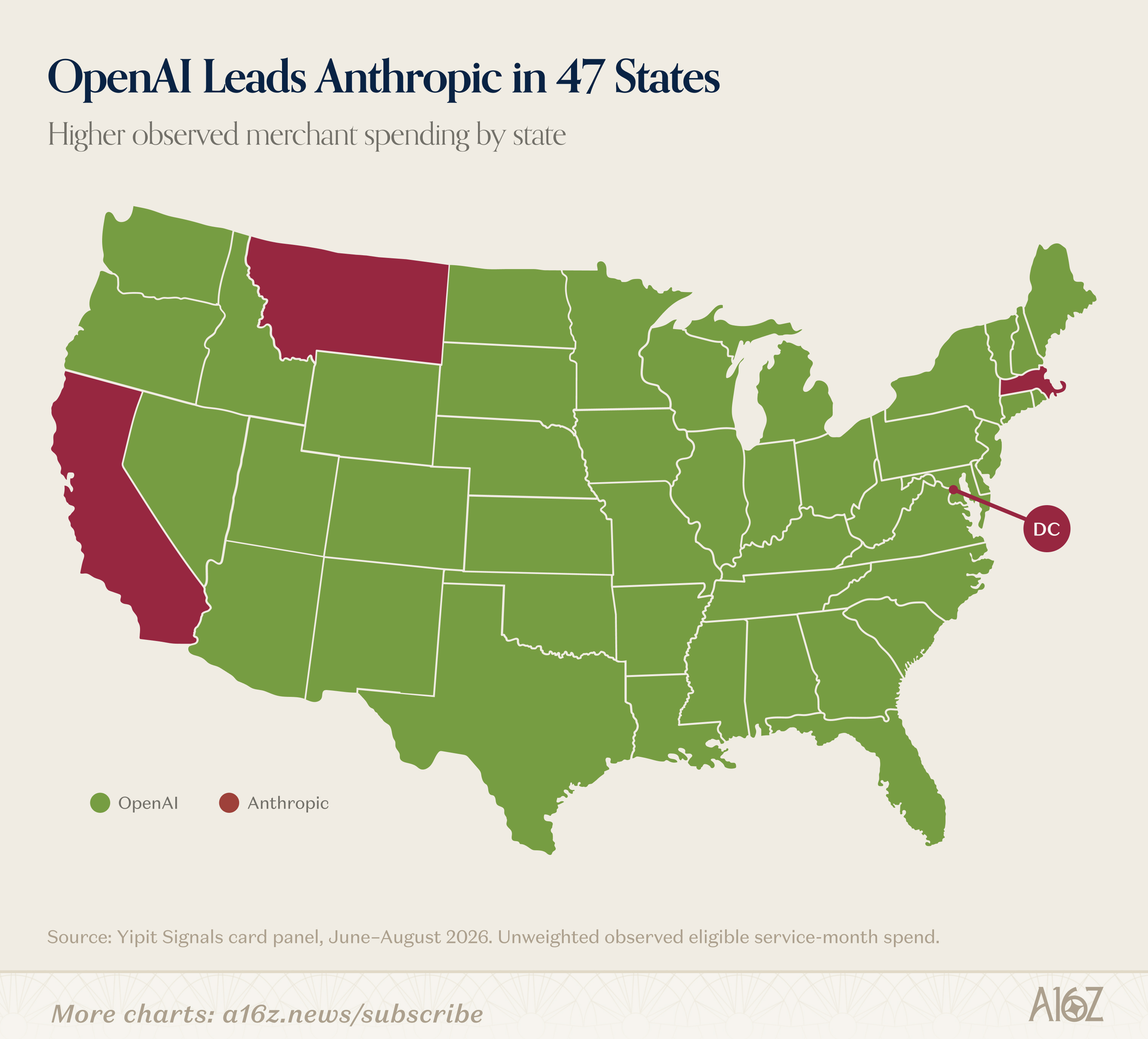
Increasingly, the question may be less “who is winning” - and more “how is each company executing on their own opportunity.” Per YipitData’s panel, only 8% of U.S. ChatGPT subscribers are also subscribed to Claude. ChatGPT has a more equal split of consumers across genders and incomes - and is also dominant in all U.S. states aside from California, Montana, and Massachusetts.越来越明显的是,问题可能不再是“谁在赢”,而是“每家公司如何执行各自的机会”。根据 YipitData 的面板数据,只有 8% 的美国 ChatGPT 订阅用户同时也订阅了 Claude。ChatGPT 在不同性别和收入水平的消费者中分布更均匀,并且除了加利福尼亚州、蒙大拿州和马萨诸塞州外,它在所有美国州均占据主导地位。
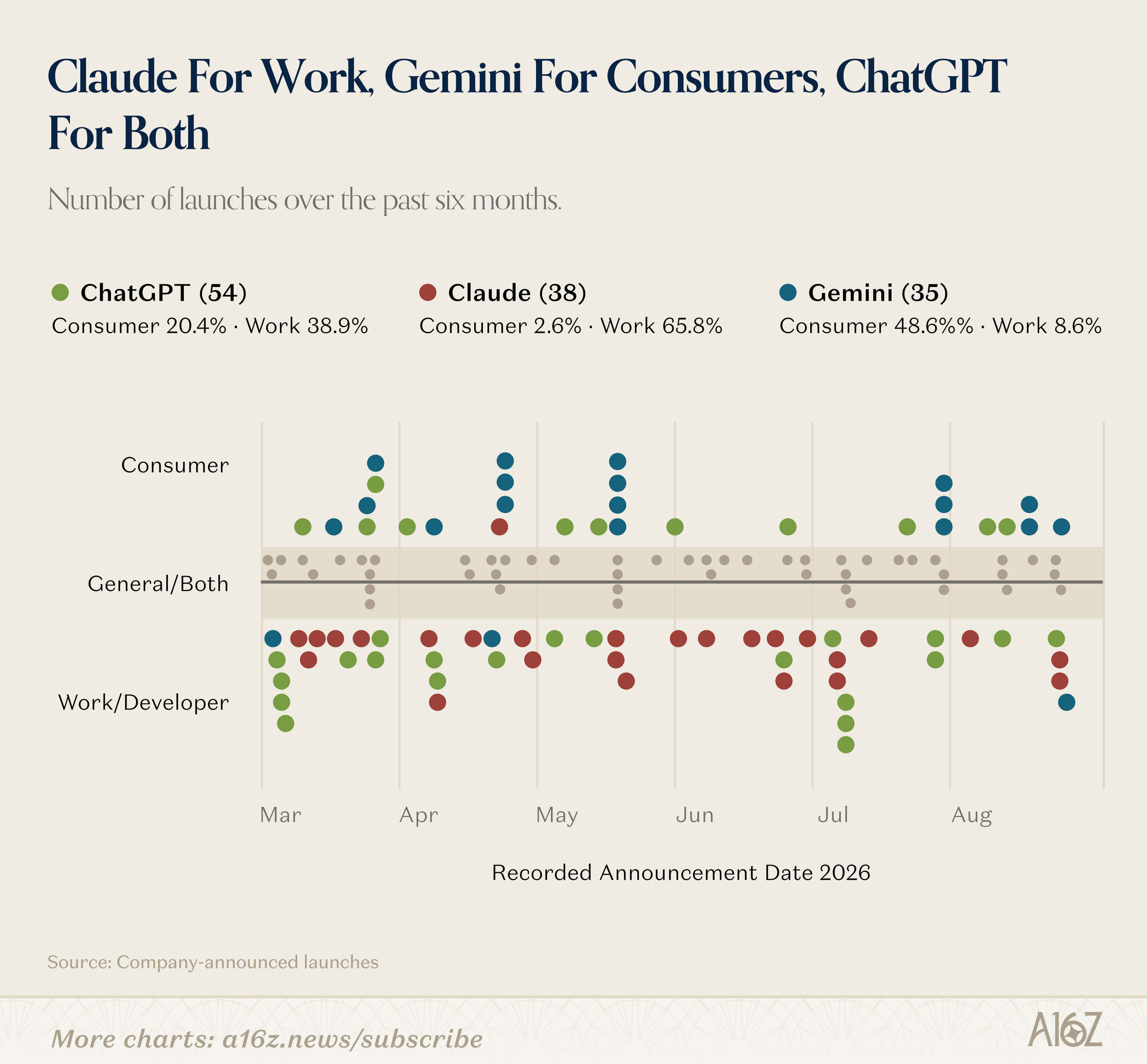
This difference in users is at least partially a result of the products being pointed in different directions. Between Anthropic, Google, and OpenAI, there were 127 new launches over the past six months. Anthropic has focused almost entirely on the prosumer (Claude Design, Code Review, Claude Science). Google has led on creative models (Lyria 3 Pro, Gemini Omni). OpenAI has tackled both consumer and enterprise - with tools for enterprise (ChatGPT Work, Sites, Dots) and for consumers (Images 2.0, Health, Personal Finance, job search).用户群体的这种差异至少部分源于产品定位的方向不同。在过去六个月里,Anthropic、Google 和 OpenAI 共发布了 127 款新产品。Anthropic 几乎完全专注于专业用户(Claude Design、Code Review、Claude Science)。Google 在创意模型方面处于领先(Lyria 3 Pro、Gemini Omni)。OpenAI 则同时兼顾消费者和企业市场——提供面向企业的工具(ChatGPT Work、Sites、Dots)以及面向消费者的工具(Images 2.0、Health、Personal Finance、职位搜索)。
2. AI spending follows a power law2. AI 消费遵循幂律分布
For the first time, we’re adding a ranking based on observed consumer spending, using data from YipitData. The data is U.S.-only and drawn from panels rather than a census; so it should not be read as total company revenue. However - it gives us a new view of how consumers pay for AI, with a clear takeaway: heavy concentration.我们首次加入了基于观测到的消费者支出排名,数据来自 YipitData。该数据仅限美国,且源自抽样面板而非普查,因此不应被视为公司的总收入。然而,它为我们观察消费者如何为 AI 付费提供了新视角,其结论非常明确:高度集中。
The base of consumers paying for AI is growing, but still narrow. In August, 4.5% of eligible consumers in YipitData’s U.S. e-receipt panel had an active paid personal subscription to at least one of ChatGPT, Gemini, or Claude, up from 2.1% a year ago.为 AI 付费的消费者基础正在扩大,但仍属小众。8 月份,YipitData 美国电子收据面板中符合条件的消费者里,有 4.5% 至少拥有 ChatGPT、Gemini 或 Claude 中一款产品的有效个人付费订阅,高于一年前的 2.1%。
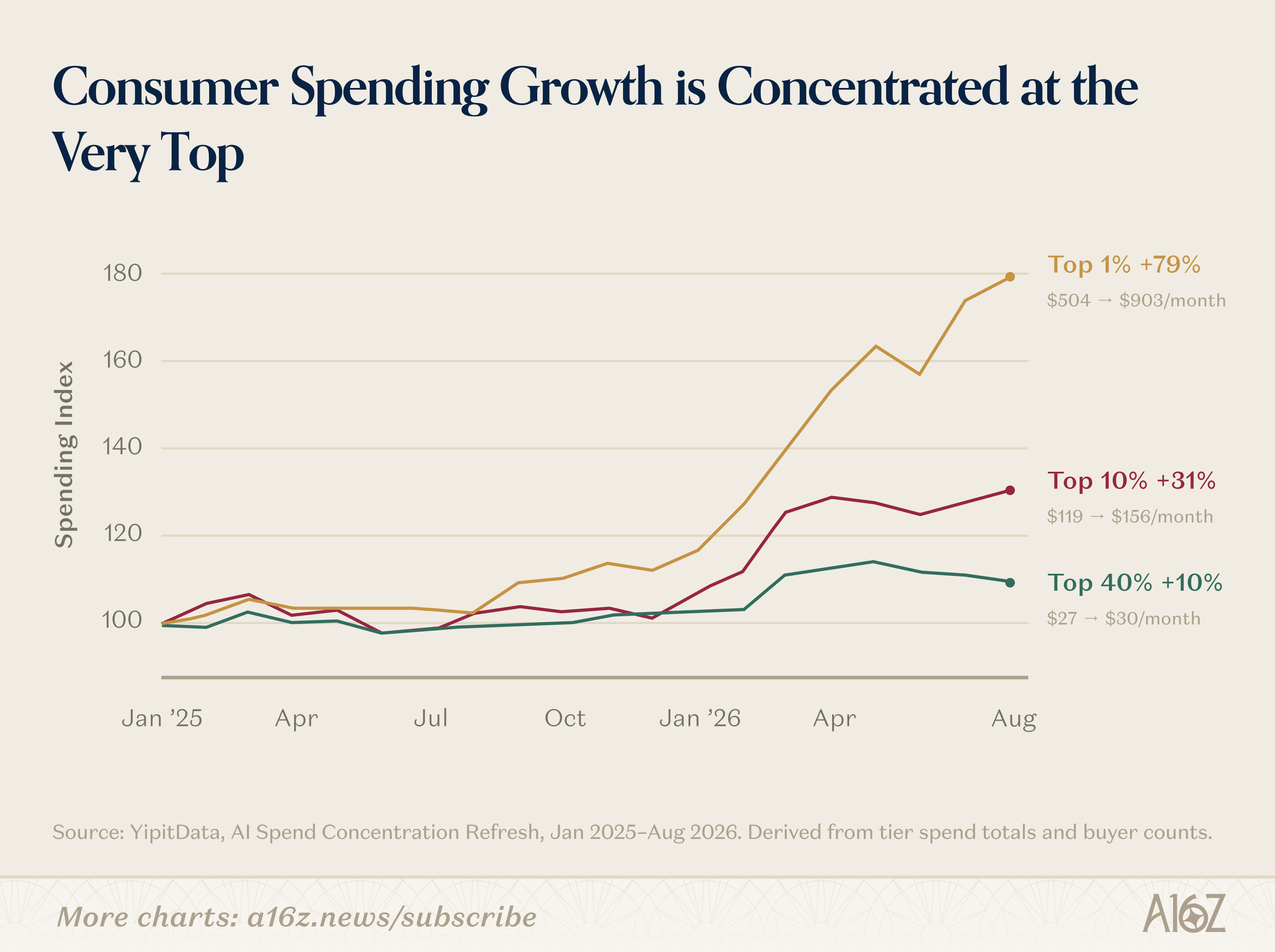
Even among the relatively narrow band of paying consumer users, spending follows a power law. Only 13% of users who pay for one AI product pay for even one other AI tool. And, spend from the top 1% of payers accounted for 19.5% of all observed consumer AI spend. This is more than the bottom 50% of spenders combined (16.6%).即使在相对狭窄的付费用户群体中,支出也遵循幂律。只有 13% 为一款 AI 产品付费的用户会为另一款 AI 工具付费。此外,排名前 1% 的高消费用户贡献了所有观测到的消费级 AI 支出的 19.5%。这一比例超过了后 50% 消费者的总和(16.6%)。
This top 1% pays an average of $903 per month on consumer cards for AI (work usage may be even higher), as of August 2026. And, they’re still growing this spend - up 80% in the last 18 months. The difference from the median AI payer is stark: they are spending $25 per month, and have barely expanded this spend over time.截至 2026 年 8 月,这前 1% 的用户平均每月在 AI 上支出 903 美元(工作用途可能更高),且这一支出仍在增长——在过去 18 个月内增长了 80%。与 AI 付费用户中位数相比,差异非常明显:中位数用户每月仅支出 25 美元,且随时间推移几乎没有增加支出。
Who are these power spenders? They look less like mainstream consumers and more like prosumers, individuals buying software to build, create, and get work done.这些高消费用户是谁?他们看起来不像主流消费者,更像是专业用户,即购买软件来构建、创作和完成工作的个人。
Across the panel, the top 1% of spenders disproportionately purchase tools for automation and product building, like n8n, fal, Manus, and Nous Research (Hermes Agent). These heavier spenders also over-index to creative tools like Higgsfield, Figma, and HeyGen.在整个面板中,排名前 1% 的用户不成比例地购买自动化和产品构建工具,如 n8n、fal、Manus 和 Nous Research (Hermes Agent)。这些高消费用户在 Higgsfield、Figma 和 HeyGen 等创意工具上的使用率也远高于平均水平。
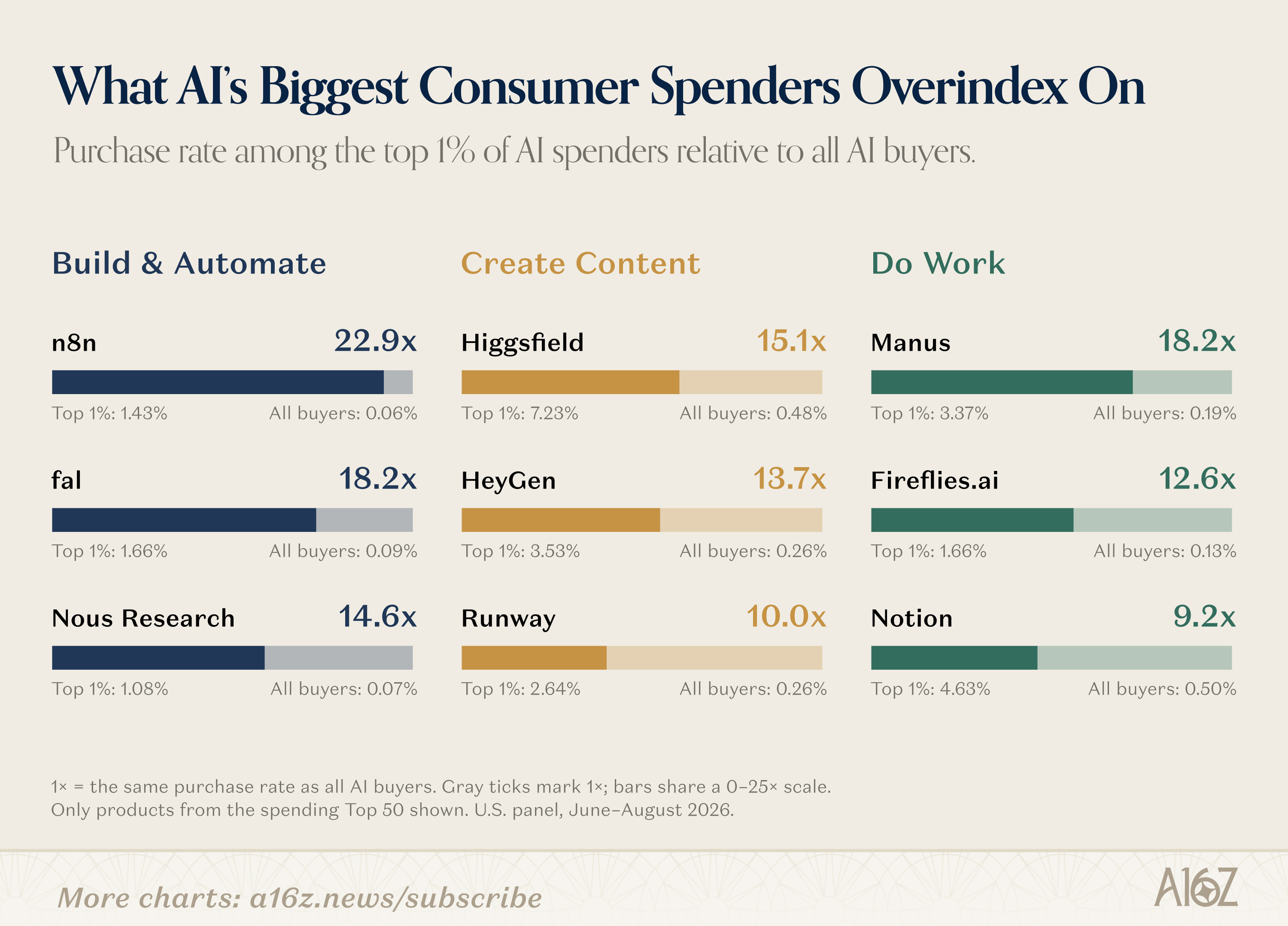
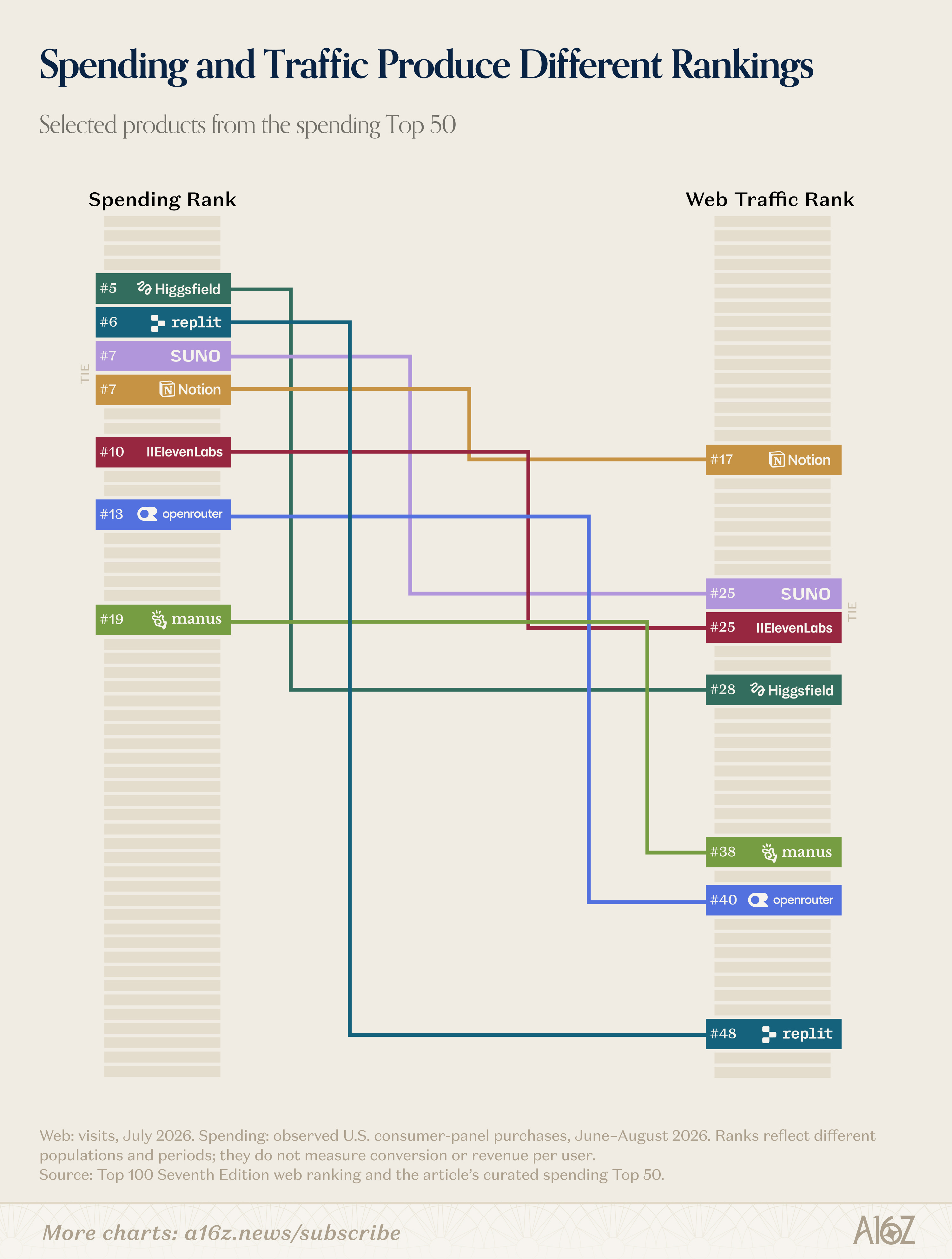
As a result, there are significant differences between consumer traffic and consumer revenue, made tangible by our first spending ranks. 29 of the top 50 vendors by spend do not appear anywhere on our web or mobile traffic lists. For those who do appear, their ranking by traffic and ranking by spend can vary drastically depending on how aggressively they monetize power users.因此,消费者流量和消费者收入之间存在显著差异,这一点通过我们首次推出的支出排名得以体现。按支出排名的前 50 家供应商中,有 29 家未出现在我们的网页或移动流量榜单上。对于那些同时上榜的公司,其流量排名和支出排名可能会因其对高价值用户的变现力度不同而产生巨大差异。
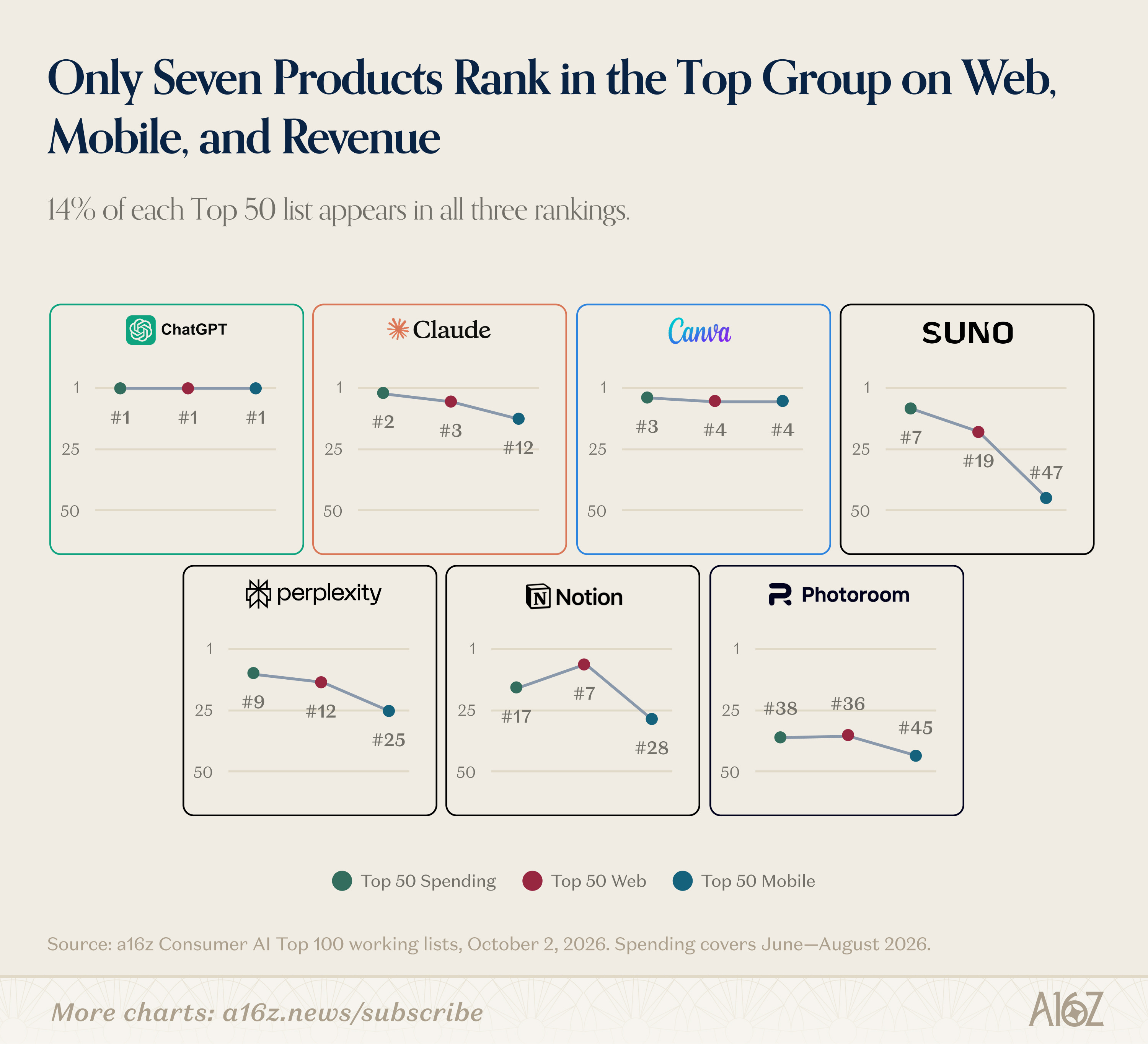
Only seven companies make all three lists - and one (ChatGPT) ranks at the top of each. This includes three model companies (ChatGPT, Claude, and Suno), two AI-native applications (Perplexity, Photoroom), and two incumbents who have added AI (Canva, Notion).仅有七家公司同时出现在这三份榜单上,其中一家(ChatGPT)在每份榜单中均位居榜首。这包括三家模型公司(ChatGPT、Claude 和 Suno)、两家 AI 原生应用(Perplexity、Photoroom)以及两家引入了 AI 的成熟企业(Canva、Notion)。
We expect the paying base to broaden as business models open up. Personal agents, in particular, show potential to monetize on transactions rather than seats, offering something closer to unlimited usage without a subscription. More on that later in the report.随着商业模式的开放,我们预计付费基础将会扩大。特别是个人智能体,展现出了基于交易而非席位进行变现的潜力,能够提供更接近无限使用且无需订阅的服务。报告后续将对此进行详细阐述。
3. The race to become your personal assistant3. 争夺个人助理的竞赛
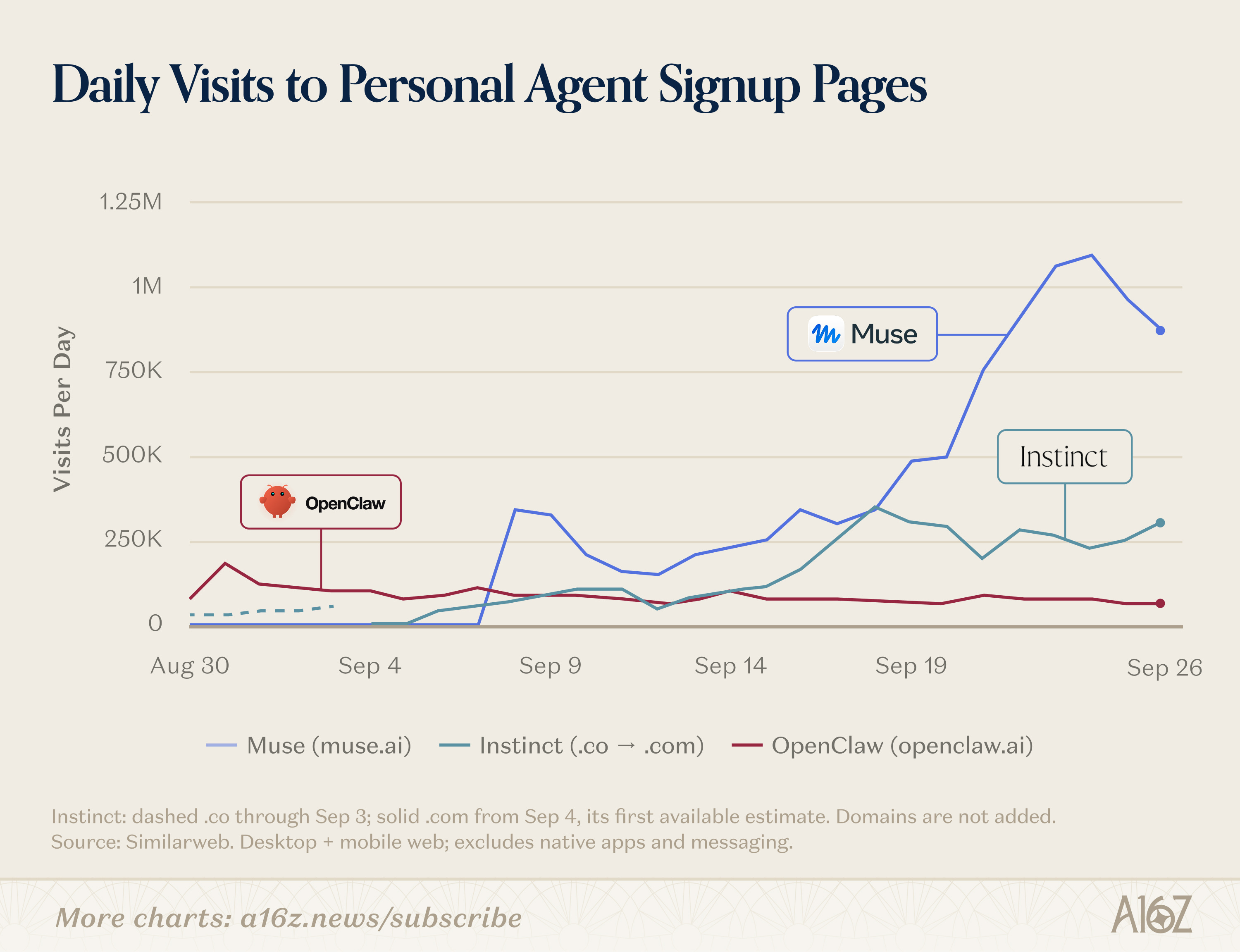
In March, we wrote that agents like OpenClaw were not yet usable by most consumers - but would be. Six months later, multiple startup consumer or prosumer agent products now report hundreds of thousands of users, including Instinct, Tomo, Poke, Lindy, and Town. And, the incumbents have struck back with agents of their own - Meta’s Muse, OpenAI’s Dots, and xAI’s Grok Bot.3 月时我们曾写道,像 OpenClaw 这样的智能体对大多数消费者而言尚不可用,但未来将会普及。六个月后,多个初创的消费级或专业级智能体产品报告称拥有数十万用户,包括 Instinct、Tomo、Poke、Lindy 和 Town。同时,成熟企业也推出了自己的智能体进行反击——Meta 的 Muse、OpenAI 的 Dots 以及 xAI 的 Grok Bot。
Most of these agents strive to be available everywhere - like a human assistant, you can text, email, or call. The channel du jour is iMessage, where viral agent Instinct launched in August 2026. Companies like DoorDash have since launched their own iMessage agent for text-to-order. More prosumer-oriented agents, or consumer agents focused on a specialized use case, often also have their own mobile or web app to provide a deeper experience.这些智能体大多致力于随处可用——就像人类助理一样,你可以通过短信、电子邮件或电话联系它们。目前最流行的渠道是 iMessage,病毒式传播的智能体 Instinct 就是在 2026 年 8 月于此平台推出的。DoorDash 等公司此后也推出了自己的 iMessage 智能体,用于“发短信即下单”。更多面向专业用户的智能体,或专注于特定用例的消费级智能体,往往也拥有自己的移动或网页应用,以提供更深入的体验。
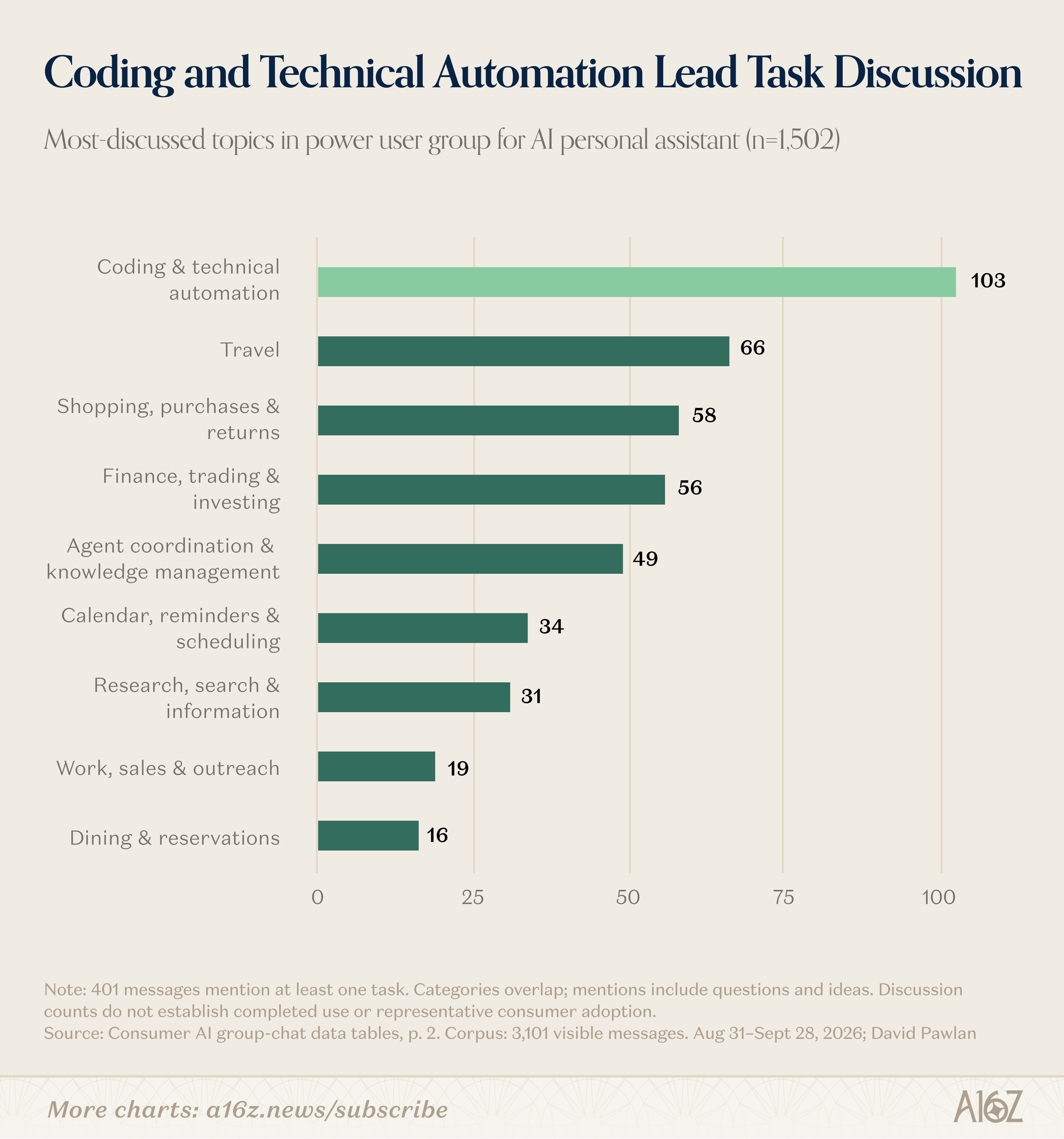
Who is using these agents, and for what? As with our spending data, it’s still largely an early power user game - and these power users look similar to those who are spending on AI. Per David Pawlan, who runs AssistantBenchmark, the most frequently discussed task domain for agents across seven early user group chats (n = 1,502) was coding and technical automation.谁在使用这些智能体,用途是什么?正如我们的支出数据所显示的,这在很大程度上仍然是早期高价值用户的游戏——这些用户看起来与那些在 AI 上投入支出的人群相似。据 AssistantBenchmark 的运营者 David Pawlan 称,在七个早期用户群聊(n = 1,502)中,智能体讨论最频繁的任务领域是编程和技术自动化。
Instinct founder Noah Shinn reported that 40% of users connect a personal credit card within three weeks - and these users spend an average of $1,300 / month through Instinct once they make a purchase. Shinn claims more than $1 billion in annualized transaction volume is already flowing through Instinct - with half of this attributable to travel.Instinct 创始人 Noah Shinn 报告称,40% 的用户在三周内绑定了个人信用卡,且这些用户在进行消费后,通过 Instinct 每月的平均支出为 1,300 美元。Shinn 声称,目前已有超过 10 亿美元的年化交易额流经 Instinct,其中一半归功于旅游业务。
As agents start to drive meaningful traffic (and revenue), the platforms are choosing sides. Amazon shut down access for Meta’s Muse in under two weeks, while Shopify, Instacart, OpenTable, Expedia, Ticketmaster, Plaid, and others have signed official integrations.随着智能体开始驱动显著的流量(和收入),平台方开始站队。亚马逊在不到两周内就切断了对 Meta Muse 的访问,而 Shopify、Instacart、OpenTable、Expedia、Ticketmaster、Plaid 等则签署了官方集成协议。
Prosumers are spending time on Grok Bot, Dots (from OpenAI), and Town. But as of late September, the consumer headline matchup is Instinct versus Muse. Instinct, founded by ex-Sierra researcher Noah Shinn, reportedly passed 100,000 users in three weeks between late August and early September, while still invite-only.专业用户在 Grok Bot、Dots(来自 OpenAI)和 Town 上花费了不少时间。但截至 9 月下旬,消费级市场的头条对决是 Instinct 对阵 Muse。由前 Sierra 研究员 Noah Shinn 创立的 Instinct 据称在 8 月下旬至 9 月初的三周内用户数突破了 10 万,且当时仍处于邀请制阶段。
Meta launched Muse on September 9, a personal agent that runs in the browser, desktop and mobile apps, and WhatsApp. It reportedly reached 250,000 daily actives in its first week - and crossed 5M downloads in less than a month. Muse is still only available in the U.S. and Canada.Meta 于 9 月 9 日推出了 Muse,这是一款可以在浏览器、桌面端、移动端应用及 WhatsApp 上运行的个人智能体。据报道,它在发布首周就达到了 25 万日活跃用户,并在不到一个月的时间内下载量突破 500 万。Muse 目前仅在美国和加拿大可用。
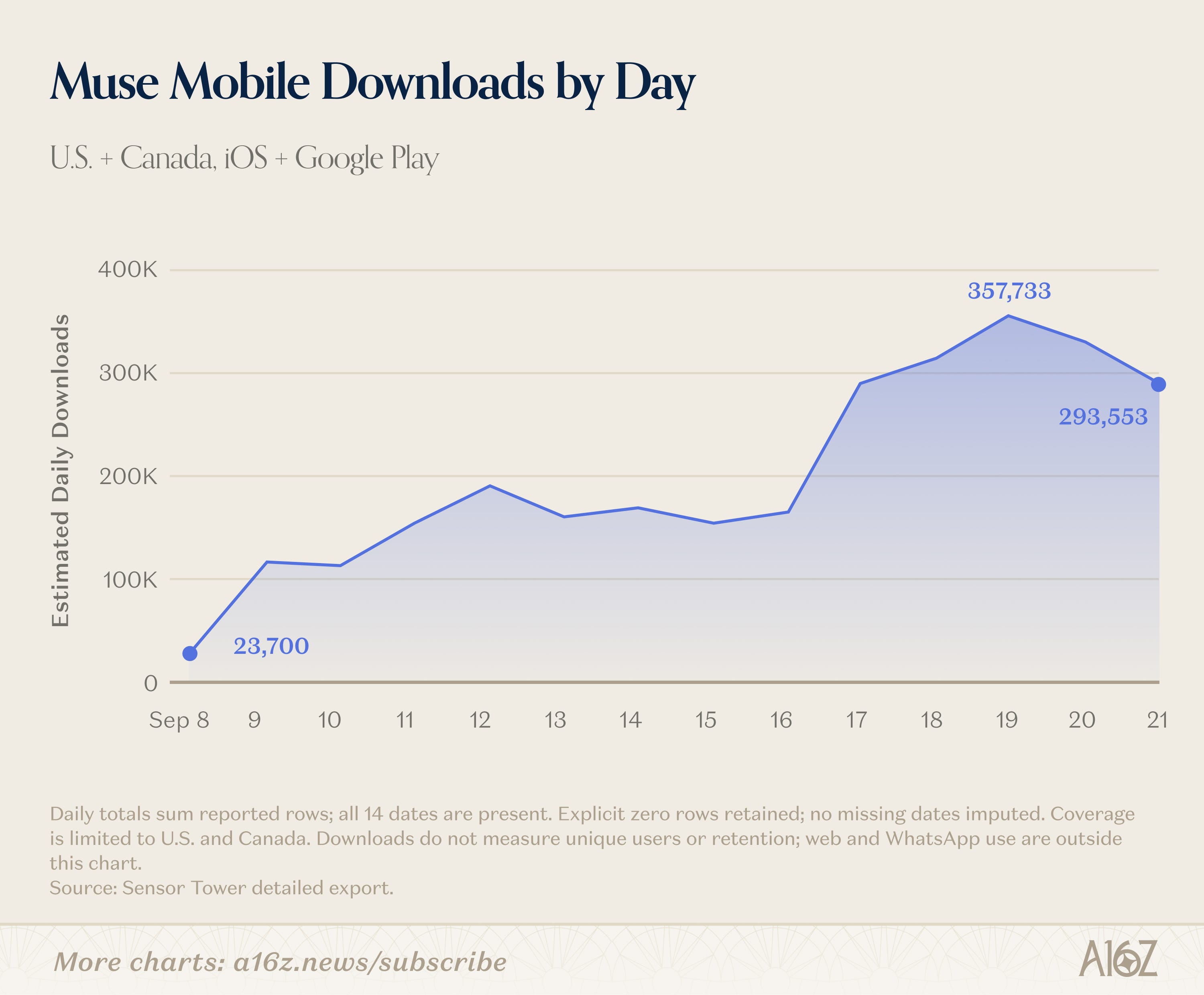
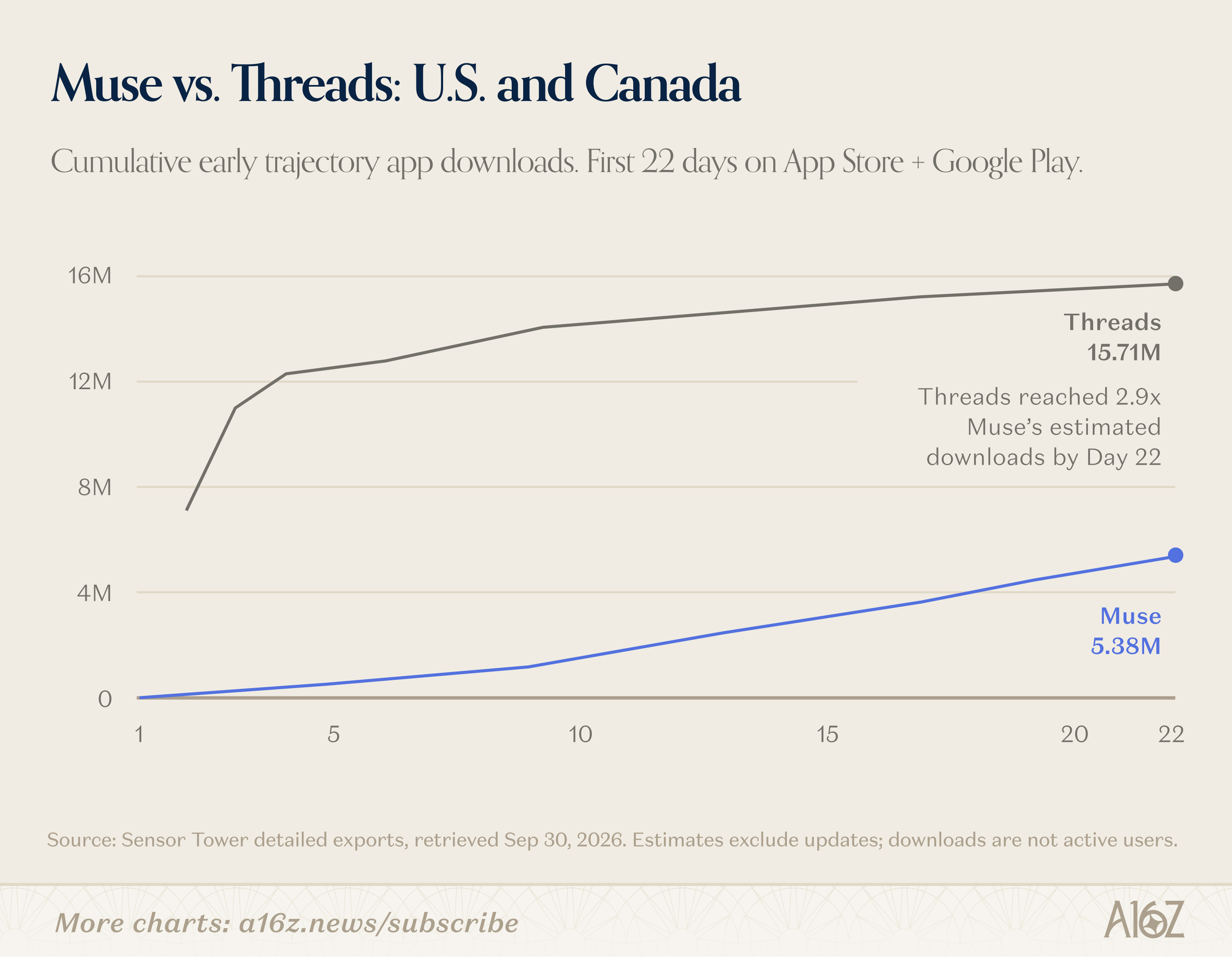
But as with every new consumer product, the primary battle is against apathy. Muse’s early traction still pales next to Meta’s Threads launch, which racked up more than 15M downloads in its first 22 days across the same two markets.但正如每一款新的消费级产品一样,主要的挑战在于对抗用户的冷漠。Muse 的早期表现与 Meta 的 Threads 发布相比仍显逊色,后者在同一两个市场的前 22 天内下载量就超过了 1500 万。
4. The incumbents have arrived. Here’s where startups are still winning.4. 成熟企业已入场。初创公司在这些领域依然占据优势。
In our last list, we expanded eligibility to include existing products where generative AI had become a core part of the experience.在上一期榜单中,我们扩大了入选资格,将生成式 AI 已成为核心体验的现有产品也纳入其中。
Those products are now prominent: Canva and Notion rank in the top ten on web, and Figma in the top 15. Superhuman (fka Grammarly) has consistently made the top half of the web list - and debuted at number four in spend. Google alone has five web entries: Gemini, NotebookLM, AI Studio, Labs, and Antigravity.这些产品如今已占据重要地位:Canva 和 Notion 在网页端排名前十,Figma 排名前 15。Superhuman(前身为 Grammarly)始终稳居网页榜单的前半部分,并在支出榜单中以第四名的成绩首次亮相。仅 Google 一家就有五个网页条目入选:Gemini、NotebookLM、AI Studio、Labs 和 Antigravity。
Some of these products may merely educate consumers about AI, sending them to AI-native products for deeper usage. Others look like serious long-term threats to new entrants. Among the startups attracting durable attention, a few themes stand out:其中一些产品可能仅起到教育消费者的作用,引导他们转向 AI 原生产品以获得更深度的使用体验。另一些则看起来对新进入者构成了严重的长期威胁。在吸引了持久关注的初创公司中,几个主题脱颖而出:
Own a differentiated model. Creative products are the clearest examples: Suno ranks #19 on web traffic and #7 on spending; ElevenLabs ranks #25 and #10. Midjourney, HeyGen, Kling, and Topaz Labs also make the spending list - all of these products are built around proprietary models. Consumers are still paying for specialized creative products, even as Google expands Nano Banana and Veo and ChatGPT saw massive success with Images 2.0.拥有差异化的模型。创意产品是最好的例子:Suno 在网页流量榜单排名第 19,在支出榜单排名第 7;ElevenLabs 分别排名第 25 和第 10。Midjourney、HeyGen、Kling 和 Topaz Labs 也进入了支出榜单——所有这些产品都是围绕专有模型构建的。尽管 Google 正在扩展 Nano Banana 和 Veo,且 ChatGPT 在 Images 2.0 上取得了巨大成功,但消费者依然愿意为专业的创意产品付费。
A distinctive sound, visual style, or training dataset can matter more for a particular creative task than which lab has the strongest general-purpose model.对于特定的创意任务而言,独特的音质、视觉风格或训练数据集,有时比哪个实验室拥有最强的通用模型更为重要。Own a multi-model experience. Cursor supports models from several labs; OpenRouter gives developers access to multiple providers. Choosing models around the customer’s task can be a product advantage. A lab selling its own model may have less incentive to send that customer to a competitor.拥有多模型体验。Cursor 支持来自多个实验室的模型;OpenRouter 让开发者能够访问多个提供商。根据客户任务选择模型可以成为一种产品优势。销售自家模型的实验室,可能缺乏动力将客户引向竞争对手。
Coding and productivity products have been early beneficiaries here: Lovable, Cursor, Base44, and Replit all make the web list. Cursor moved from #41 to #35, while Base44 debuts at #46.编程和生产力产品是这一趋势的早期受益者:Lovable、Cursor、Base44 和 Replit 均进入了网页榜单。Cursor 从第 41 名升至第 35 名,而 Base44 则以第 46 名的成绩首次上榜。Own an audience with specific needs. OpenEvidence enters the web list at #47 serving physicians; Venice debuts at #43 with a focus on private AI. Sources, privacy, and fit with the customer’s work can matter as much as the underlying model.拥有具有特定需求的用户群体。OpenEvidence 以第 47 名进入网页榜单,服务于医生群体;Venice 以第 43 名首次上榜,专注于隐私 AI。数据来源、隐私保护以及与客户工作的契合度,其重要性不亚于底层模型。
Content policies create openings, too: the NSFW products excluded from this edition would have composed more than 20% of the web traffic list. They serve an audience the mainstream assistants have been reluctant to cater to - OpenAI told users in 2025 that Adult Mode was on the way, but indefinitely paused plans earlier this year.内容政策也创造了机会:本期剔除的 NSFW 产品本可占据网页流量榜单 20% 以上的份额。它们服务的是主流助理一直不愿触及的受众——OpenAI 在 2025 年曾告诉用户“成人模式”即将推出,但今年早些时候无限期暂停了相关计划。Own an experience that would require changing a legacy interface. “Legacy” can mean Google Docs or Calendar, or the blank prompt box of ChatGPT or Claude. Startups have fewer existing user habits and revenue streams to protect, which may give them more freedom to change how the product works.拥有需要改变遗留界面的体验。“遗留”可能指 Google Docs 或日历,也可能是 ChatGPT 或 Claude 的空白提示框。初创公司没有现有的用户习惯和收入来源需要保护,这可能使它们在改变产品运作方式上拥有更大的自由度。
One example - the labs have also not ventured (far) into hardware. Notetaker Plaud, which sells both a physical device and a subscription, debuted at #16 on the consumer spend list. Whether or not this is an advantage that sustains is to be determined. Meta announced an expansion into hardware with Muse in their smart glasses and an AI tamagotchi, while OpenAI’s acquisition of io Products hints at hardware ambitions.一个例子是,实验室尚未(大幅)涉足硬件。销售实体设备和订阅服务的笔记记录工具 Plaud 在消费者支出榜单中以第 16 名首次亮相。这种优势能否持续尚待观察。Meta 宣布通过 Muse 将业务扩展到智能眼镜和 AI 电子宠物等硬件领域,而 OpenAI 对 io Products 的收购也暗示了其硬件野心。
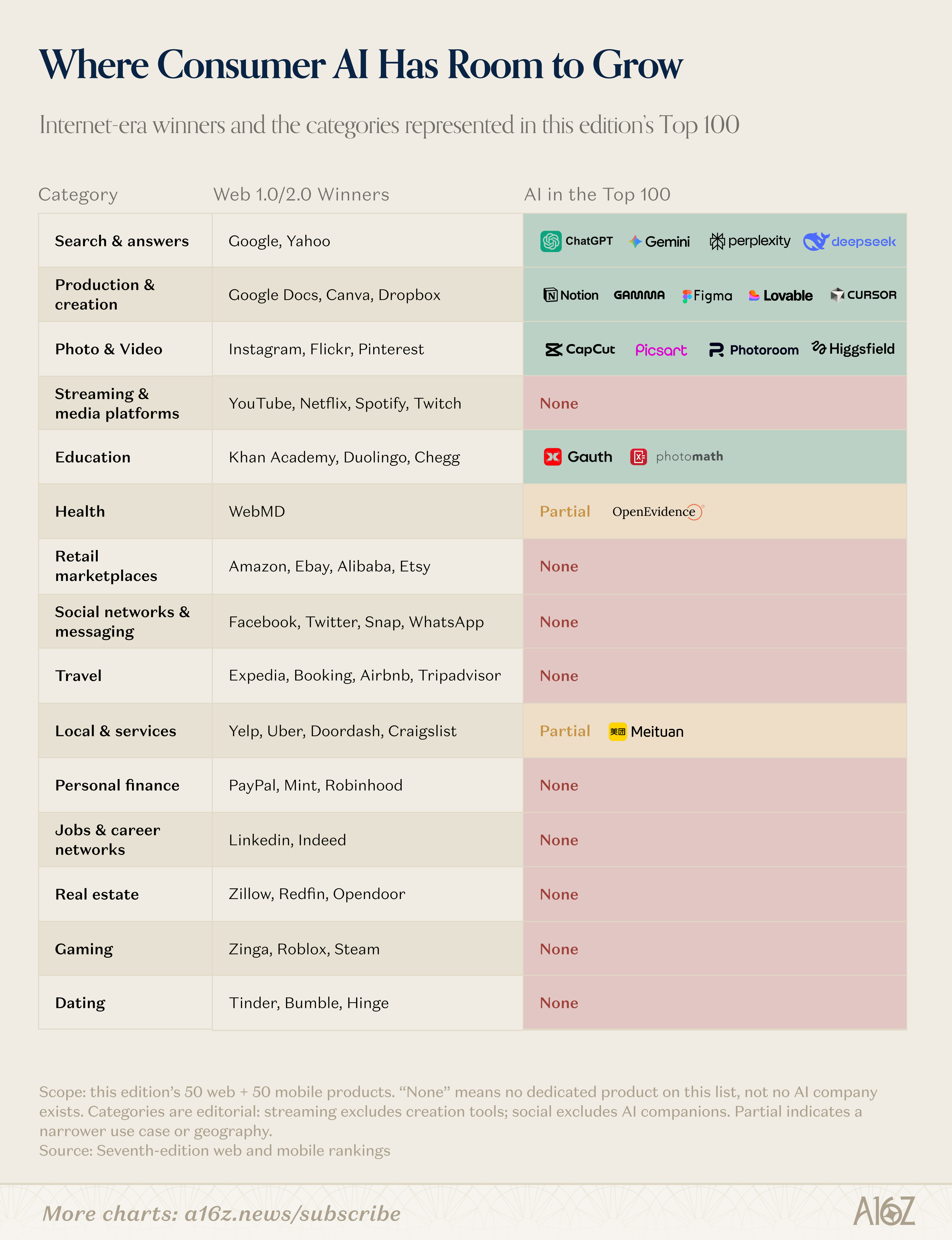
The clearest way to think about what comes next may be to look at the companies that defined the last two consumer internet eras. Many of the biggest businesses were built around transactions and networks - almost none of the top consumer AI products today have any real multi-player appeal. AI may also create categories of consumer attention and spend that we haven’t seen before.思考未来方向最清晰的方式,或许是观察那些定义了过去两个消费互联网时代的公司。许多最大的业务都是围绕交易和网络构建的——而当今顶级的消费级 AI 产品几乎没有任何真正的多用户互动吸引力。AI 也可能会创造出我们从未见过的消费者关注和消费类别。
5. Most consumer AI products monetize via subscription. We need new business models.5. 大多数消费级 AI 产品通过订阅变现。我们需要新的商业模式。
Consumer AI has found an audience - but as our revenue data shows, deep usage remains fairly constrained.消费级 AI 已经找到了受众,但正如我们的收入数据所示,深度的使用仍然相当受限。
Why? Almost all of the most-trafficked consumer AI companies gate their most valuable features, or even just extended session time, behind a paywall - either subscriptions, or one-off credit purchases. Consumers who can pay for AI are paying a lot, but the vast majority of users still cannot or will not pay for software. In the U.S., only about half of active AI users report that they use it daily.为什么?几乎所有高流量的消费级 AI 公司都将最有价值的功能,甚至仅仅是延长会话时间,置于付费墙之后——要么是订阅,要么是一次性购买额度。能为 AI 付费的消费者支出巨大,但绝大多数用户仍然不能或不愿为软件付费。在美国,只有约一半的活跃 AI 用户表示他们每天使用。
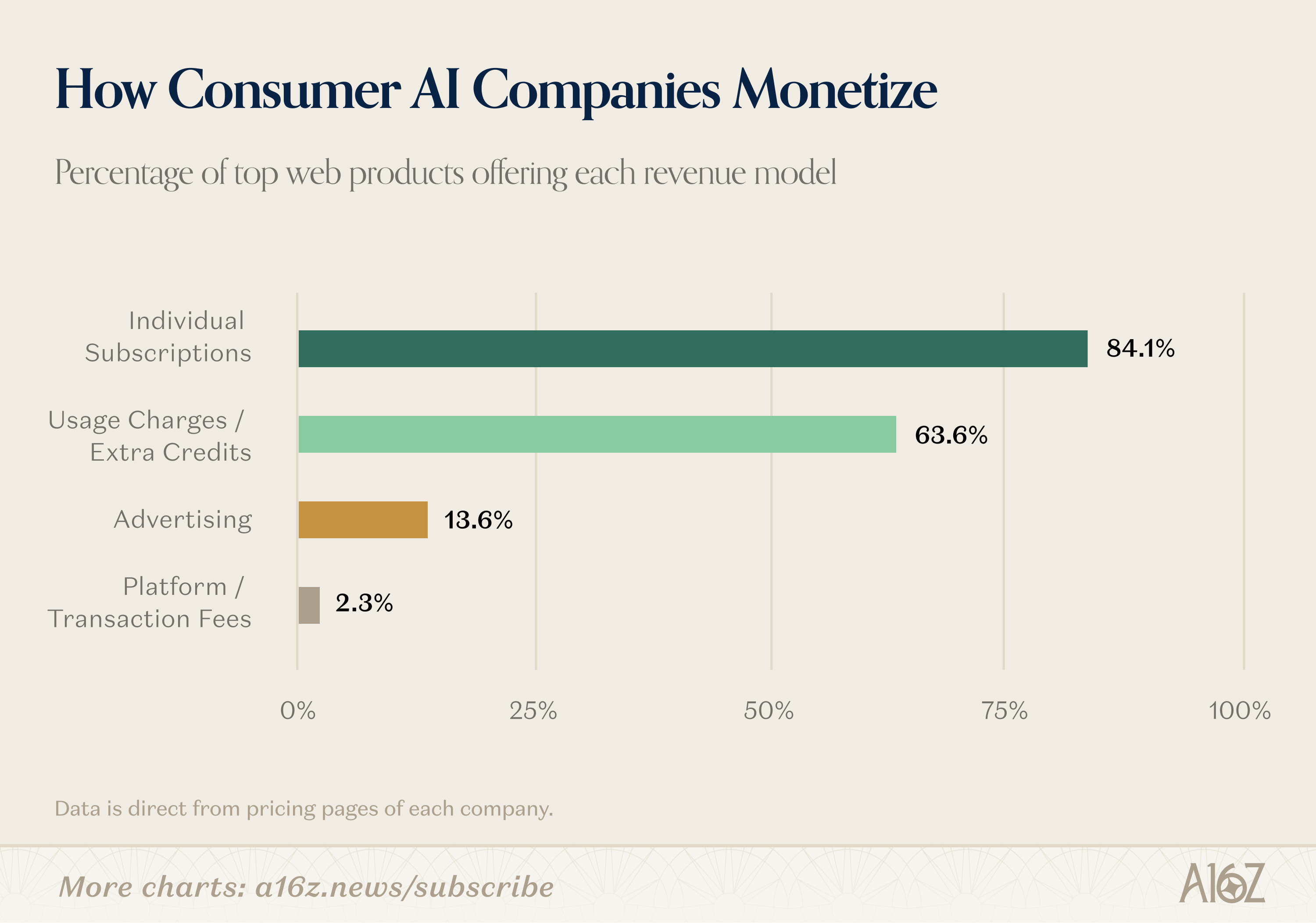
Of the 44 AI-native products in our top web rankings, all of them already have some monetization model live. The most popular by far is paid subscriptions, with 84% of products offering it, followed by usage charges / extra credits at 64% adoption (companies can monetize in multiple ways). Only 14% have ads, and 2% make revenue via transaction or platform fees.在我们网页榜单前 50 名的 44 款 AI 原生产品中,所有产品都已经有了某种变现模式。最受欢迎的无疑是付费订阅,84% 的产品提供该服务,其次是使用费/额外额度,采用率为 64%(公司可以采用多种方式变现)。仅有 14% 的产品有广告,2% 通过交易或平台费获取收入。
This is an inversion of the pre-AI consumer Internet, where consumers were the product instead of paying for the product. In 2025, advertising generated 97.6% of Meta’s revenue and 73.2% of Alphabet’s. Amazon’s separately reported subscription-services business generated $49.6 billion, but represented just 6.9% of its total revenue.这是 AI 时代前消费互联网的一种倒置,当时消费者是产品的一部分,而不是为产品付费。2025 年,广告收入占 Meta 总收入的 97.6%,占 Alphabet 总收入的 73.2%。亚马逊单独报告的订阅服务业务收入为 496 亿美元,但仅占其总收入的 6.9%。
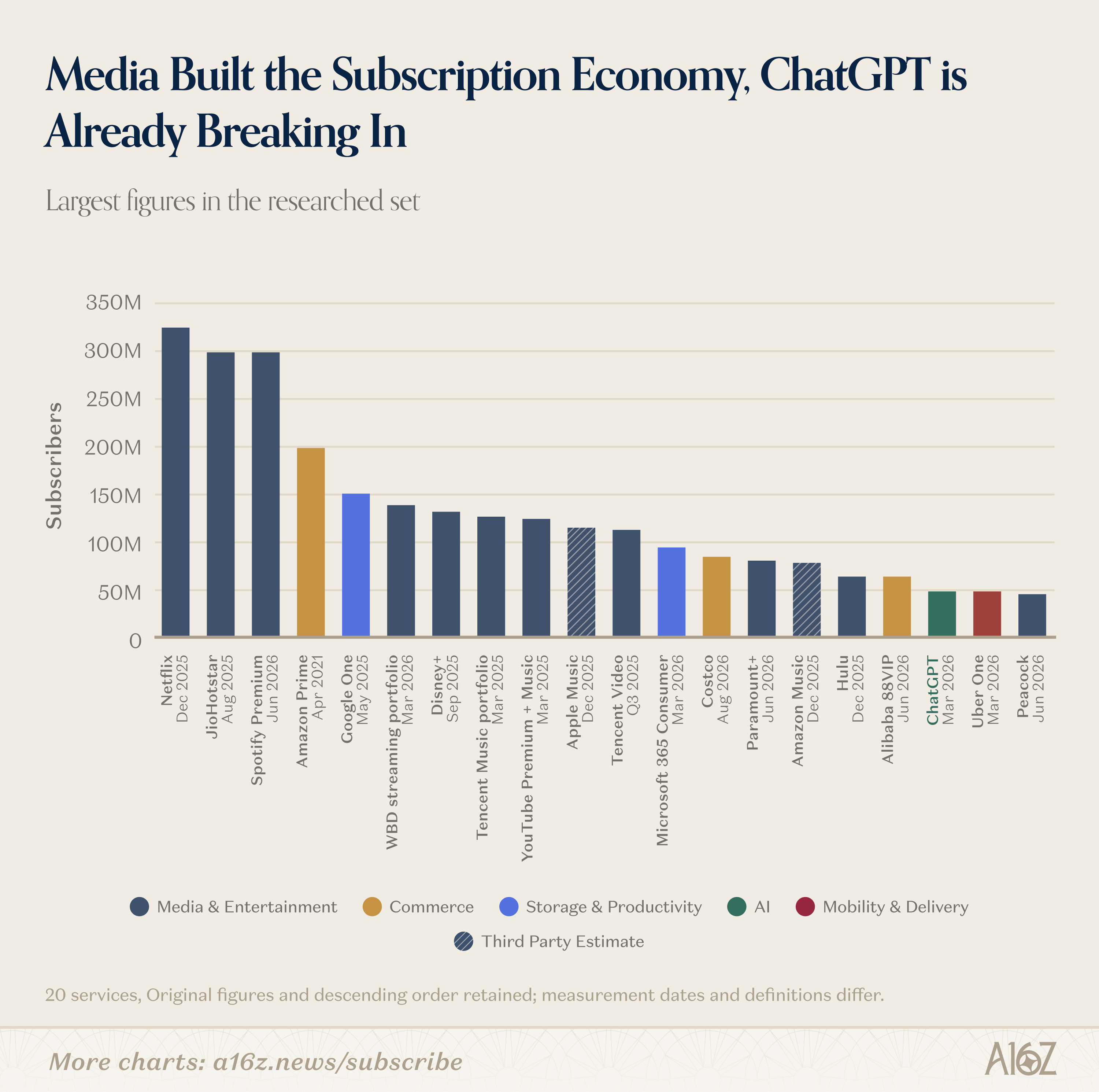
Subscriptions are not an unprecedented model for massive consumer businesses, but they’ve largely been concentrated in media - where users are paying for proprietary content, or ad-free access to it. Of the top 20 global consumer subscription products, 65% are media businesses (Netflix, Hotstar, Spotify, etc). ChatGPT already ranks in the top 20 with three and a half years of growth - representing how difficult it is to build a massive paid consumer subscriber base.订阅对于大型消费业务来说并非前所未有的模式,但它们主要集中在媒体领域——用户为专有内容或无广告体验付费。在全球前 20 大消费级订阅产品中,65% 是媒体企业(Netflix、Hotstar、Spotify 等)。ChatGPT 凭借三年半的增长已跻身前 20 名——这体现了构建庞大的付费消费者订阅基础是多么困难。
There is a good reason why AI companies monetize via subscription or credits. Selling ads or making transactional revenue often requires a large user base. When users were nearly free to serve, consumer companies could fairly easily eat the burn to build density. But given high model costs, forgoing early revenue has not been an option in consumer AI. In all likelihood, this will get easier as open source models continue to proliferate - and as product builders can separate tasks that need the most expensive frontier models from those that can use cheaper intelligence.AI 公司通过订阅或额度变现是有充分理由的。销售广告或获取交易收入通常需要庞大的用户群。当服务用户的成本几乎为零时,消费级公司可以相对轻松地通过烧钱来建立密度。但考虑到高昂的模型成本,在消费级 AI 中放弃早期收入并非选项。很可能随着开源模型的持续激增,以及产品构建者能够将需要昂贵前沿模型的任务与可以使用廉价智能的任务区分开来,这种情况会变得更容易。
As more consumer AI products reach scale, we are also starting to see other business models emerge. OpenAI said ChatGPT advertising reached a $1 billion annualized revenue run rate in August, on a base that totals 1.2 billion weekly active users. An estimated 50-60% of U.S. physicians use OpenEvidence, which also now (partially) monetizes via ads.随着越来越多的消费级 AI 产品达到规模化,我们也开始看到其他商业模式的出现。OpenAI 表示,8 月份 ChatGPT 广告业务的年化收入运行率达到了 10 亿美元,其周活跃用户总数达 12 亿。据估计,50-60% 的美国医生使用 OpenEvidence,该平台目前也(部分)通过广告变现。
Personal agents could open another path, as consumers are now making attributable purchases entirely via AI. The standard model might look like an affiliate fee or take rate. Both Instinct and Muse have described plans to earn a fee from transactions over time, though neither is doing this yet - and ChatGPT also currently does not charge for purchases that start in-product.个人智能体可能开辟另一条路径,因为消费者现在完全可以通过 AI 进行可归因的购买。标准模式可能看起来像联盟佣金或抽成。Instinct 和 Muse 都描述过未来通过交易赚取费用的计划,尽管目前尚未实施——ChatGPT 目前也不会对产品内发起的购买行为收费。
Our spending data shows how valuable AI has become to people who use it to build, create, and get work done. The next opportunity is to make it just as useful for more of everyday life. Subscriptions will remain a natural fit for many of those products. Advertising and transaction fees could give founders more ways to serve consumers - and, give consumers a real shot at accessing the magic of AI.我们的支出数据表明,对于那些利用 AI 构建、创作和完成工作的人来说,AI 已经变得多么重要。下一个机会是让它在日常生活中发挥同样的作用。订阅对于许多此类产品来说仍将是自然的选择。广告和交易费可以为创始人提供更多服务消费者的途径,并让消费者真正有机会触及 AI 的魔力。



This newsletter is provided for informational purposes only, and should not be relied upon as legal, business, investment, or tax advice. Furthermore, this content is not investment advice, nor is it intended for use by any investors or prospective investors in any a16z funds. This newsletter may link to other websites or contain other information obtained from third-party sources - a16z has not independently verified nor makes any representations about the current or enduring accuracy of such information. If this content includes third-party advertisements, a16z has not reviewed such advertisements and does not endorse any advertising content or related companies contained therein. Any investments or portfolio companies mentioned, referred to, or described are not representative of all investments in vehicles managed by a16z; visit https://a16z.com/investment-list/ for a full list of investments. Other important information can be found at a16z.com/disclosures. You’re receiving this newsletter since you opted in earlier; if you would like to opt out of future newsletters you may unsubscribe immediately.本通讯仅供参考,不应被视为法律、商业、投资或税务建议。此外,本内容并非投资建议,也不旨在供 a16z 基金的任何投资者或潜在投资者使用。本通讯可能链接到其他网站或包含从第三方来源获取的其他信息——a16z 未对该等信息的当前或持续准确性进行独立验证,也不作任何陈述。如果本内容包含第三方广告,a16z 未审查此类广告,也不认可其中包含的任何广告内容或相关公司。提及、引用或描述的任何投资或投资组合公司并不代表 a16z 管理的工具中的所有投资;访问 https://a16z.com/investment-list/ 获取完整投资列表。其他重要信息可在 a16z.com/disclosures 找到。您收到此通讯是因为您之前选择了订阅;如果您希望退订未来的通讯,可以立即取消订阅。


