The idea of a youngster vacillating between whether to become a magician or join the Central Intelligence Agency may sound implausible, but those two working environments have deeper commonalities than it would seem. So, in any case, believes John McLaughlin, whose more than 30 years at the CIA included periods as its deputy director and acting director. He also describes himself as a lifelong amateur magician, an avocation that owes much to his boyhood discovery of Quicker Than the Eye, a magic manual from 1932 by one John Mulholland. Around the same time the young McLaughlin came across that book in the library, Mulholland was writing the more specialized guidebooks Some Operational Applications of the Art of Deception and Recognition Signals — though nobody without a serious security clearance would have known it.一个年轻人徘徊在“成为魔术师”还是“加入中央情报局”之间的想法听起来可能不太可信,但这两个工作环境之间有着比表面看起来更深层的共同点。至少,约翰·麦克劳林(John McLaughlin)是这样认为的,他在中情局工作了三十多年,期间曾担任副局长和代理局长。他还称自己是一位终身业余魔术师,这一爱好很大程度上归功于他童年时发现的一本名为《比眼快》(Quicker Than the Eye)的魔术手册,该书由约翰·穆霍兰德(John Mulholland)于1932年编写。就在年轻的麦克劳林在图书馆偶然发现那本书的同一时期,穆霍兰德正在撰写更专业的指南《欺骗艺术的某些应用》(Some Operational Applications of the Art of Deception)和《识别信号》(Recognition Signals)——尽管没有高级安全许可的人对此一无所知。
In 1953, Mulholland left his position as editor of the magicians’ trade magazine The Sphinx, ostensibly for health reasons, but actually to go to work for the CIA. Formed just six years before, the organization was still determining what its mission of preventing surprise foreign attacks against the U.S. and countering the global advance of communism would entail on the ground. To anyone who’s made enough of a habit of novels and films dealing with Cold War espionage, it may come as no surprise that the arts of disguise, misdirection, and sleight of hand practiced by master magicians would look useful indeed to the CIA. “Just as a magician’s methods must elude detection in front of a closely attentive audience,” writes McLaughlin, “so an intelligence officer doing espionage work must elude close surveillance and pass messages and materiel without detection.”1953年,穆霍兰德辞去了魔术师行业杂志《斯芬克斯》(The Sphinx)编辑的职务,表面上是因为健康原因,但实际上是为了去中情局工作。该组织成立于六年前,当时还在摸索其“防止美国遭受突发外国袭击”和“对抗全球共产主义扩张”的使命在实地操作中意味着什么。对于那些习惯了冷战间谍小说和电影的人来说,大师级魔术师所运用的伪装、误导和手法技巧对中情局来说确实有用,这并不令人惊讶。麦克劳林写道:“正如魔术师的方法必须在全神贯注的观众面前避开察觉一样,从事间谍活动的情报官员也必须避开严密的监视,并在不被发现的情况下传递信息和物资。”
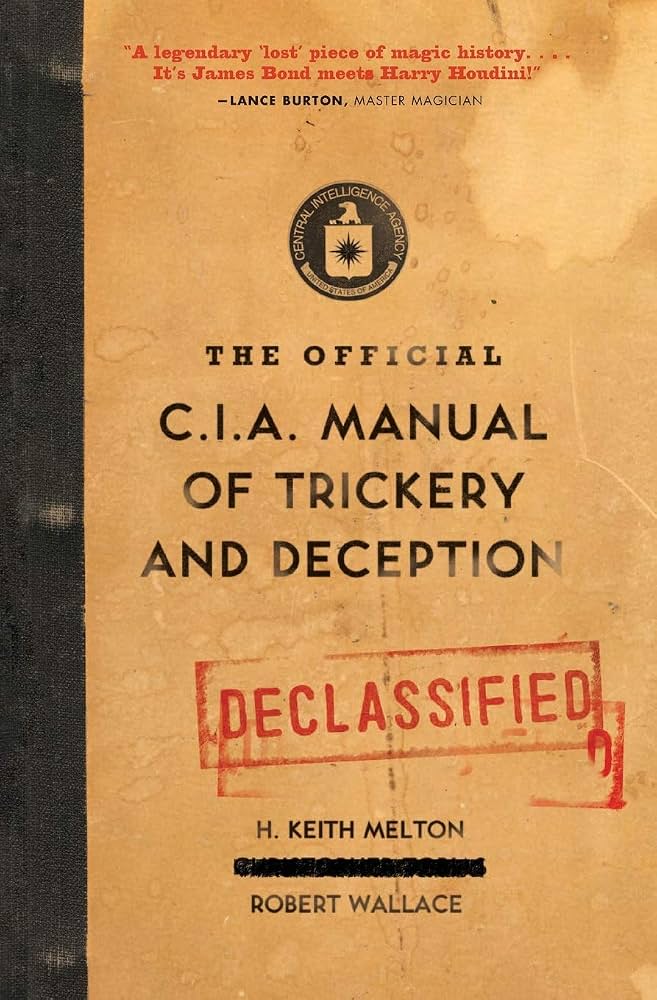
Additionally, “analysts must be as familiar as magicians with methods of deception, because analysts are almost always working with incomplete information and in circumstances where an adversary is seeking to mislead them — or in the magician’s term, misdirect them.” The Company’s specialists in counterintelligence described their subfield as a “wilderness of mirrors,” an expression professional illusionists must find especially evocative. Commissioned in the time of the CIA’s human-experimentation program MKULTRA, previously featured here on Open Culture, Mulholland’s manuals were long assumed officially destroyed along with many other of its documents in 1973. After they unexpectedly resurfaced during declassification in the two-thousands, they were published in The Official CIA Manual of Trickery and Deception by Agency historians H. Keith Melton and Robert Wallace. You can find a copy over at the Internet Archive.此外,“分析师必须像魔术师一样熟悉欺骗手段,因为分析师几乎总是在信息不全的情况下工作,而且是在对手试图误导他们——或者用魔术师的术语来说,是‘误导’(misdirect)他们——的情况下工作。”中情局的反间谍专家将他们的细分领域描述为“镜子荒原”(a wilderness of mirrors),职业幻术师一定会觉得这个表达格外传神。穆霍兰德的手册编写于中情局人体实验项目“MKULTRA”时期(Open Culture此前曾报道过),长期以来人们一直认为它与该机构的其他许多文件一起在1973年被正式销毁。在21世纪解密过程中,这些手册意外重现,随后由中情局历史学家H·基思·梅尔顿(H. Keith Melton)和罗伯特·华莱士(Robert Wallace)整理出版为《中情局官方欺诈与伪装手册》(The Official CIA Manual of Trickery and Deception)。你可以在互联网档案馆(Internet Archive)找到副本。
At that time, the Boston Globe published illustrated explanations of some of Mulholland’s techniques, such as transporting spies using a mechanism similar to the one that conceals an apparently sawed-in-half stagehand, or surreptitiously dropping into a drink a pill affixed to the back of a book of matches. Amid “the superpower struggle for power and influence around the world,” writes Tom Scocca, “both the ideas and techniques of secret war pervaded the culture — the corrosive belief in hidden conspiracy and the nifty thrill of spycraft itself, the codes and disguises and miniature cameras.” Today, “Mulholland’s account of real-world stagecraft amounts to an etiquette manual for a lost moment of history. The matchbook trick depends on people smoking and drinking. There is a survey of the many pockets found in every man’s suit, and which ones are most natural for casually slipping objects into.” However much of the romance has drained out of espionage — as it has from so much else since the mid-twentieth century — the best magicians know that old tricks can always be re-enchanted for a new world. You can read The Official CIA Manual of Trickery and Deception here.当时,《波士顿环球报》刊登了穆霍兰德部分技术的图解说明,例如使用类似于隐藏舞台上“被锯成两半的助手”的装置来运送间谍,或者不动声色地将贴在火柴盒背面的药丸掉进饮料里。汤姆·斯科卡(Tom Scocca)写道,在“全球争夺权力和影响力的超级大国斗争”中,“秘密战争的理念和技术渗透到了文化之中——对隐藏阴谋的腐蚀性信仰,以及间谍活动本身带来的巧妙快感,包括密码、伪装和微型相机。”如今,“穆霍兰德对现实世界舞台技巧的描述,相当于一段逝去历史的礼仪手册。火柴盒戏法依赖于人们抽烟喝酒的习惯。书中还调查了每件男士西装上都有的许多口袋,以及哪些口袋最适合随手塞入物品。”尽管间谍活动中的浪漫色彩已像20世纪中期以来的许多事物一样消退,但最优秀的魔术师知道,古老的戏法总能为新世界重新焕发魅力。你可以在此处阅读《中情局官方欺诈与伪装手册》。
Related content:相关内容:
12 Million Declassified CIA Documents Now Free Online: Secret Tunnels, UFOs, Psychic Experiments & More1200万份解密中情局文件现可在线免费查阅:秘密隧道、UFO、心理实验等
Discover the CIA’s Simple Sabotage Field Manual: A Timeless Guide to Subverting Any Organization with “Purposeful Stupidity” (1944)探索中情局的《简单破坏现场手册》:一部通过“有目的的愚蠢”颠覆任何组织的永恒指南(1944年)
The CIA’s Former Chief of Disguise Show How Spies Use Costumes in Undercover Operations中情局前伪装主管演示间谍如何在卧底行动中使用服装
Inside MKUltra, the CIA’s Secret Program That Used LSD to Achieve Mind Control (1953–1973)深入了解MKULTRA:中情局利用LSD实现精神控制的秘密计划(1953–1973年)
When the CIA Studied Psychic Techniques to Alter Human Consciousness & Unlock Time Travel: Discover “The Gateway Process”当中情局研究心理技术以改变人类意识并解锁时间旅行时:探索“网关流程”(The Gateway Process)
The CIA’s Rectal Tool Kit for Spies — Created for Truly Desperate Situations During The Cold War中情局的间谍直肠工具包——为冷战期间真正绝望的情况而设计
Based in Seoul, Colin Marshall writes and broadcasts on cities, language, and culture. He’s the author of the newsletter Books on Cities as well as the books 한국 요약 금지 (No Summarizing Korea) and Korean Newtro. Follow him on the social network formerly known as Twitter at @colinmarshall.科林·马歇尔(Colin Marshall)常驻首尔,从事有关城市、语言和文化的写作与广播。他是时事通讯《城市书籍》(Books on Cities)的作者,也著有《韩国摘要禁止》(한국 요약 금지)和《韩国新复古》(Korean Newtro)等书。请在曾被称为Twitter的社交网络上关注他:@colinmarshall。




Fascinated by Central Intelligence Agency operations, I consider integrating a magician into the organizational framework an act of profound ingenuity. Should additional declassified, intelligence-related materials become available, kindly transmit hyperlinks to the designated electronic mail address.
I’m only receiving 1221.oo a month in disability and still holding a sign for money. It’s little is never a nough. I pay my rent 340.oo . And only spend 165 a week .it’s hard to pay nothing .I eat at 130 a week anyways . How does this little pay.