Toward provably private learning from federated data迈向可证明的联邦数据隐私学习
October 2, 20262026年10月2日
Katharine Daly, Software Engineer, and Daniel Ramage, Research Director, Google ResearchKatharine Daly,软件工程师;Daniel Ramage,Google Research 研究总监
We announce a new Federated Learning system that provides externally verifiable privacy guarantees while shifting computation to the server to improve training speed, accuracy, and device coverage.我们宣布推出一套全新的联邦学习系统,它在提供外部可验证隐私保证的同时,将计算转移到服务器端,从而提高了训练速度、准确性和设备覆盖率。
Quick links
In 2017, Google introduced Federated Learning (FL) a machine learning technique that trains models across decentralized, private data. It has been used to power everyday helpful features, including next-word prediction and Smart Compose on Gboard, reply suggestions in Google Messages, and Smart Text Selection in Android.2017年,Google 推出了联邦学习(FL),这是一种跨去中心化私有数据训练模型的机器学习技术。它已被用于支持日常的实用功能,包括 Gboard 上的下一个词预测和智能撰写(Smart Compose)、Google 信息应用中的回复建议,以及 Android 系统的智能文本选择功能。
Our FL systems development is guided by four essential privacy principles: (1) data minimization, (2) data anonymization, (3) transparency and control, and (4) verifiability and auditability. Years of research development on anonymization have led to strong differential privacy (DP) guarantees for production models through algorithms like matrix factorization DP-FTRL (MF-DP-FTRL) and distributed differential privacy coupled with Secure Aggregation. In 2025, we introduced an evolved definition of FL centered on these four principles:我们的联邦学习系统开发遵循四项基本隐私原则:(1)数据最小化;(2)数据匿名化;(3)透明度与控制;(4)可验证性与可审计性。多年来在匿名化方面的研究开发,通过矩阵分解 DP-FTRL (MF-DP-FTRL) 等算法以及结合安全聚合(Secure Aggregation)的分布式差分隐私(DP),为生产模型带来了强大的差分隐私保证。2025年,我们围绕这四项原则提出了联邦学习的演进定义:
Federated learning (FL) is a machine learning setting where multiple entities (clients) collaborate in solving a machine learning problem, under the coordination of a service provider. A complete FL system should enable clients to maintain full control over their data, the set of workloads allowed to access their data, and the anonymization properties of those workloads. FL systems should provide appropriate transparency and control to the users whose data is managed by FL clients.联邦学习(FL)是一种机器学习环境,其中多个实体(客户端)在服务提供商的协调下协作解决机器学习问题。一个完整的联邦学习系统应使客户端能够完全控制其数据、允许访问其数据的作业集,以及这些作业的匿名化属性。联邦学习系统应向其数据由联邦学习客户端管理的用户提供适当的透明度和控制权。
In “Toward provably private learning from federated data”, we announce the next generation of our FL system, which leverages Trusted Execution Environments (TEEs) to provide fully verifiable and auditable data anonymization guarantees. Logic that runs in TEEs is remotely attestable (third parties can verify the logic that is being executed), and it also gains confidentiality (its internal state cannot be observed) and integrity (the logic cannot be disrupted), subject to current-generation TEE limitations. Our new TEE-based FL system builds on these properties which TEEs offer at the level of a single machine to form a fully verifiable end-to-end FL system that achieves stronger privacy guarantees and improved accuracy. Gboard has already adopted the new system and is benefiting from substantially faster compute times than our previous FL system.在《迈向可证明的联邦数据隐私学习》一文中,我们宣布了下一代联邦学习系统。该系统利用可信执行环境(TEE)提供完全可验证且可审计的数据匿名化保证。在 TEE 中运行的逻辑是可远程证明的(第三方可以验证正在执行的逻辑),并且在当前一代 TEE 的限制范围内,它还获得了机密性(其内部状态无法被观察)和完整性(逻辑无法被破坏)。我们基于 TEE 的新联邦学习系统利用了 TEE 在单机层面提供的这些属性,构建了一个完全可验证的端到端联邦学习系统,从而实现了更强的隐私保证和更高的准确性。Gboard 已经采用了这套新系统,并受益于比我们之前的联邦学习系统显著更快的计算时间。
Building a verifiably private FL system out of individual TEEs基于单个 TEE 构建可验证的隐私联邦学习系统
Our TEE-based FL system builds on techniques developed in our earlier work on confidential federated analytics and provably private insights.我们基于 TEE 的联邦学习系统建立在我们早期关于机密联邦分析和可证明隐私洞察的研究技术之上。
The system coordinates four core operational concepts:该系统协调四个核心操作概念:
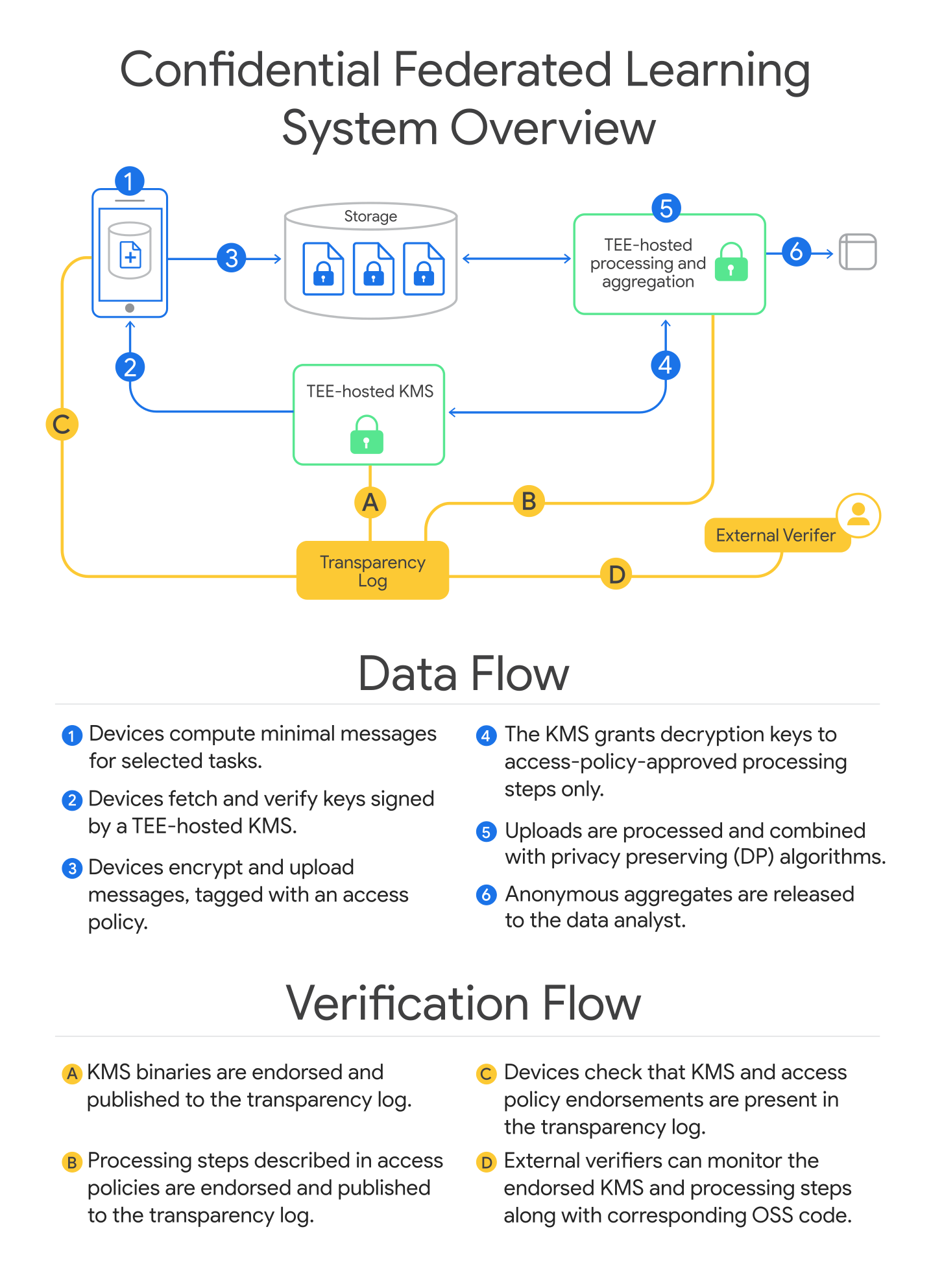
- Data upload: Client devices locally encrypt training examples and upload them. The devices pre-authorize an access policy, which is the set of TEE computations that will be allowed to process this data, and these computations only release anonymized results. Clients require access policies to be published to a public transparency log.数据上传:客户端设备在本地加密训练样本并上传。设备预先授权一项访问策略,即允许处理此数据的 TEE 计算集合,且这些计算仅发布匿名化结果。客户端要求将访问策略发布到公共透明度日志中。
- KMS and policy verification: The Key Management System (KMS), which consists of a cluster of TEEs implementing the RAFT consensus protocol, only gives decryption keys to server-side TEE workloads that match the computations in the access policy.KMS 与策略验证:密钥管理系统(KMS)由一组实现 RAFT 共识协议的 TEE 集群组成,它仅向符合访问策略中计算要求的服务器端 TEE 工作负载提供解密密钥。
- Workload execution: A data processing TEE executes a Python program that implements a training loop. This "root" TEE delegates parallelizable subtasks to a cluster of worker TEEs. Distributed logic is expressed using Federated Language, an open-source, framework-agnostic orchestration language derived from TensorFlow Federated, which powered our earlier FL system. The training loop periodically releases anonymized model weights to the data analyst.工作负载执行:数据处理 TEE 执行实现训练循环的 Python 程序。此“根”TEE 将可并行化的子任务委托给一组工作者 TEE。分布式逻辑使用 Federated Language 表达,这是一种源自 TensorFlow Federated(我们早期联邦学习系统的驱动力)的开源、框架无关的编排语言。训练循环会定期向数据分析师发布匿名化的模型权重。
- Fault-tolerant recovery: The Python program saves a KMS-encrypted recovery state at the end of the training round. This can be used to recover from intermittent root or worker failures, without leaking any additional privacy-sensitive information.容错恢复:Python 程序在训练轮次结束时保存一个经 KMS 加密的恢复状态。这可用于从间歇性的根或工作者故障中恢复,且不会泄露任何额外的隐私敏感信息。
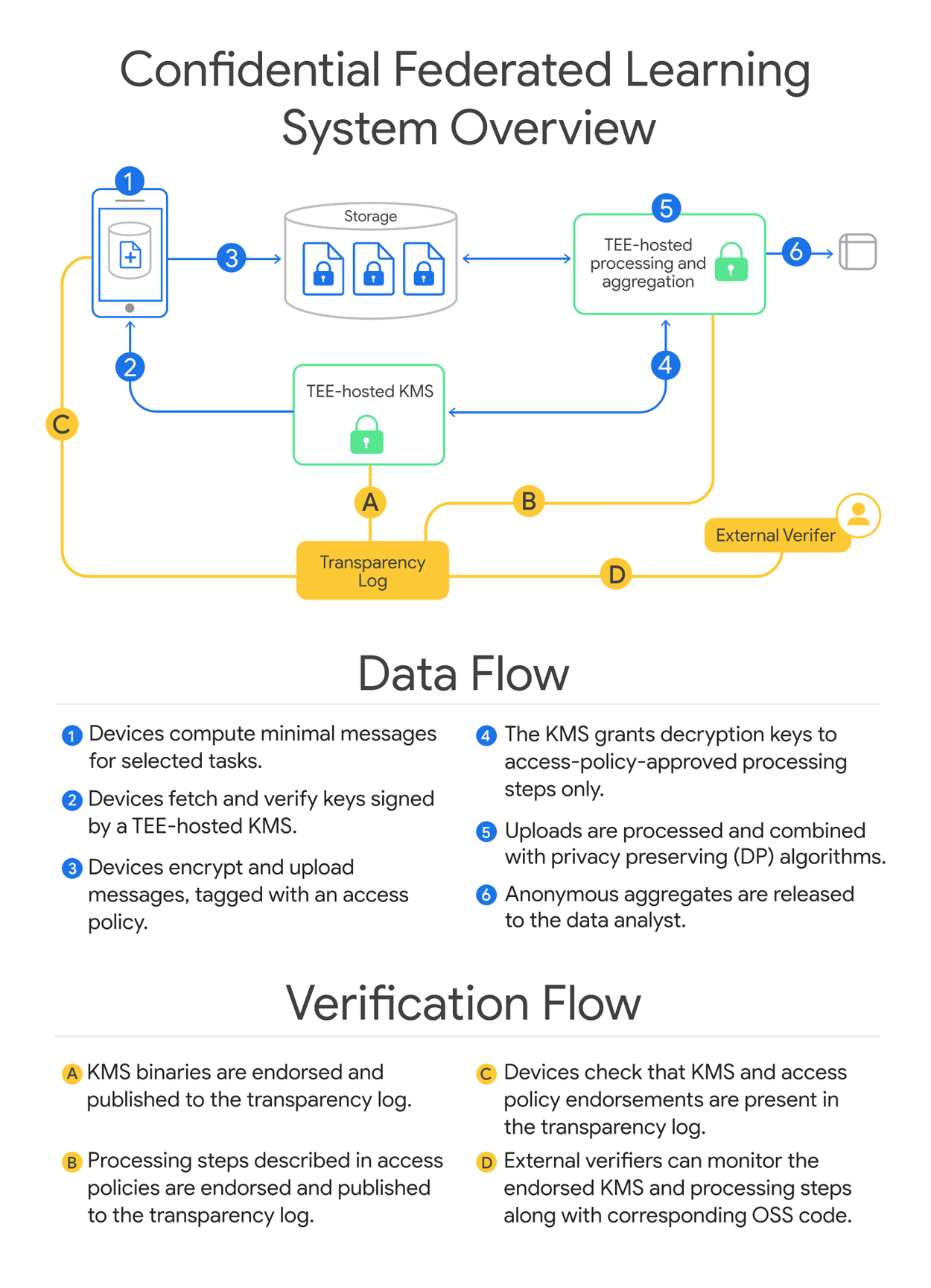
This diagram shows both the flow of data through the system as well as the steps needed to validate the privacy guarantees of workloads running on the system.该图表展示了数据在系统中的流动过程,以及验证在系统上运行的工作负载的隐私保证所需的步骤。
For more details on the TEE-based FL system design please see our whitepaper, Toward provably private learning from federated data.关于基于 TEE 的联邦学习系统设计的更多详情,请参阅我们的白皮书《迈向可证明的联邦数据隐私学习》。
How TEE-based FL strengthens privacy基于 TEE 的联邦学习如何加强隐私保护
In earlier FL systems, device data was uploaded for the purpose of immediate aggregation, but there was no way for external observers to verify that the data was never logged or inspected. Later, Secure Aggregation allowed uploads to be protected cryptographically, but was not compatible with state-of-the-art central DP guarantees. Our new TEE-based system represents the next milestone in our ongoing effort to completely remove the need to trust the server operator.在早期的联邦学习系统中,设备数据被上传以进行即时聚合,但外部观察者无法验证数据是否从未被记录或检查。后来,安全聚合允许对上传内容进行加密保护,但与最先进的中心化差分隐私(DP)保证不兼容。我们新的基于 TEE 的系统代表了我们持续努力彻底消除对服务器运营商信任这一目标的一个新里程碑。
In our new TEE-based FL system, only metrics and differentially private model weights are visible to workload operators. Encrypted training data collected from devices can only be decrypted and processed within TEEs running Python training programs represented in the access policies, and only for a limited amount of time after upload.在我们新的基于 TEE 的联邦学习系统中,只有指标和经过差分隐私处理的模型权重对工作负载操作员可见。从设备收集的加密训练数据只能在运行访问策略中定义的 Python 训练程序的 TEE 内进行解密和处理,且仅在上传后的有限时间内有效。
Public transparency log and reproducible builds公共透明度日志与可复现构建
Devices participating in our new TEE-based FL system know the full set of server workloads that may access data they’re uploading. The access policies representing these potential future server workloads are published to Rekor, a public transparency log, and external auditors are able to observe these logs to track the full set of server-side workloads that devices could potentially be participating in.参与我们新系统中的设备了解所有可能访问其上传数据的服务器工作负载集合。代表这些潜在未来服务器工作负载的访问策略会被发布到 Rekor(一个公共透明度日志)中,外部审计人员可以观察这些日志,以跟踪设备可能参与的所有服务器端工作负载。
The KMS and data processing binaries used in our FL system can be reproducibly built from open source code published in the Confidential Federated Compute Github repository.我们联邦学习系统中使用的 KMS 和数据处理二进制文件,可以从发布在 Confidential Federated Compute GitHub 仓库中的开源代码进行可复现构建。
Verifiable execution with dynamic sideloading具有动态侧加载的可验证执行
In our earlier FL systems, the logic running on the server could be verified neither by devices nor auditors, and thus we needed to be trusted to correctly add random noise to gradient sums to provide differential privacy.在我们早期的联邦学习系统中,在服务器上运行的逻辑既不能被设备验证,也不能被审计人员验证,因此我们需要被信任能够正确地向梯度和中添加随机噪声以提供差分隐私。
In our new TEE-based FL system, the access policies that are published to Rekor directly describe the Python program that expresses the FL training logic. To protect proprietary model architectures and data preprocessing logic while preserving auditability, our data processing TEEs support sideloading serialized information into the Python program at runtime. As long as all privacy-relevant logic remains hardcoded in the Python program, this sideloading functionality allows logic that must remain proprietary to run in the TEE while still providing strong externally verifiable privacy guarantees (see below for a discussion on side-channel observations).在我们新的基于 TEE 的联邦学习系统中,发布到 Rekor 的访问策略直接描述了表达联邦学习训练逻辑的 Python 程序。为了在保护专有模型架构和数据预处理逻辑的同时保持可审计性,我们的数据处理 TEE 支持在运行时将序列化信息侧加载到 Python 程序中。只要所有与隐私相关的逻辑保持硬编码在 Python 程序中,这种侧加载功能就允许必须保持专有的逻辑在 TEE 中运行,同时仍然提供强大的外部可验证隐私保证(关于侧信道观察的讨论见下文)。
How Gboard is using TEE-based FLGboard 如何使用基于 TEE 的联邦学习
Gboard has deployed this TEE-based FL system to launch English and Japanese next word prediction models with stronger privacy guarantees and improved accuracy. These improvements can be attributed to several aspects of the new system design.Gboard 已经部署了这套基于 TEE 的联邦学习系统,用于推出具有更强隐私保证和更高准确性的英语和日语下一个词预测模型。这些改进归功于新系统设计的几个方面。
Mitigating diurnal availability constraints缓解昼夜可用性限制
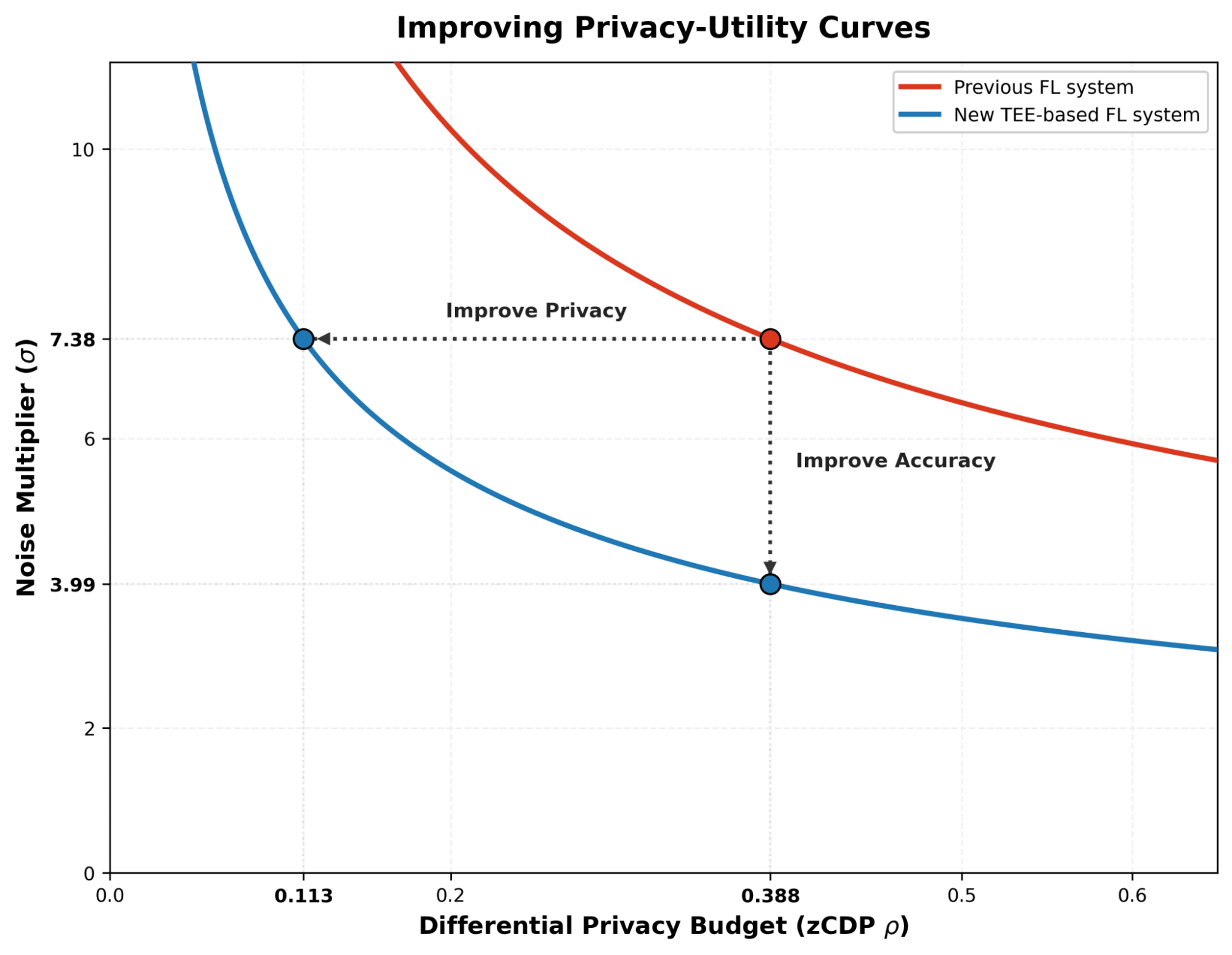
By collecting all device uploads before running the server-side training workload, we no longer have to worry about diurnal variations in device availability impacting training progress. At server-side execution time, we can dynamically calculate the optimal device participation schedule within the program, and can use it to tune other DP parameters.通过在运行服务器端训练工作负载之前收集所有设备上传的数据,我们不再需要担心设备可用性的昼夜变化会影响训练进度。在服务器端执行时,我们可以在程序内动态计算最优的设备参与调度,并利用它来调整其他差分隐私参数。
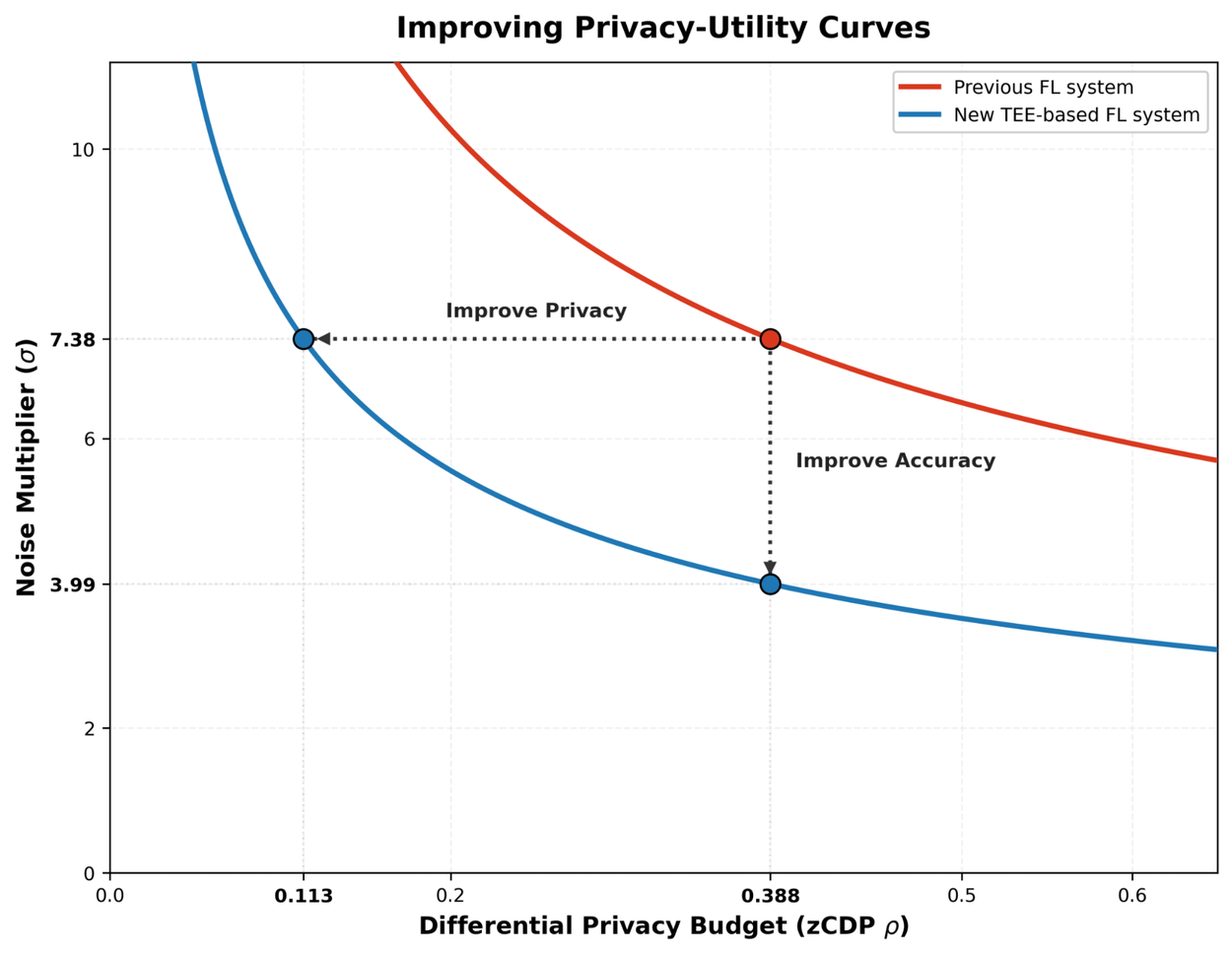
This graph shows the stronger privacy guarantees and/or smaller noise multipliers that become possible with the new TEE-based system by optimizing device participation schedules. These curves were derived from training an English next word prediction model for 5000 rounds with cohorts of 6500 devices on both systems.该图表显示了通过优化设备参与调度,新的基于 TEE 的系统所能实现的更强隐私保证和/或更小的噪声乘数。这些曲线源自两个系统上各使用 6500 台设备组成的群组,对英语下一个词预测模型进行 5000 轮训练的结果。
Training speedups训练加速
In the past, training these FL models could take 1-2 months each, with progress limited by device availability, on-device compute, and competition across multiple training workloads for the same set of device resources. With the new TEE-based system, bottlenecks have been moved to the server, and computation parallelization across many machines allows us to achieve significant speedups in training time, currently only limited by TEE resource availability.过去,训练这些联邦学习模型每个可能需要 1-2 个月,进度受限于设备可用性、设备端计算能力以及多个训练工作负载对同一组设备资源的竞争。有了新的基于 TEE 的系统,瓶颈已转移到服务器,多台机器间的计算并行化使我们能够显著缩短训练时间,目前仅受限于 TEE 资源的可用性。
What’s next?下一步是什么?
In our new TEE-based FL system, computation of client gradients is shifted to the server, lifting limitations related to on-device compute resources that were present in earlier systems. This paves the way for training increasingly larger models using FL techniques. Integrating TEEs with accelerators will play an important role in such use cases.在我们新的基于 TEE 的联邦学习系统中,客户端梯度的计算被转移到服务器,消除了早期系统中存在的设备端计算资源限制。这为使用联邦学习技术训练规模更大的模型铺平了道路。将 TEE 与加速器集成将在这些用例中发挥重要作用。
The system we have described above is capable of executing not just FL training workloads in a verifiable manner, but also arbitrary workloads that can be expressed using Python. We are experimenting with running other types of workloads on this infrastructure, such as synthetic data generation workloads. Another area of exploration: using the data processing TEEs that execute arbitrary Python in combination with our other data processing TEEs that specialize in functionality such as LLM inference.我们上述描述的系统不仅能够以可验证的方式执行联邦学习训练工作负载,还能执行任何可以用 Python 表达的任意工作负载。我们正在试验在此基础设施上运行其他类型的工作负载,例如合成数据生成工作负载。另一个探索领域是:将执行任意 Python 代码的数据处理 TEE 与我们其他专门从事大语言模型推理等功能的数据处理 TEE 结合使用。
This work is a step toward rigorous proof that server side processing preserves individual privacy. With external verifiers able to inspect exactly what code we run at Google, we are able to offer strong assurances that data is processed server-side exactly as described. We expect future TEE hardware, along with ongoing research into mitigating side-channel observations, to offer deeper protections for dynamically loaded workloads against malicious server-side attacks. We anticipate that systems like ours may one day come with full proofs of correctness of the software implementations of the DP algorithms and system components.这项工作是迈向严格证明服务器端处理能保护个人隐私的一步。由于外部验证者能够检查我们在 Google 运行的确切代码,我们能够提供强有力的保证,证明数据在服务器端是按照描述的方式进行处理的。我们预计未来的 TEE 硬件,连同对缓解侧信道观察的持续研究,将为动态加载的工作负载提供针对恶意服务器端攻击的更深层保护。我们预计,像我们这样的系统有朝一日可能会附带完整的差分隐私算法和系统组件软件实现正确性证明。
Acknowledgements致谢
The authors would like to thank the collaborators who contributed to the infrastructure design and implementation: Arun Ganesh, Brendan McMahan, Brett McLarnon, Chunxiang (Jake) Zheng, Emily Glanz, Maya Spivak, Michael Reneer, Nova Fallen, Stefan Dierauf, Suxin Guo, Timon Van Overveldt, Yu Xiao, Zachary Charles, and Zachary Garrett. We also thank close partners who supported the Gboard integration: Haicheng Sun, Heng Su, Jianpeng Hou, Liyang Jiang, Noriyuki Takahashi, Wenzhi Mao, Xiaojuan Fang, Yanxiang Zhang, Yingjie Liu, Yuanbo Zhang, and Yun Wang. This work was supported by Corinna Cortes, Shumin Zhai, and Yossi Matias. We additionally thank Maysam Moussalem for feedback on the writing of this post.作者感谢为基础设施设计和实现做出贡献的合作者:Arun Ganesh、Brendan McMahan、Brett McLarnon、Chunxiang (Jake) Zheng、Emily Glanz、Maya Spivak、Michael Reneer、Nova Fallen、Stefan Dierauf、Suxin Guo、Timon Van Overveldt、Yu Xiao、Zachary Charles 和 Zachary Garrett。我们还要感谢支持 Gboard 集成的密切合作伙伴:Haicheng Sun、Heng Su、Jianpeng Hou、Liyang Jiang、Noriyuki Takahashi、Wenzhi Mao、Xiaojuan Fang、Yanxiang Zhang、Yingjie Liu、Yuanbo Zhang 和 Yun Wang。这项工作得到了 Corinna Cortes、Shumin Zhai 和 Yossi Matias 的支持。此外,我们还要感谢 Maysam Moussalem 对本文撰写提供的反馈。
- Mobile Systems 移动系统
- Security, Privacy and Abuse Prevention 安全、隐私与滥用防范
- Software Systems & Engineering 软件系统与工程
Quick links快速链接
- Paper 论文
Other posts of interest
-
June 26, 2026
Accelerating Gemini Nano models on Pixel with frozen Multi-Token Prediction- Machine Intelligence ·
- Mobile Systems ·
- Natural Language Processing
-

June 10, 2026
New framework for auditing machine unlearning- Algorithms & Theory ·
- Responsible AI ·
- Security, Privacy and Abuse Prevention
-

May 27, 2026
Private analytics via zero-trust aggregation- Security, Privacy and Abuse Prevention