



Are universities still relevant in the age of AI? Will they continue to provide economic value to students and society in the coming years? Can they survive AI disruption?在 AI 时代,大学还有存在的意义吗?未来几年,它们还能继续为学生和社会提供经济价值吗?它们能从 AI 的颠覆中存活下来吗?
Over the past few years, we have watched AI models become as capable as or more capable than humans in most cognitively valuable fields, and many young people today are deeply uncertain about the skills and career paths least likely to be undermined by AI advancements.过去几年里,我们目睹了 AI 模型在大多数具有认知价值的领域变得与人类相当甚至更胜一筹。如今,许多年轻人对于哪些技能和职业道路最不容易受到 AI 进步的冲击,感到深深的不安。
We have also seen AI enter schools and universities as students use it for homework, projects, and as a learning assistant, while teachers struggle to adapt their materials and teaching methods to this emerging ‘co-learning’ environment.我们也看到 AI 进入了学校和大学,学生们将其用于家庭作业、项目和学习辅助,而教师们则在努力调整教材和教学方法,以适应这种新兴的“共同学习”环境。
Many watch these developments and declare that universities are dead and that pursuing a degree is a useless or futile endeavor.许多人观察到这些发展,便断言大学已死,攻读学位是一项毫无用处或徒劳的努力。
Maybe not, if they evolve and reshape their mission.如果大学能够进化并重塑其使命,或许并非如此。
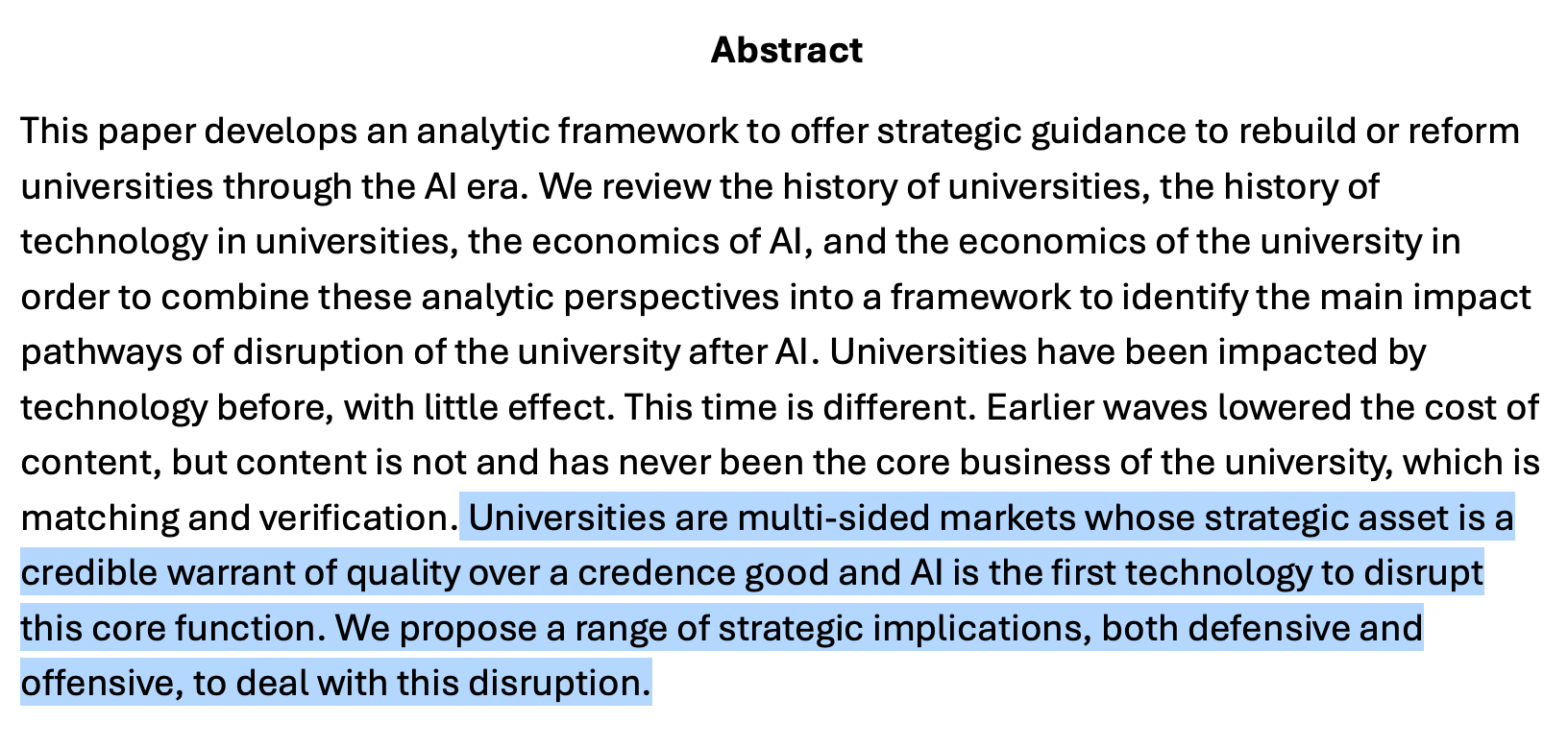
In his new paper, “The University after AI,” Jason Potts offers a fascinating analysis of the role, function, and value of universities, explaining in detail how AI is disrupting them and putting them at risk of becoming irrelevant in the post-AI age.杰森·波茨(Jason Potts)在其新论文《AI 时代下的大学》(The University after AI)中,对大学的角色、功能和价值进行了引人入胜的分析,详细解释了 AI 如何颠覆大学,并使其面临在后 AI 时代变得无关紧要的风险。
When describing universities, he writes:在描述大学时,他写道:
“A university is a self-governing micro-republic, corporate in form, approximately 1000 years old (older than nation states, younger than religion), that exists within but always apart from society (for instance they often have their own police and justice tribunals), and which serves as the custodian of knowledge, creator of new knowledge, and whose primary business is to upload that knowledge into a select group of the next generation. This is a service that students want and that society is willing to pay for.”“大学是一个自治的微型共和国,形式上是公司制的,拥有大约 1000 年的历史(比民族国家古老,比宗教年轻),它存在于社会之中,但始终独立于社会(例如,它们通常拥有自己的警察和司法法庭),它是知识的保管者、新知识的创造者,其主要业务是将这些知识传授给下一代中的特定群体。这是学生想要且社会愿意付费的服务。”
He also states:他还指出:
“A university, then, is neither a cloister nor a factory but a platform, or a multi-sided market whose primary economic function is to reduce the transaction costs of matching distinct groups who wish to trade with one another.”“因此,大学既不是修道院也不是工厂,而是一个平台,或者说是一个多边市场,其主要的经济功能是降低匹配那些希望相互交易的不同群体之间的交易成本。”
In light of the threat posed by AI, the author offers the following ten proposals to restructure the role, function, and value of universities:鉴于 AI 带来的威胁,作者提出了以下十项重构大学角色、功能和价值的建议:
Institutionally separate certification from instruction在制度上将认证与教学分离
Restore the costly signal恢复昂贵的信号传递
Rebuild the missing junior loop重建缺失的初级环节(junior loop)
Fast-response accreditation快速响应的认证机制
Sell the cohort销售群体价值(cohort)
Host scholars rather than employ them接待学者而非雇佣学者
Move to the new frontier向新前沿领域进军
Shed sides精简冗余方
Make the claim on graduate outcomes explicit明确毕业生预期成果
Governance as the production technology of the warrant将治理作为授权的生产技术
The paper offers a fantastic economic analysis of AI’s impact on this 1,000-year-old institution, informs broader discussions on AI ethics, policy, and regulation, and makes for a great weekend read.这篇论文对 AI 对这一千年机构的影响进行了极好的经济分析,为有关 AI 伦理、政策和监管的更广泛讨论提供了参考,非常适合周末阅读。
You can find the abstract and my follow-up recommendations below. The full paper is available here.您可以在下方找到摘要和我的后续建议。完整论文可在此处获取。
My recommendations:我的建议:
For everyone: if you enjoyed the paper, share your perspective in a public comment, tag the author, and join the conversation on AI policy, ethics, and regulation.致所有人:如果您喜欢这篇论文,请在公开评论中分享您的观点,标记作者,并参与关于 AI 政策、伦理和监管的讨论。
For paid subscribers attending my workshops and classes: this paper complements our discussion from last month on how AI affects teaching and learning and offers a fascinating analysis of the future of universities. Don't miss it!致参加我研讨会和课程的付费订阅者:这篇论文补充了我们上个月关于 AI 如何影响教学和学习的讨论,并对大学的未来进行了引人入胜的分析。不容错过!


When the first paragraph here is about the "economic value" of universities, the academic world is not deep enough in trouble yet.
Dr. Jarovsky I appreciate your insight into AI but have no idea why you like this Potts piece. the 10 items you list in your X post are indecipherable in themselves, and the whole paper follows from an incorrect understanding of universities ("they sell matching and verification."). This fully commoditized view of education has a long history and married itself to ed-tech with the first content management systems and related developments in the early 1990s. It resurged with MOOCs and its back with AI. It excludes (1) the process of learning and teaching; (2) the process of research, collective as well as individual; (3) intellectual goods held in common in intangible forms (4) the disjunction between management and educational processes; (5) knowledge creation and transmission as a community; (6) the personal relationships (teacher-student, teacher-teacher, student-student, frontline staff with all) that are central to the everyday life of any university (or school); (7) the inter-university relations that create knowledge in cooperation (as well as competition) as as social process. It excludes, people, thinking, learning, discovery, knowledge as both private and social processes. Universities don't really have Hart assets, and they certainly aren't alienable from academic life and owned in effect by management. Rey G points out how specific to economics this piece is, and I would add that it's completely enfolded in assumptions rejected by most other social sciences regarding the autonomy of market forces and subordinate institutions that try to signal them. Put in other terms, the economics of education also acknowledges non-pecuniary effects, both private and "external" or social, and their existence makes this "disintermediation" model untenable. The real story of Anglophone universities is that policymakers and senior managers have stripped out the public / social / external ("public good") effects of the model, and in the UK and US in particular they now lurch from funding crisis to funding crisis amidst general social confusion about the university's intellectual purposes. At the heart of this decline lies the new academic precariant, and Potts's vision of "hosted" academics is of a universal gig economy if I am able to understand his writing correctly. People are still paying to go to college because they still in spite of everything find a teacher or two and a group of friends who care about them personally and about the labor of improving their intellectual powers to the point that they can understand the world with enough insight to face its challenges successfully. The university is an intellectual and an existential project. To the extent that universities really do become disintermediating platforms, why would anyone go? why would anyone study for 10 years to get advanced knowledge to develop and transmit in them?