Project HydraFusion: Frontier quality via multi-model orchestration
In controlled offline evaluations, HydraFusion’s selective coding workflows matched or exceeded the evaluated Opus 5 baseline while reducing estimated workflow cost. Now available as a research preview in GitHub Copilot.
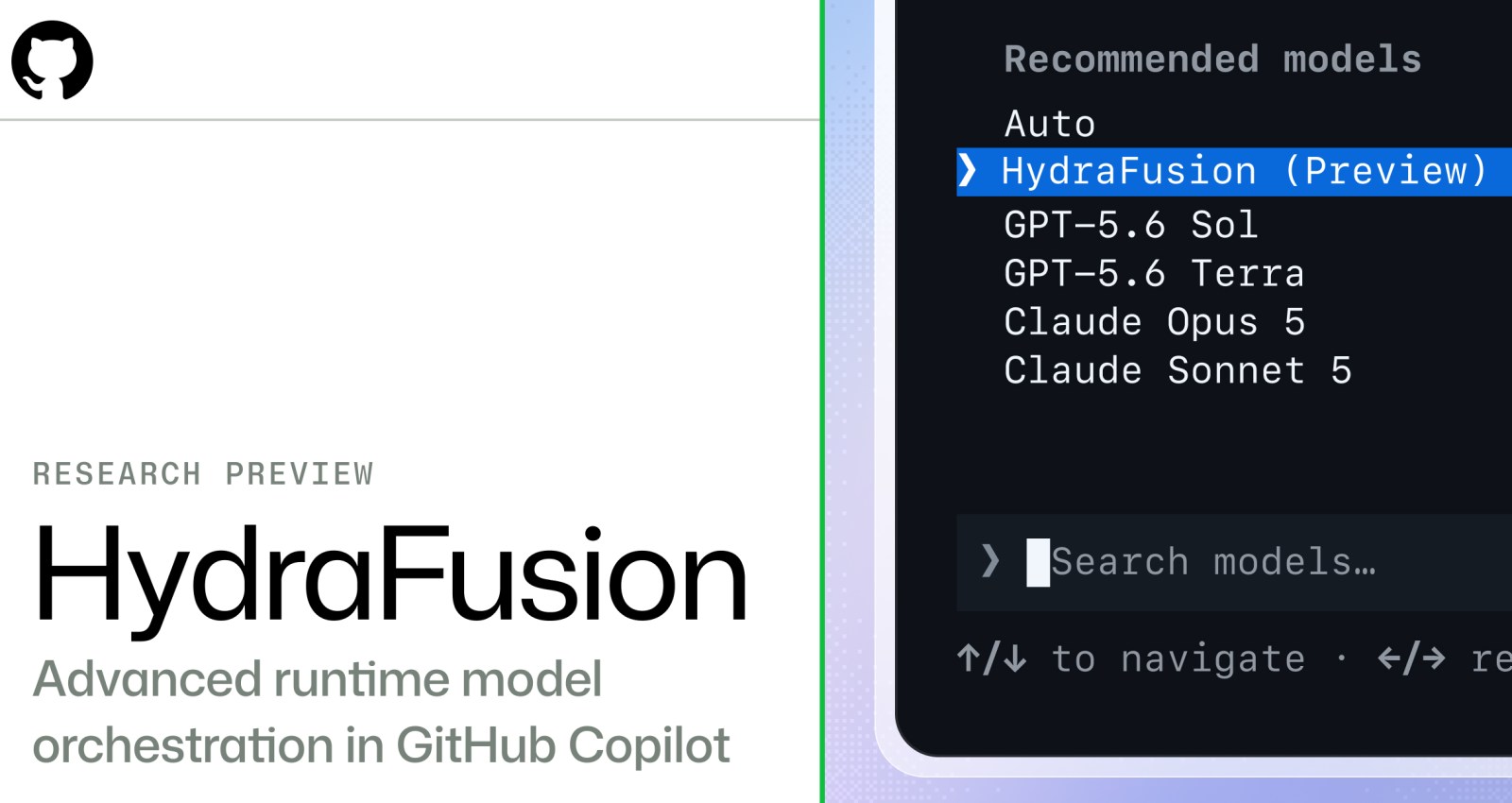
Providing developers the best model for the task at hand has always been our goal. Earlier this year, we made that easier by launching Auto model selection, which reviews your task and matches it to the best-suited model for that task. 为开发者提供最适合当前任务的模型始终是我们的目标。今年早些时候,我们推出了“自动模型选择”(Auto model selection)功能,简化了这一流程。该功能会自动评估您的任务,并匹配最合适的模型。
Today, we’re introducing Project HydraFusion, a research preview that delivers frontier intelligence through runtime orchestration. It creates a full execution plan, choosing from models across multiple providers to draft, critique and revise, or cascade to more powerful models to complete your task. 今天,我们推出了 Project HydraFusion,这是一个通过运行时编排提供前沿智能的研究预览版。它能够创建一个完整的执行计划,从多个提供商的模型中进行选择,以完成草拟、评估、修订,或级联调用更强大的模型来处理您的任务。
HydraFusion fills a key role in our overall strategy to deliver automated semantic routing between local, cloud, and compound models. For developers, that complexity stays behind the scenes: you select HydraFusion like any other model, and it chooses a workflow that balances performance, cost, and latency for each task. HydraFusion 在我们实现本地、云端和复合模型之间自动语义路由的整体战略中扮演着关键角色。对于开发者而言,这种复杂性被隐藏在后台:您只需像选择其他模型一样选择 HydraFusion,它就会为您选择一个在性能、成本和延迟之间取得平衡的工作流。
HydraFusion treats workflow selection as an optimization problem. It uses capability signals for reasoning, code generation, debugging, and tool use to select the most efficient execution pattern to meet the quality bar. HydraFusion 将工作流选择视为一个优化问题。它利用推理、代码生成、调试和工具使用等能力信号,来选择最有效的执行模式,以达到质量标准。
For each request, HydraFusion currently chooses one of three execution patterns:对于每个请求,HydraFusion 目前会选择以下三种执行模式之一:
- Single. One selected model solves the task directly.单一模式(Single):选择一个模型直接解决任务。
- Cascade. An efficient model drafts a solution and a quality gate decides whether to accept it or escalate to a stronger model.级联模式(Cascade):由一个高效模型草拟解决方案,再通过质量门控决定是采纳该方案,还是升级调用更强大的模型。
- Critique. One model drafts a result, an independent read-only critic from a different model family reviews it (following the same review pattern as Rubber Duck), and the drafting model revises once.评估模式(Critique):由一个模型草拟结果,再由来自不同模型系列的独立只读评估器进行审查(遵循与 Rubber Duck 相同的审查模式),最后由草拟模型进行一次修订。
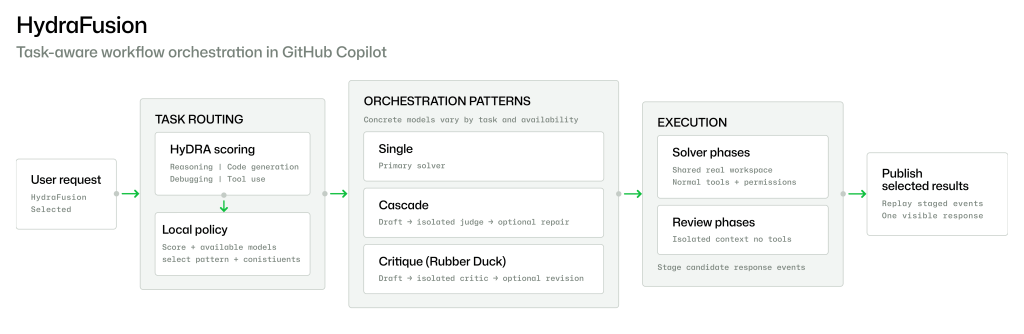
Each pattern addresses a different quality-to-cost trade-off. Single preserves speed and efficiency when one model can solve the task directly. Cascade gives an efficient model the first attempt while retaining a path to stronger inference when the candidate does not clear the acceptance gate. Critique adds an independent perspective for tasks where review is more useful than another unaided attempt.每种模式都针对不同的质量与成本权衡。单一模式在单个模型能直接解决任务时,保持了速度和效率。级联模式让高效模型先行尝试,同时在候选方案未通过验收门控时,保留了调用更强推理能力的路径。评估模式则为那些通过审查比再次盲目尝试更有用的任务,提供了独立的视角。
In offline evaluations across three agentic coding benchmarks, HydraFusion consistently demonstrated frontier-level quality with substantial estimated cost savings. On TerminalBench 2.1, it improved verified task quality by 4.9 percentage points at 67% lower estimated cost compared with Claude Opus 5.在三个智能编码基准测试的离线评估中,HydraFusion 一贯展现出前沿水平的质量,并显著降低了预估成本。在 TerminalBench 2.1 上,与 Claude Opus 5 相比,它在预估成本降低 67% 的情况下,将已验证的任务质量提高了 4.9 个百分点。
Let’s dive into the approach, the results, and the benchmarks.让我们深入探讨其方法、结果和基准测试。
Adaptive multi-model orchestration自适应多模型编排
Developers already coordinate models manually: choosing one for a task, asking another to review the work, or escalating a difficult problem to a more capable model. HydraFusion brings that familiar process into the runtime. You choose HydraFusion once and stay focused on your task while it manages the models and workflow behind the scenes. 开发者目前已经在手动协调模型:为一个任务选择一个模型,让另一个模型审查工作,或者将困难问题升级给更强大的模型。HydraFusion 将这一熟悉的过程带入了运行时。您只需选择一次 HydraFusion,即可专注于任务本身,而它会在后台管理模型和工作流。
The key is selectivity. Some coding tasks can be solved directly, while others benefit from review, revision, or escalation. HydraFusion evaluates each request and chooses the least complex workflow expected to meet its needs, using additional model calls only when they are likely to improve the result. This adaptive approach balances quality, cost, and latency across models.关键在于选择性。有些编码任务可以直接解决,而另一些则受益于审查、修订或升级。HydraFusion 会评估每个请求,并选择预期能满足需求且复杂度最低的工作流,仅在可能改善结果时才调用额外的模型。这种自适应方法在不同模型之间平衡了质量、成本和延迟。
As the model frontier advances, so does HydraFusion. When new models become available in GitHub Copilot, we can evaluate and incorporate them into its model pool, bringing their strengths to the tasks best suited to them.随着模型前沿的推进,HydraFusion 也在不断进步。当 GitHub Copilot 中出现新模型时,我们可以对其进行评估并纳入模型池,将其优势发挥在最适合的任务上。
Building HydraFusion构建 HydraFusion
Turning adaptive multi-model orchestration into one dependable coding experience requires careful control of execution, review, cost, and repository state. HydraFusion is built around five operating principles:将自适应多模型编排转化为一种可靠的编码体验,需要对执行、审查、成本和仓库状态进行严格控制。HydraFusion 构建于五项操作原则之上:
- Complete accounting. Aggregate cost and usage across every workflow leg, including drafting, critique, revision, escalation, retry, and fallback.完整核算。汇总每个工作流环节的成本和使用情况,包括草拟、评估、修订、升级、重试和回退。
- Bounded execution. Give each leg explicit timeout and cancellation behavior to keep execution and cost within defined limits.边界执行。为每个环节提供明确的超时和取消行为,以将执行时间和成本控制在定义的限度内。
- Isolated review. Run review steps in isolated, tool-less contexts, while solver steps use the shared workspace and normal permission-aware agent loop. This allows models to assess the work independently without modifying the repository.隔离审查。在隔离的、无工具的上下文中运行审查步骤,而求解步骤则使用共享工作区和正常的权限感知代理循环。这允许模型在不修改仓库的情况下独立评估工作。
- Fail-safe application. Apply no patch when the workflow is cancelled or fails validation, preventing incomplete changes from reaching the repository.故障安全应用。当工作流被取消或验证失败时,不应用任何补丁,防止不完整的更改进入仓库。
- Validated routing. Verify workflow definitions, model bindings, fallback behavior, and model availability before execution begins.验证路由。在执行开始前,验证工作流定义、模型绑定、回退行为和模型可用性。
Together, these principles make multi-model orchestration practical for repository-level work. Internally, the runtime records the role, outcome, cost, latency, and diagnostics of each leg so the workflow can be understood after execution. Externally, the developer receives one coherent response and one permission-aware change set. 这些原则共同使多模型编排在仓库级工作中变得切实可行。在内部,运行时会记录每个环节的角色、结果、成本、延迟和诊断信息,以便在执行后理解工作流。在外部,开发者收到的是一个连贯的响应和一个具有权限意识的变更集。
Benchmarking results基准测试结果
Fixed HydraFusion policies were evaluated across three agentic coding benchmarks — TerminalBench 2.1, DeepSWE, and CheckpointBench, our internal benchmark based on real GitHub Copilot sessions — using Claude Opus 5 and GPT-5.6 Sol as comparison baselines. Each policy used the same task inputs, tools, execution limits, pricing assumptions, grading conditions, and treatment of missing results. The evaluation measured verified task quality, which is the share of tasks confirmed as correctly answered, and the complete estimated workflow cost. Cost accounting included every invoked leg, such as drafting, critique, revision, escalation, retry, and fallback. The results below show the best tuned HydraFusion configuration. 我们使用 Claude Opus 5 和 GPT-5.6 Sol 作为比较基准,在三个智能编码基准测试——TerminalBench 2.1、DeepSWE 和基于真实 GitHub Copilot 会话的内部基准 CheckpointBench 上,对固定的 HydraFusion 策略进行了评估。每个策略均使用相同的任务输入、工具、执行限制、定价假设、评分条件和缺失结果处理方式。评估衡量了已验证的任务质量(即被确认正确回答的任务比例)以及预估的完整工作流成本。成本核算包含了所有调用的环节,如草拟、评估、修订、升级、重试和回退。以下结果展示了经过最佳调优的 HydraFusion 配置。
| Benchmarks | Cost vs. Opus 5 | Quality vs. Opus 5 |
|---|---|---|
| TerminalBench 2.1 | 67% lower | +4.9 points |
| DeepSWE | 36% lower | -1.5 points |
| CheckpointBench | 65% lower | -0.1 points |
These controlled offline results are specific to the evaluated benchmark revisions, workflow configurations, model pool, and pricing assumptions, with all models evaluated at the same medium reasoning level. Through this research preview, we’ll validate how these results translate to real developer workloads and use the findings to further optimize HydraFusion for production quality, latency, reliability, caching efficiency, cost, and safety. 这些受控的离线结果特定于评估的基准版本、工作流配置、模型池和定价假设,所有模型均在相同的中等推理水平下进行评估。通过本次研究预览,我们将验证这些结果如何转化为真实的开发者工作负载,并利用研究发现进一步优化 HydraFusion 的生产质量、延迟、可靠性、缓存效率、成本和安全性。
TerminalBench 2.1TerminalBench 2.1
TerminalBench 2.1 evaluates coding agents on complex, multi-step tasks in terminal environments. TerminalBench 2.1 评估编码代理在终端环境中处理复杂、多步骤任务的能力。
Figure 2 compares HydraFusion and Opus 5 across verified task quality and estimated workflow cost. 图 2 比较了 HydraFusion 和 Opus 5 在已验证任务质量和预估工作流成本方面的表现。
DeepSWEDeepSWE
DeepSWE evaluates challenging repository-level software engineering tasks that require navigating large codebases, understanding cross-file dependencies, and producing end-to-end fixes. On this benchmark, HydraFusion comes within 1.5 percentage points of Opus 5 while reducing cost by 36%, demonstrating a compelling quality-cost tradeoff for complex real-world engineering tasks.DeepSWE 评估具有挑战性的仓库级软件工程任务,这些任务需要导航大型代码库、理解跨文件依赖关系并生成端到端的修复方案。在此基准测试中,HydraFusion 的表现与 Opus 5 相差不到 1.5 个百分点,同时成本降低了 36%,展示了其在复杂现实工程任务中极具吸引力的质量-成本权衡。
CheckpointBenchCheckpointBench
Distribution by programming language, task difficulty, and the kind of work the developer was doing按编程语言、任务难度以及开发者所做工作类型进行的分布
CheckpointBench is an internal multi-turn benchmark curated from real GitHub Copilot agentic coding sessions. Each conversation is anchored to a specific public repository and immutable commit, ensuring every session is replayable. The benchmark is balanced across language, task type, difficulty, scrubbed for quality, resulting in a realistic evaluation set that closely mirrors production agentic sessions. On this benchmark, HydraFusion comes within 0.1 percentage points of Opus 5 at 65% lower cost.CheckpointBench 是一个内部多轮基准测试,选自真实的 GitHub Copilot 智能编码会话。每个对话都锚定在特定的公共仓库和不可变提交上,确保每个会话均可重现。该基准测试在语言、任务类型和难度方面保持平衡,并经过质量筛选,从而形成了一个非常贴近生产环境代理会话的真实评估集。在此基准测试中,HydraFusion 的表现与 Opus 5 相差不到 0.1 个百分点,成本降低了 65%。
Early internal testing has echoed that result.早期的内部测试也印证了这一结果。
So far, the reasoning and task solving capability [of HydraFusion] is at or better than Opus.[HydraFusion 的] 推理和任务解决能力目前已达到或优于 Opus。
Principal Software Engineer at Microsoft
Hill-climbing HydraFusionHydraFusion 的爬坡式优化
HydraFusion’s routing policies were shaped by how developers use GitHub Copilot on real coding tasks. To make those workflows reproducible, we curated CheckpointBench from real Copilot coding-session trajectories. We refined HydraFusion repeatedly across CheckpointBench, DeepSWE, and TerminalBench 2.1, optimizing across the evaluation sets rather than for any single benchmark.HydraFusion 的路由策略是根据开发者在真实编码任务中使用 GitHub Copilot 的方式形成的。为了使这些工作流可重现,我们从真实的 Copilot 编码会话轨迹中整理出了 CheckpointBench。我们在 CheckpointBench、DeepSWE 和 TerminalBench 2.1 上反复优化 HydraFusion,针对整个评估集进行优化,而非仅仅针对某个单一基准。
HydraFusion’s per-capability scores provided a consistent basis for comparing candidate routing policies. Instead of manually tuning thresholds, we used beam search to build the optimal decision policy. Each candidate was measured against a frozen baseline on quality, cost, and failure modes, so improvements were evaluated on stable ground.HydraFusion 的按能力评分提供了比较候选路由策略的一致基础。我们没有手动调整阈值,而是使用束搜索(beam search)来构建最优决策策略。每个候选策略都在质量、成本和故障模式方面与冻结的基准进行对比测量,从而确保改进在稳定的基础上进行评估。
TerminalBench 2.1 provides the most complete sequence of runs, making it the clearest view of this iterative improvement. The progression was not linear. Between August 11 and August 25, two operational failures in the evaluation harness produced invalid runs. Those failures were excluded from the performance trend, corrected, and followed by continued gains in the HydraFusion configurations. By August 25, HydraFusion had reached its strongest operating points in the recorded series.TerminalBench 2.1 提供了最完整的运行序列,使其成为观察这种迭代改进最清晰的窗口。这一过程并非线性。在 8 月 11 日至 8 月 25 日之间,评估工具中的两次操作故障导致了无效运行。这些故障被从性能趋势中排除并进行了纠正,随后 HydraFusion 的配置持续取得进展。到 8 月 25 日,HydraFusion 在记录序列中达到了其最强的运行点。
This development record shows how the policies improved from repeated experiments. TerminalBench 2.1 was one of several benchmarks used during development. Its relative saturation makes broader validation important, so the three-benchmark evaluation also includes DeepSWE’s more demanding repository-level tasks. The research preview extends that learning loop to real developer workloads.这份开发记录展示了策略如何通过反复实验得到改进。TerminalBench 2.1 是开发过程中使用的多个基准测试之一。其相对饱和度使得更广泛的验证变得重要,因此三基准评估还包括了 DeepSWE 更苛刻的仓库级任务。本次研究预览将该学习循环扩展到了真实的开发者工作负载中。
Try the research preview尝试研究预览版
For this preview, first-turn, single-prompt coding tasks are the best place to start. We’ll be focusing on strong multi-turn performance with longer, iterative sessions next.对于本次预览,首轮、单提示词的编码任务是最好的起点。接下来,我们将重点关注更长、更具迭代性的多轮任务表现。
This preview is designed to learn which tasks benefit from compound workflows and how orchestration affects latency and cost in practice. For the best experience today, start with substantial, well-scoped coding tasks that you can hand to Copilot in autopilot mode in a single prompt. Share what you find, including where it excels, where it falls short, and what you’d want to see next, through /feedback in Copilot CLI or in the GitHub Community discussion.本次预览旨在了解哪些任务受益于复合工作流,以及编排在实践中如何影响延迟和成本。为了获得最佳体验,请从您可以一次性通过 Copilot 自动驾驶模式处理的、范围明确的实质性编码任务开始。通过 Copilot CLI 中的 /feedback 或 GitHub 社区讨论分享您的发现,包括它在哪些方面表现出色、哪些方面有待改进,以及您下一步希望看到什么。
HydraFusion remains an active research effort. Results, models, workflows, availability, names, and product behavior may change as we learn from the preview. We believe the next real gain in coding agents will come from combining frontier intelligence with runtime orchestration. HydraFusion is our first bet on that idea: moving from choosing the best model to dynamically constructing the best way to solve each task.HydraFusion 仍是一项积极的研究工作。随着我们从预览中学习,结果、模型、工作流、可用性、名称和产品行为可能会发生变化。我们相信,编码代理的下一个真正飞跃将来自将前沿智能与运行时编排相结合。HydraFusion 是我们对这一理念的首次尝试:从选择最佳模型转变为动态构建解决每个任务的最佳方式。
Acknowledgments致谢
A huge thank-you to the researchers, engineers, product managers, and designers across GitHub and Microsoft who curated the training data and built the training pipeline, evaluation suites, client experience, and serving stack. We are especially grateful to the GitHub Copilot CLI, Copilot API and VS Code team for overcoming numerous challenges to bring this research preview to our customers. 衷心感谢 GitHub 和微软各地的研究人员、工程师、产品经理和设计师,他们整理了训练数据,构建了训练流水线、评估套件、客户端体验和服务栈。我们特别感谢 GitHub Copilot CLI、Copilot API 和 VS Code 团队,他们克服了重重困难,将这一研究预览版带给我们的客户。
Meet the Team团队介绍
 Aashna Garg, Principal Applied Scientist, Code AIAashna Garg,代码 AI 首席应用科学家
 Shengyu Fu, Partner Applied Science Manager, Code AIShengyu Fu,代码 AI 合伙人应用科学经理
 Carlos Castro, Partner Architect, GitHub CopilotCarlos Castro,GitHub Copilot 合伙人架构师
 Siddharth Singha Roy, Research Scientist II, Code AI Siddharth Singha Roy,代码 AI 二级研究科学家
 Andy Salerno, Principal Software Engineer, GitHub CopilotAndy Salerno,GitHub Copilot 首席软件工程师
Tags:标签:
Written by 作者

Related posts

GitHub Copilot app for Beginners: Run several agents at once
Learn how to run parallel agents in the GitHub Copilot app, and experience the moment it stops feeling scary and starts feeling powerful.
Decoding the new AI lingo: Loops, harnesses, squads, hill climbing… oh my!
From loop engineering to harnesses, squads, and open weights, the GitHub Podcast breaks down the AI terms showing up in developer conversations.

How we make AI coding more cost efficient without sacrificing task quality
Why shorter outputs can cost more, and how GitHub Copilot reduces wasted work across the complete coding task.
