TimesFM-3: A zero-shot foundation model for multivariate forecasting
August 31, 2026
Ayush Jain and Rajat Sen, Research Scientists, Google Research
We introduce TimesFM-3, a state-of-the-art time series foundation model that enables highly accurate multivariate time series forecasting in a single forward pass, significantly outperforming other forecasting models across major benchmarks.我们推出了 TimesFM-3,这是一款最先进的时间序列基础模型,能够通过单次前向传递实现高精度的多变量时间序列预测,在各大基准测试中表现显著优于其他预测模型。
Quick links快速链接
- GitHub GitHub
- HuggingFace HuggingFace
Since the debut of TimesFM in 2024, we’ve seen the adoption of time-series foundation models for real-world time-series forecasting tasks across multiple domains, such as retail, finance, observability, manufacturing, healthcare and natural sciences.自 2024 年 TimesFM 问世以来,我们见证了时间序列基础模型在零售、金融、可观测性、制造业、医疗保健和自然科学等多个领域的实际预测任务中得到广泛应用。
Up until TimesFM-2.5 (released in September 2025), our models were strictly limited to univariate forecasting: forecasting using only the history of a single time series. Yet, most real-world forecasting problems are inherently multivariate: where multiple time series and auxiliary external features jointly impact the future forecast of a time series. Consider forecasting ice cream sales for a retail chain. Past sales alone rarely tell the full story. A good forecast should also draw on sales of related products (e.g., ice cream cones, syrups), historical foot traffic, and known future events like weather forecasts, promotions, and holidays.在 2025 年 9 月发布的 TimesFM-2.5 之前,我们的模型仅限于单变量预测,即仅使用单个时间序列的历史数据进行预测。然而,大多数现实世界的预测问题本质上都是多变量的,即多个时间序列和辅助外部特征共同影响未来的预测结果。以零售连锁店的冰淇淋销量预测为例,仅靠过去的销售数据往往无法反映全貌。一个好的预测模型还应参考相关产品的销量(如冰淇淋蛋筒、糖浆)、历史客流量,以及天气预报、促销活动和节假日等已知的未来事件。
Today we introduce TimesFM-3, the next generation of our time-series foundation model that is natively pre-trained for multivariate forecasting. TimesFM-3 has 330 million parameters and is pre-trained on a real-world and synthetic time-series corpus comprising more than 1 trillion time points. Building on the efficiency and zero-shot generalization of its predecessors, TimesFM-3 adds robust support for complex multivariate scenarios in a zero-shot manner. It can jointly predict multiple coevolving time series, capturing dependencies that improve overall accuracy without requiring task-specific fine-tuning. The model natively supports:今天,我们推出了 TimesFM-3,这是我们下一代时间序列基础模型,原生预训练支持多变量预测。TimesFM-3 拥有 3.3 亿个参数,并在包含超过 1 万亿个时间点的数据集(涵盖真实世界和合成时间序列)上进行了预训练。在继承前代模型高效性和零样本泛化能力的基础上,TimesFM-3 以零样本方式增加了对复杂多变量场景的强大支持。它能够联合预测多个协同演变的时间序列,捕捉相关性以提高整体准确性,且无需进行特定任务的微调。该模型原生支持:
- Multiple targets: Forecast multiple related time series simultaneously (e.g., jointly forecasting different brands of ice cream). The model supports both point and quantile forecasts for all targets.多个目标:同时预测多个相关的时间序列(例如,联合预测不同品牌的冰淇淋销量)。模型支持所有目标的点预测和分位数预测。
- Past covariates: Incorporate features that are only known historically (e.g., past foot traffic).过去协变量:纳入仅在历史上已知的特征(例如,过去的客流量)。
- Past-future (dynamic) covariates: Leverage known future events to guide the forecast (e.g., planned promotional campaigns or weather forecasts).过去-未来(动态)协变量:利用已知的未来事件来指导预测(例如,计划中的促销活动或天气预报)。
Under the hood: Architecture & inference技术内幕:架构与推理
TimesFM-3 builds on the proven decoder-only transformer architecture of its predecessors. As in previous versions, we process time series efficiently by grouping contiguous data points into patches of 32 time steps. We then apply normalization per time-series similar to that of TimesFM-2.5 in order to account for time series with vastly different scales.TimesFM-3 构建于前代模型经过验证的仅解码器(decoder-only)Transformer 架构之上。与之前版本一样,我们通过将连续数据点分组为 32 个时间步长的补丁(patch)来高效处理时间序列。此外,我们采用了类似于 TimesFM-2.5 的逐时间序列归一化方法,以处理规模差异巨大的时间序列。
Multivariate token construction多变量 Token 构建
For target and past-covariate series, a token is constructed directly from a single patch. However, for past-future covariates, TimesFM-3 employs a clever "lookahead" strategy: each token concatenates the current patch with future patches, allowing the model to peek at upcoming known signals.对于目标序列和过去协变量序列,Token 直接从单个补丁构建。然而,对于过去-未来协变量,TimesFM-3 采用了巧妙的“前瞻”策略:每个 Token 将当前补丁与未来补丁拼接,使模型能够预见即将到来的已知信号。
Alternating attention architecture交替注意力架构
Once the patches are tokenized, they pass through an input residual block and enter the main transformer stack, which operates as a 2D grid:一旦补丁被标记化(tokenized),它们将通过一个输入残差块,进入作为 2D 网格运行的主 Transformer 堆栈:
- Causal temporal attention: Tokens attend horizontally across time. To prevent data leakage, this attention is strictly causal — a token can only look at past tokens within its own specific time series.因果时间注意力:Token 在时间维度上横向关注。为了防止数据泄露,这种注意力是严格因果的——一个 Token 只能查看其特定时间序列内的过去 Token。
- Full variate attention: Tokens attend vertically across series. At any given time step, a token can look at all other time series in the dataset, allowing the model to learn complex cross-series correlations (e.g., how a promotion in one series affects sales in another).全变量注意力:Token 在序列维度上纵向关注。在任何给定的时间步长,一个 Token 都可以查看数据集中的所有其他时间序列,从而使模型能够学习复杂的跨序列相关性(例如,一个序列中的促销活动如何影响另一个序列的销量)。
These two attention mechanisms alternate for several layers, seamlessly blending temporal patterns with cross-series relationships.这两种注意力机制在多个层中交替进行,将时间模式与跨序列关系无缝融合。
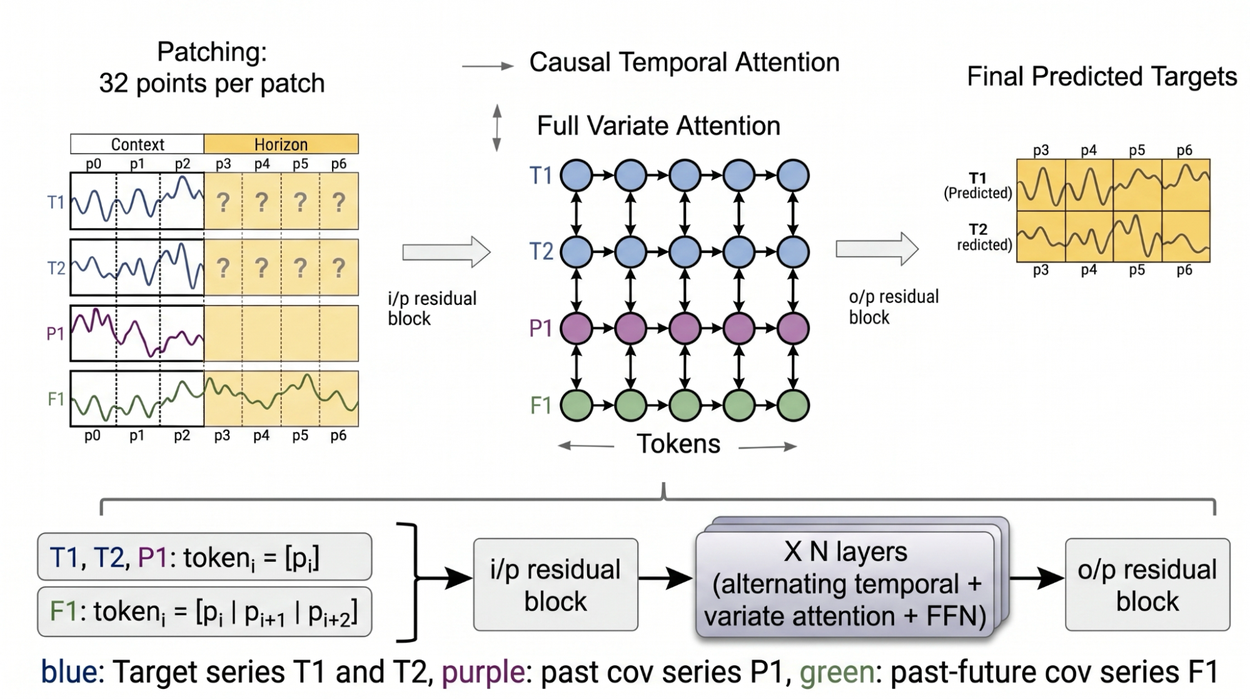
TimesFM-3 architecture.TimesFM-3 架构。
Non-autoregressive decode: Forecasting in a single pass非自回归解码:单次传递完成预测
Previous versions of TimesFM generated forecasts one patch at a time, introducing latency, compounding error accumulation, and computational cost. TimesFM-3 uses the strategy of Contiguous Patch Masking to generate the entire forecasting horizon in a single forward pass. The model appends masked placeholder tokens for the future horizon alongside the observed context. Target and past-covariate series are masked in the horizon (since their future values are unknown), while past–future covariates remain visible, providing the model with known future signals like holidays or scheduled events. Through the alternating attention layers, the model fills in all masked horizon patches simultaneously, with no iterative loop required. The model predicts 9 quantiles (from the 10th to the 90th percentile) for each target time series at every horizon step, providing a full probabilistic view of the forecast uncertainty.TimesFM 的旧版本每次生成一个补丁的预测,这引入了延迟、复合误差积累和计算成本。TimesFM-3 使用连续补丁掩码(Contiguous Patch Masking)策略,在单次前向传递中生成整个预测范围。模型在观测到的上下文旁边附加了用于未来范围的掩码占位符 Token。目标序列和过去协变量序列在未来范围被掩码(因为其未来值未知),而过去-未来协变量保持可见,为模型提供诸如节假日或计划事件等已知的未来信号。通过交替注意力层,模型同时填充所有被掩码的未来补丁,无需迭代循环。模型为每个目标时间序列在每个预测步长预测 9 个分位数(从第 10 到第 90 百分位),从而提供对预测不确定性的全面概率视图。
Illustrative example for multivariate forecasting多变量预测演示示例
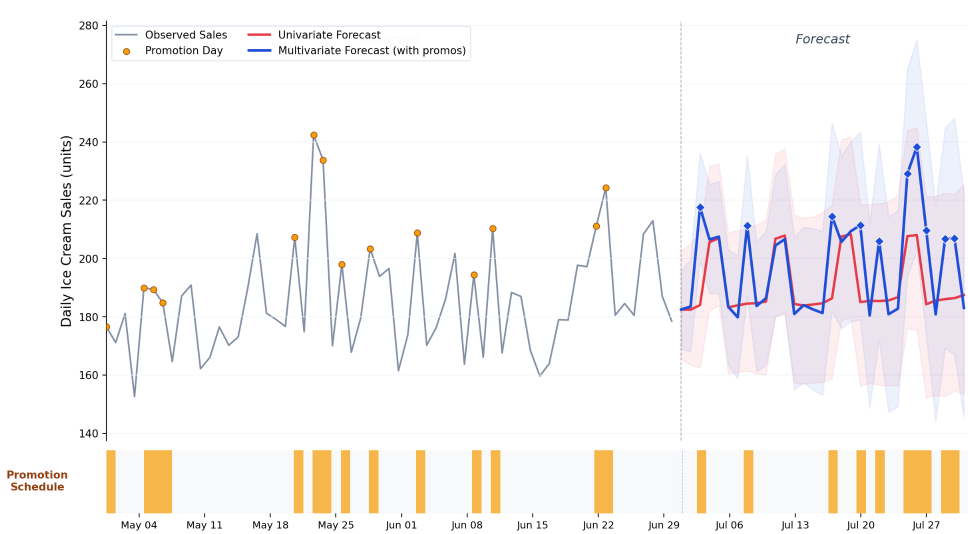
Let’s revisit the ice cream sales example. Imagine you are working on next month’s promotion schedule and want to forecast the sales to anticipate. A standard univariate model (the red line, below) looks at the historical sales and projects a weekly pattern forward — but it has no idea about planned promotions on specific days. TimesFM-3's multivariate mode (the blue line, below) takes a different approach: by passing in the planned promotion schedule as a past-future covariate, the model learns the relationship between promotions and sales lift from the historical context, then applies that knowledge to future days with planned promotions. The result is a forecast that anticipates a ~20% sales bump on each promotion day. In the chart below, the amber blocks in the promotion covariates highlight which days have promotions — and the blue forecast visibly responds to each one, while the red forecast does not. Over the full month, this adds up to a more accurate forecast for projected revenue.让我们回顾一下冰淇淋销量的例子。假设您正在制定下个月的促销计划并希望预测销量以进行准备。标准的单变量模型(下图红线)查看历史销量并向后推算每周的模式,但它不知道特定日期的计划促销活动。TimesFM-3 的多变量模式(下图蓝线)采用了不同的方法:通过将计划的促销时间表作为过去-未来协变量输入,模型从历史上下文中学习促销与销量提升之间的关系,然后将这些知识应用于未来有促销计划的日子。结果是预测能够预期到每个促销日约 20% 的销量增长。在下图中,促销协变量中的琥珀色块突出了哪些天有促销活动,蓝色预测明显对每一项活动做出了响应,而红色预测则没有。在整个月内,这汇总成了一个更准确的预期收入预测。
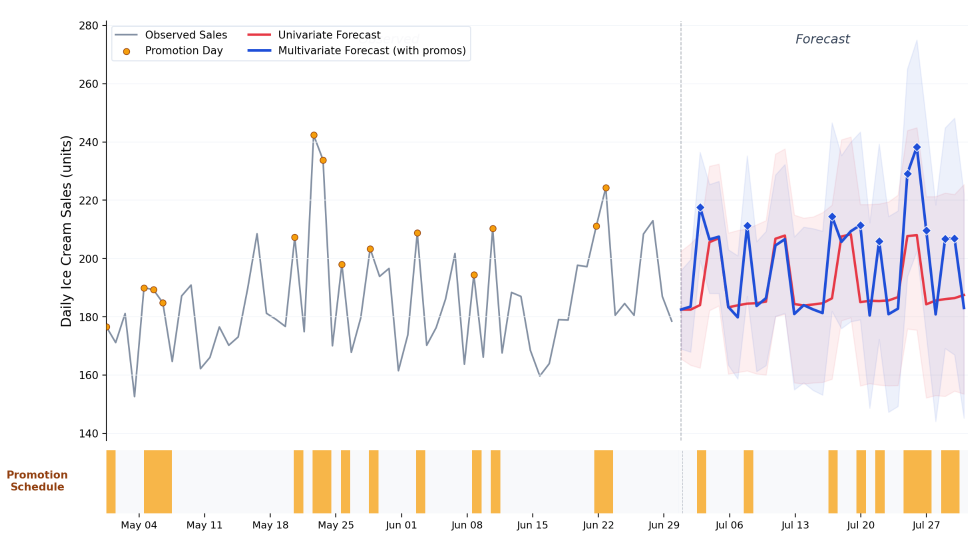
Planning promotions: TimesFM-3's multivariate forecast uses a promotion covariate to anticipate sales lift on planned promotion days in the future.规划促销:TimesFM-3 的多变量预测使用促销协变量来预期未来计划促销日的销量提升。
Evaluation and benchmarks评估与基准测试
We evaluated TimesFM-3 on three comprehensive public forecasting benchmarks: Gift-Eval, FEV-Bench, and Time. On all three benchmarks, TimesFM-3 is the top-ranked model in terms of both point and probabilistic forecasting metrics among all pre-trained foundation models. The plots below show average rank across tasks for both point forecast accuracy and probabilistic forecast quality (lower is better) for the three benchmarks. We compare against recent foundation models including multivariate-capable models, such as Chronos-2 and the Toto 2.0 family, as well as our previous model TimesFM-2.5.我们在三个全面的公共预测基准上评估了 TimesFM-3:Gift-Eval、FEV-Bench 和 Time。在这三个基准测试中,TimesFM-3 在点预测和概率预测指标方面均位居所有预训练基础模型之首。下图显示了这三个基准测试在点预测准确性和概率预测质量方面的平均排名(数值越低越好)。我们将其与包括 Chronos-2 和 Toto 2.0 系列在内的近期多变量基础模型,以及我们之前的模型 TimesFM-2.5 进行了比较。
Each plot includes two entries for TimesFM-3. The "univariate mode" point shows performance when the model is evaluated without any covariate or cross-series information, treating each target series independently, just like a traditional univariate model. Even in this univariate mode, TimesFM-3 already matches or outperforms other competing models. When we switch to the full multivariate mode, TimesFM-3 takes another leap, achieving the best average rank in both point and probabilistic forecasting across the board.每个图表都包含 TimesFM-3 的两个条目。“单变量模式”点显示了模型在没有任何协变量或跨序列信息、像传统单变量模型一样独立对待每个目标序列时的性能。即使在这种单变量模式下,TimesFM-3 也已经匹配或超越了其他竞争模型。当我们切换到完整的多变量模式时,TimesFM-3 实现了进一步的飞跃,在点预测和概率预测方面均取得了最佳平均排名。

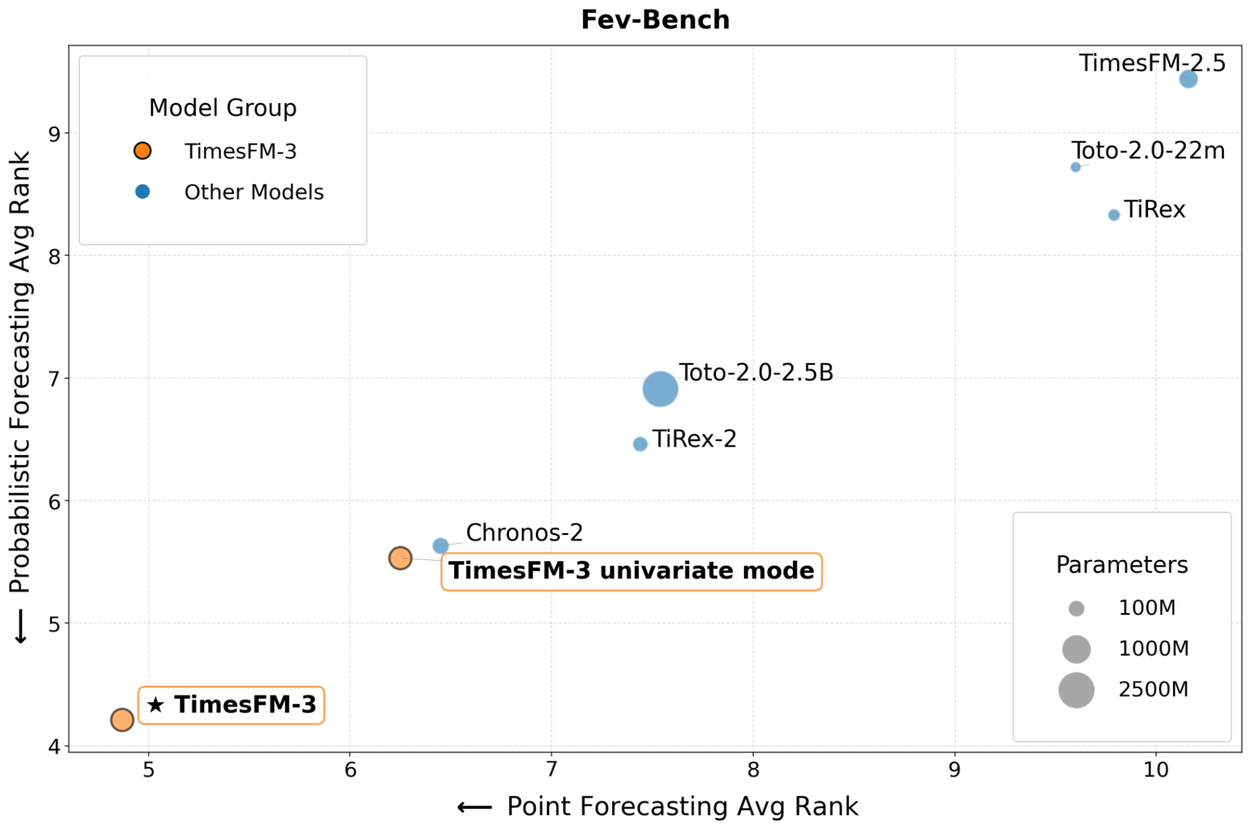
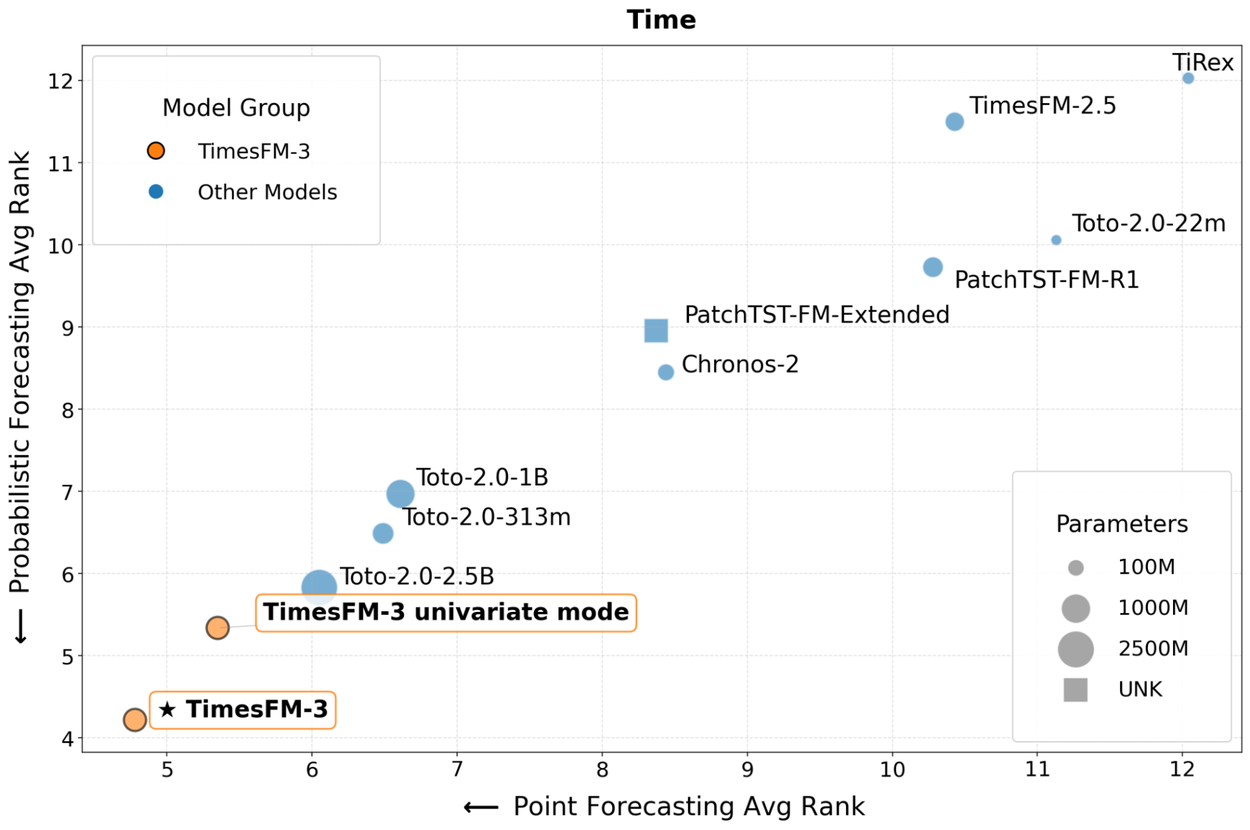
Performance on Gift-Eval (top), Fev-Bench (middle), and Time (bottom): TimesFM-3 in univariate mode already outperforms other replicable time-series foundation models in both point and probabilistic forecasting metrics. Multivariate mode further improves performance by leveraging cross-series information and covariates when available.在 Gift-Eval(上)、Fev-Bench(中)和 Time(下)上的表现:TimesFM-3 在单变量模式下已经在点预测和概率预测指标上超越了其他可复制的时间序列基础模型。多变量模式通过在可用时利用跨序列信息和协变量,进一步提升了性能。
Conclusion结论
We introduce TimesFM-3, the latest generation of our TimesFM family of zero-shot time series foundation models, that obtains state-of-the-art multivariate and univariate forecasting performance on multiple public benchmarks. TimesFM-3 is now available on GitHub and Hugging Face, with its BigQuery integration landing in the coming weeks. In the meantime, you can try TimesFM-2.5 immediately on your univariate tasks to familiarize yourself with the AI.FORECAST command in BigQuery - no ML expertise required.我们推出了 TimesFM-3,这是我们 TimesFM 系列零样本时间序列基础模型的最新一代,在多个公共基准测试中获得了最先进的多变量和单变量预测性能。TimesFM-3 现已在 GitHub 和 Hugging Face 上发布,其 BigQuery 集成将在未来几周内推出。在此期间,您可以立即在单变量任务上尝试 TimesFM-2.5,以熟悉 BigQuery 中的 AI.FORECAST 命令——无需机器学习专业知识。
Acknowledgements致谢
This project is joint work with Yichen Zhou, Petros Mol, Abhimanyu Das and Samet Oymak.本项目由 Yichen Zhou、Petros Mol、Abhimanyu Das 和 Samet Oymak 共同完成。
- Data Management 数据管理
- Machine Intelligence 机器智能
- Product 产品
Quick links
Other posts of interest
-
August 27, 2026
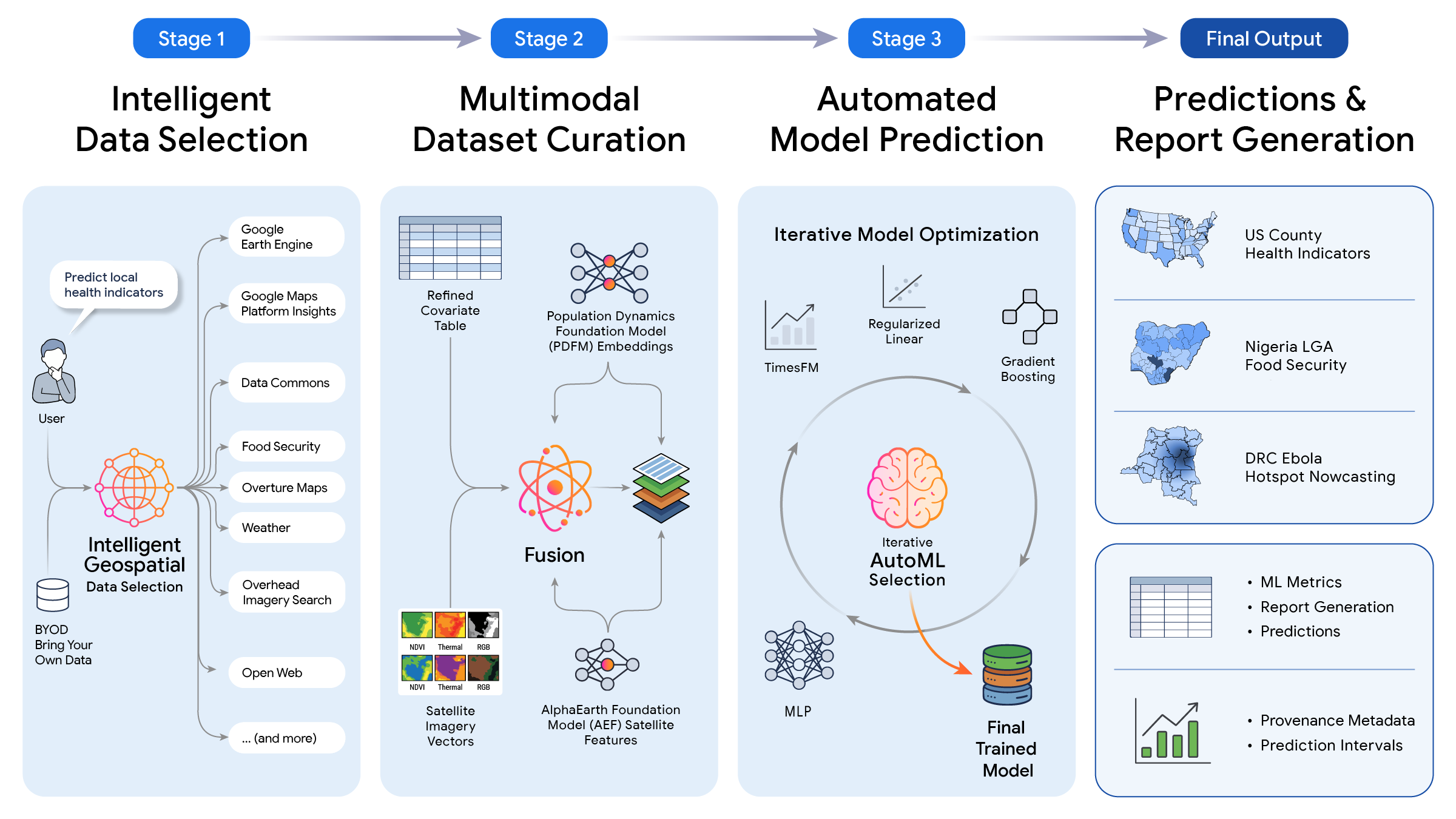
Planetary prediction engine: Automating global models via Earth AI- Earth AI ·
- Generative AI ·
- Machine Intelligence
-

August 26, 2026
GlucoFM: Foundation model for continuous glucose monitoring- Health & Bioscience ·
- Machine Intelligence
-
August 25, 2026
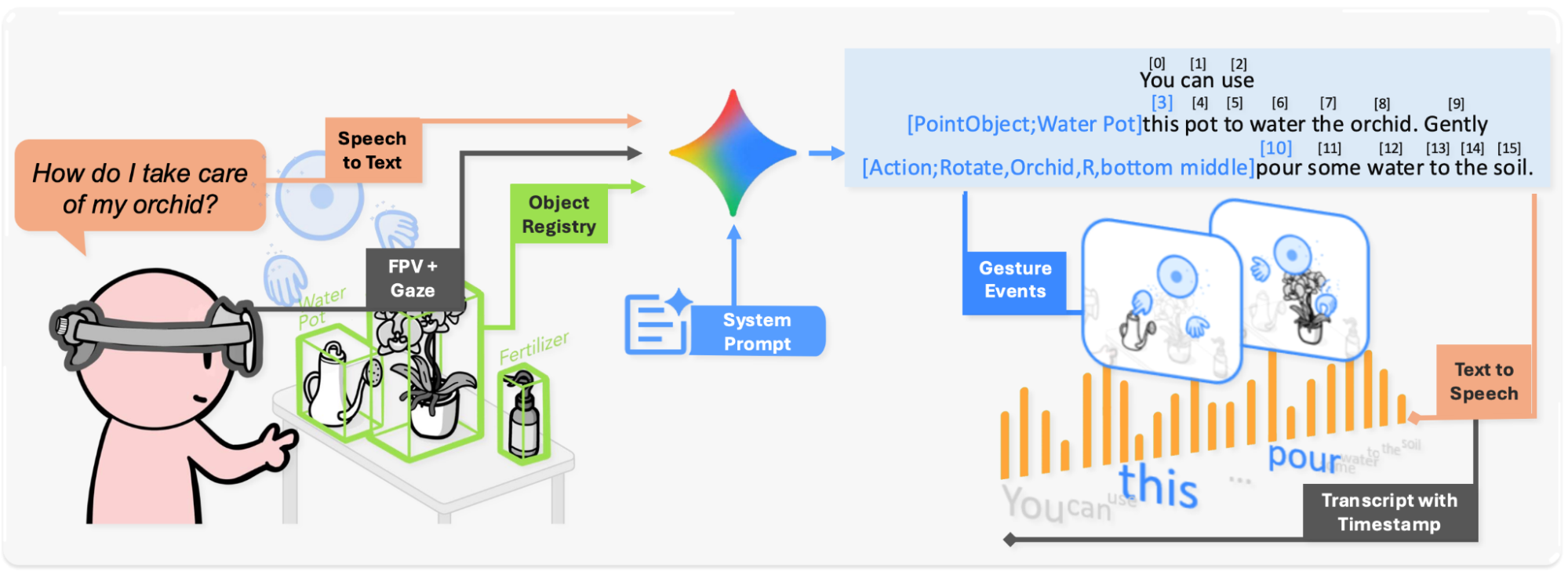
AgentHands: Generating interactive hand gestures for spatially grounded agent conversations in XR- Human-Computer Interaction and Visualization ·
- Machine Intelligence