JetBrains ResearchJetBrains 研究
Research is crucial for progress and innovation, which is why at JetBrains we are passionate about both scientific and market research研究对于进步与创新至关重要,这也是我们在 JetBrains 热衷于科学研究和市场研究的原因。
How Much Code Do Developers Really Let Agents Write?开发者到底让智能体编写了多少代码?

“100% of my code is written by [insert whichever AI coding agent is popular right now]!”
You’ve probably heard this claim many times this year.“我 100% 的代码都是由 [插入当前流行的 AI 编码智能体名称] 编写的!”今年你可能已经多次听到过这种说法。
We wanted to find out how many developers have actually fully outsourced code writing to agents and how the share of agent-generated code differs across regions, tech stacks, and seniority levels.我们希望了解到底有多少开发者真正将代码编写工作完全外包给了智能体,以及智能体生成的代码占比在不同地区、技术栈和资历水平之间有何差异。
Luckily, our large-scale, globally representative Developer Ecosystem Survey 2026 gave us the perfect opportunity to uncover the trends. In May–July 2026, we asked over 15,000 professional developers worldwide:
“What percentage of the code that you produced last month for work was …?幸运的是,我们大规模且具有全球代表性的《2026 开发者生态系统调查》为我们揭示这些趋势提供了绝佳机会。在 2026 年 5 月至 7 月期间,我们询问了全球 15,000 多名专业开发者:“您上个月工作中产生的代码中,有多少百分比是……?”
- Fully generated by AI agents完全由 AI 智能体生成
- Written by you with some AI assistance由您编写,并有 AI 辅助
- Fully written by you without any AI assistance”完全由您编写,没有任何 AI 辅助”
The answer options were: 0%, 1%–20%, 21%–40%, …, 81%–99%, 100%, and I don’t know.答案选项为:0%、1%–20%、21%–40%、……、81%–99%、100% 以及“我不知道”。
Here is what we found:以下是我们的发现:
Expectedly, manual coding is disappearing quickly, but not everybody has made the leap to a fully agentic development workflow yet.不出所料,手动编码正在迅速消失,但并非每个人都已完全转向智能体驱动的开发工作流。
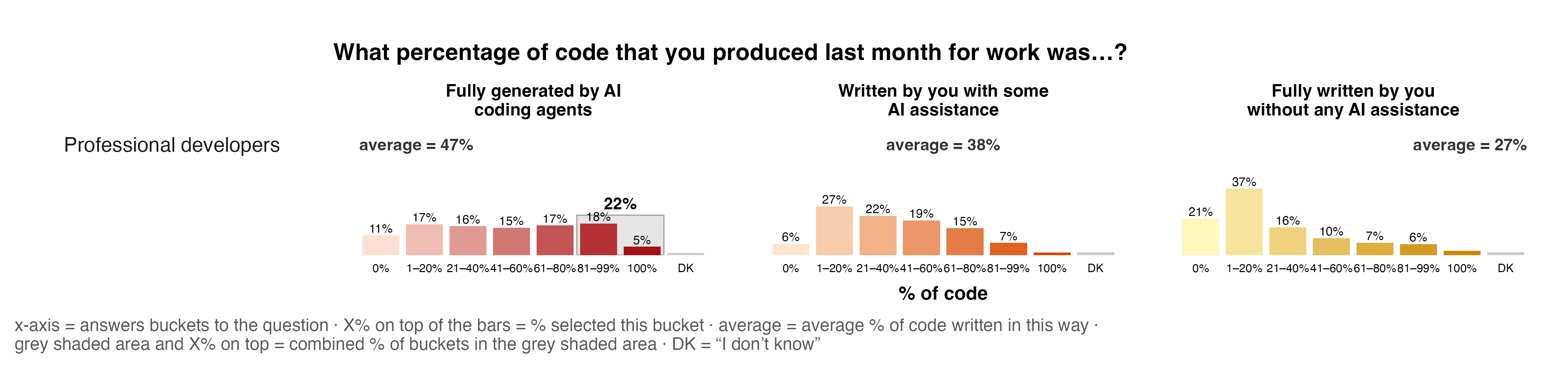
On average, professional developers report that:平均而言,专业开发者报告称:
- ~47% of their code is fully written by agents.~47% 的代码完全由智能体编写。
- ~38% is written with some AI assistance.~38% 的代码是在 AI 辅助下编写的。
- ~27% is written fully manually.~27% 的代码是完全手动编写的。
However, adoption varies wildly across the board. Over half of all developers now write less than 20% of their code manually, and one in five writes literally zero code without AI help. At the same time, the group that relies almost entirely on coding agents (over 80% agent-generated code) remains a minority of around 22%. Most developers are sitting somewhere in the middle.然而,普及程度在各方面差异巨大。目前超过半数的开发者手动编写的代码量不到 20%,每五个人中就有一人几乎完全不依赖 AI 辅助编写代码。与此同时,完全依赖编码智能体(超过 80% 的代码由智能体生成)的群体仍是少数,约占 22%。大多数开发者处于中间地带。
Agentic coding by professional experience按专业经验划分的智能体编码情况
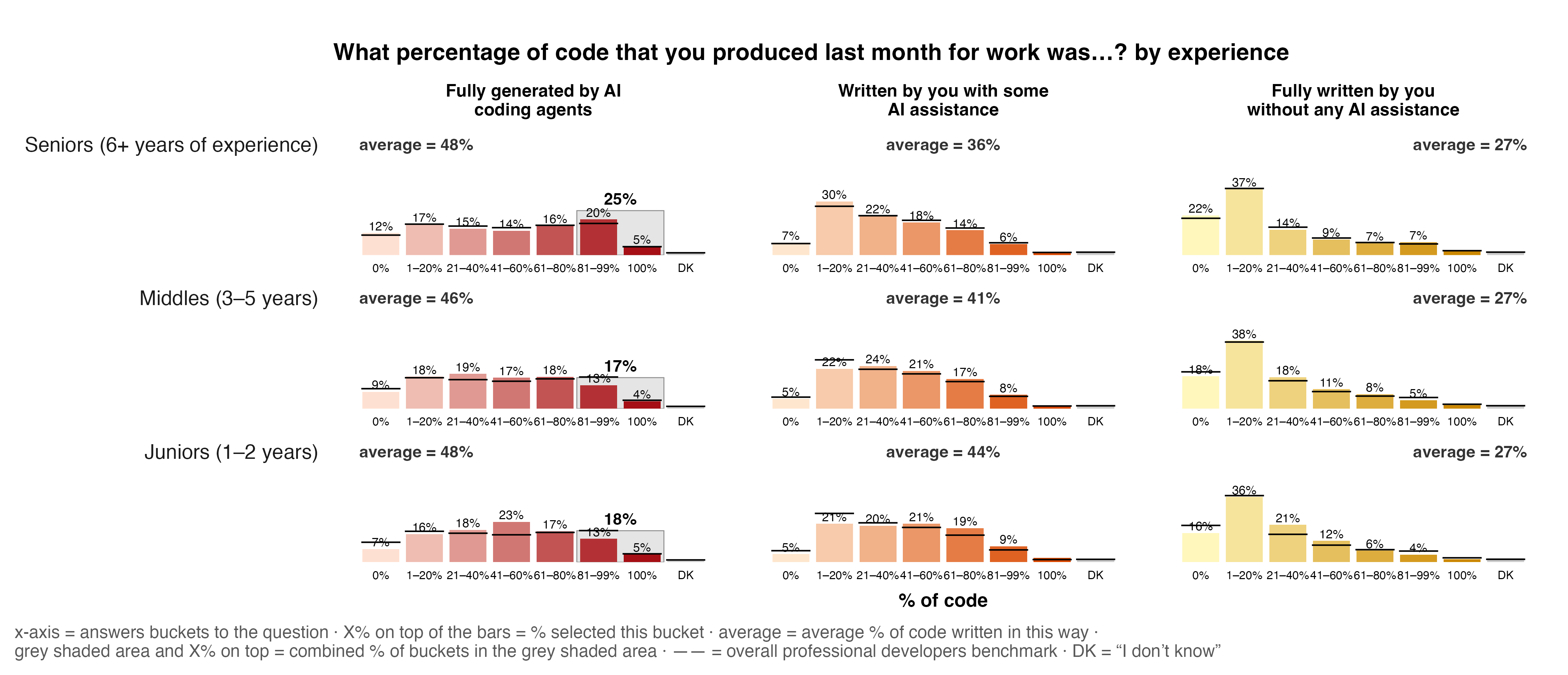
Interestingly, senior developers are among the first to hand coding over to agents. About a quarter of senior developers generate the vast majority of their code (over 80%) using agents, compared to a smaller fraction of juniors who tend to lean more toward AI-assisted workflows rather than fully agentic coding.有趣的是,资深开发者是首批将编码任务移交给智能体的人群。约有四分之一的资深开发者使用智能体生成了绝大部分代码(超过 80%),而初级开发者的比例则较低,他们倾向于采用 AI 辅助工作流,而非完全由智能体编码。
That said, not all seniors are agentic-first yet. Adoption varies widely within this group. See the charts below.话虽如此,并非所有资深开发者都已优先采用智能体。该群体内部的普及程度差异很大。请参阅下方的图表。
Agentic coding by most-used AI coding tools按最常用 AI 编码工具划分的智能体编码情况
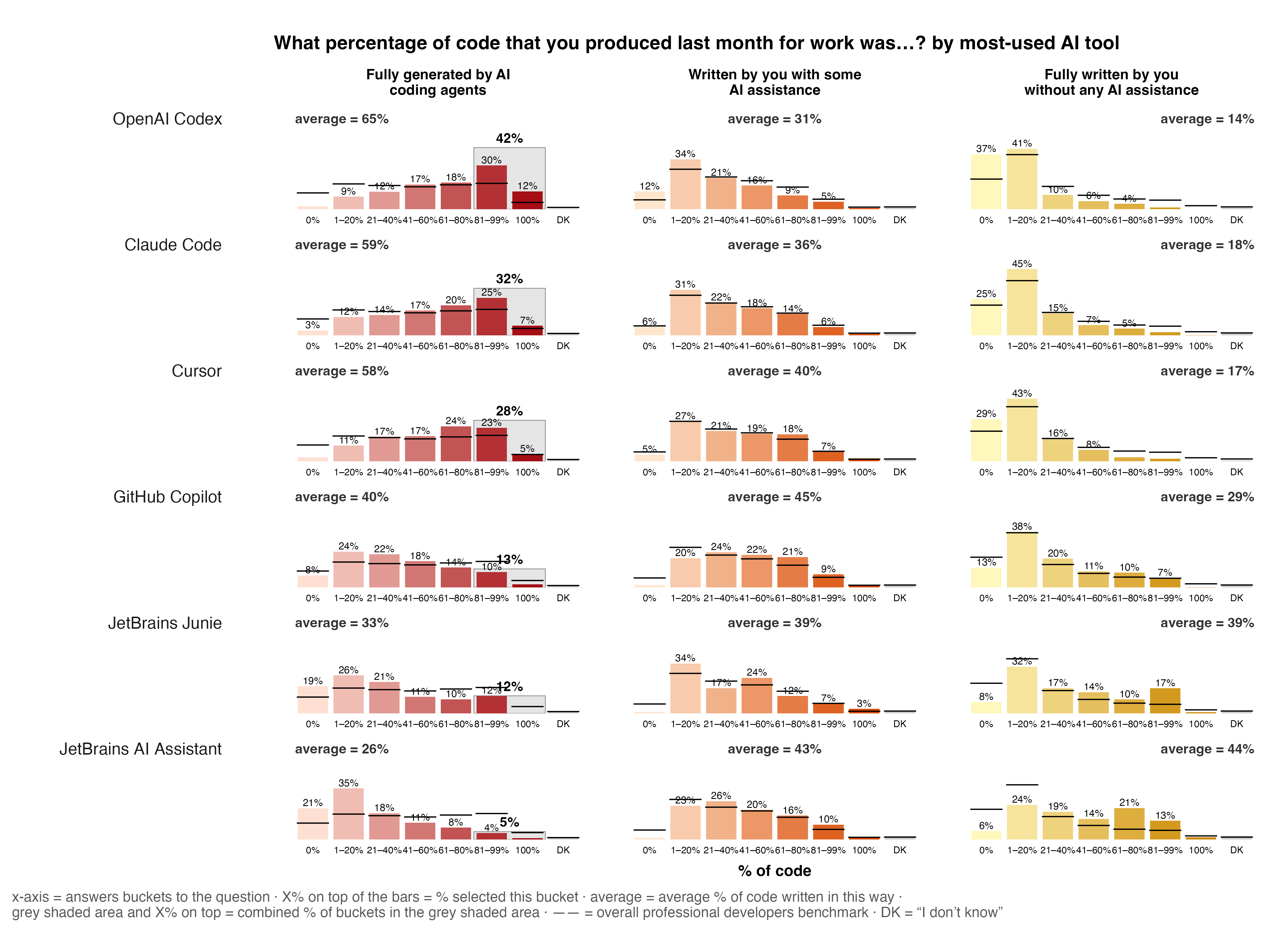
About 32% of developers who report Claude Code as their most-used AI coding tool generate over 80% of their code with agents.在报告称 Claude Code 为其最常用 AI 编码工具的开发者中,约有 32% 的人使用智能体生成了超过 80% 的代码。
Interestingly, among developers who use Codex, this share is notably higher at 42%. The share of developers who don’t write code without AI assistance at all is 37% among Codex users, which is tangibly higher than among users of other AI coding tools.有趣的是,在使用 Codex 的开发者中,这一比例显著更高,达到 42%。在 Codex 用户中,完全不使用 AI 辅助编写代码的开发者比例为 37%,这明显高于其他 AI 编码工具的用户群体。
Our interpretation is that while Claude Code is increasingly becoming the mainstream AI coding tool (already the de facto standard, with 39% adoption at work), its audience no longer consists predominantly of advanced users of agents. Codex, on the other hand, is catching up in terms of awareness and adoption, and its user base might have more advanced users seeking better value for money (Codex has historically offered higher quotas).我们的解读是,虽然 Claude Code 正日益成为主流 AI 编码工具(已成为事实上的标准,工作中使用率达 39%),但其受众已不再主要是智能体的高级用户。另一方面,Codex 在知名度和普及度上正在迎头赶上,其用户群中可能包含更多寻求更高性价比的高级用户(Codex 历史上提供了更高的配额)。
Cursor users are similar to Claude Code users – on average, 58% of their code is agent-generated, and for 28% of its users, coding agents generate over 80% of their code.Cursor 用户的情况与 Claude Code 用户相似——平均而言,他们 58% 的代码由智能体生成,且 28% 的用户有超过 80% 的代码是由智能体生成的。
Agentic coding by main programming language按主要编程语言划分的智能体编码情况
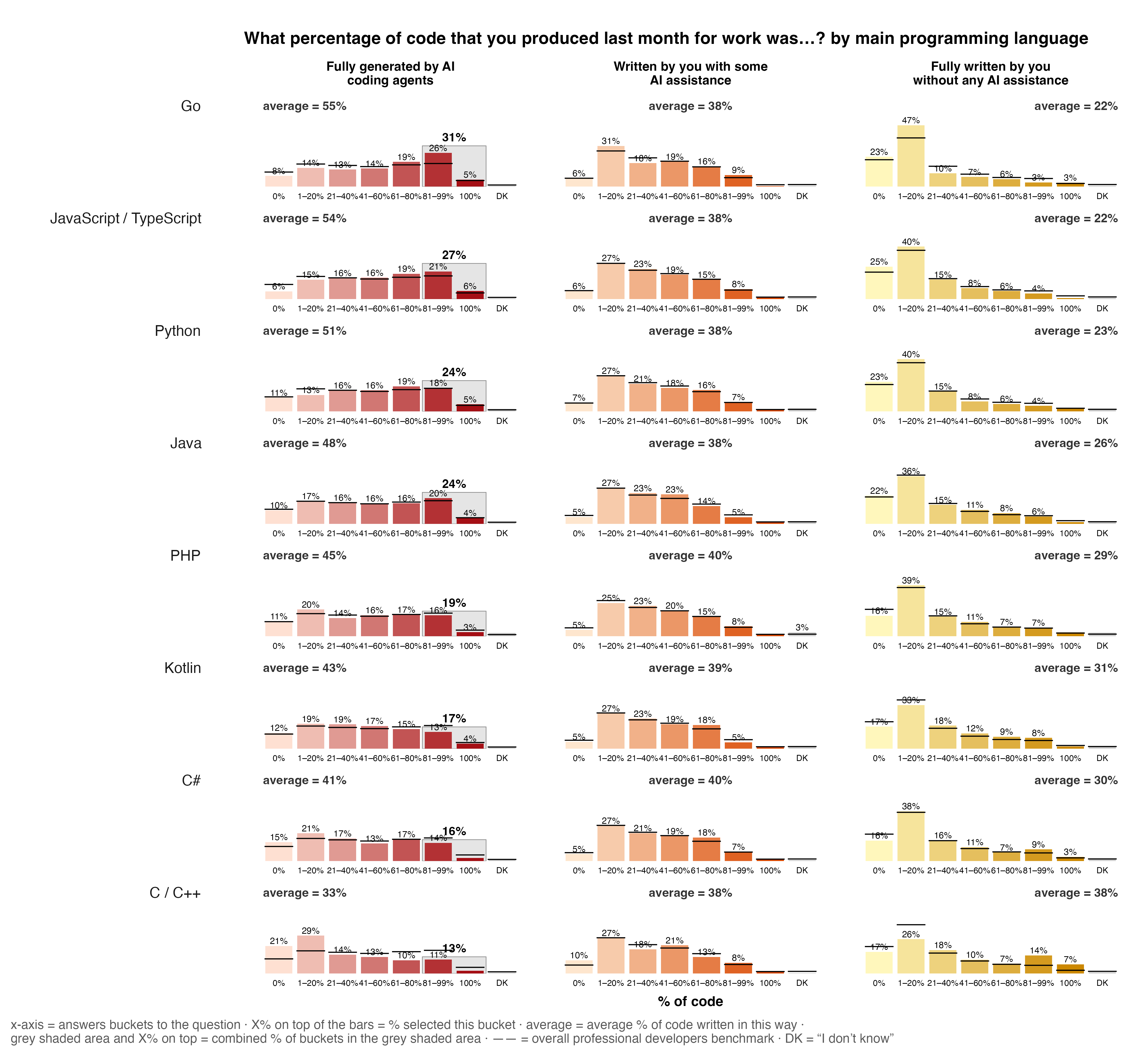
There is a clear split in agentic coding adoption by tech stack. Developers with Go, JavaScript, and TypeScript as their main programming languages report the highest shares of agent-generated code, averaging 54%–55%.智能体编码的普及程度在不同技术栈之间存在明显分化。以 Go、JavaScript 和 TypeScript 为主要编程语言的开发者报告的智能体生成代码比例最高,平均为 54%–55%。
On the other end of the spectrum, C and C++ developers remain the least agentic, maintaining a much higher proportion of manually written code – 38% on average.在另一端,C 和 C++ 开发者仍然最少使用智能体,他们保持着更高比例的手动编写代码——平均为 38%。
Java and Python developers sit in the middle with 48%–51%.Java 和 Python 开发者处于中间水平,比例为 48%–51%。
Agentic coding by regions按地区划分的智能体编码情况
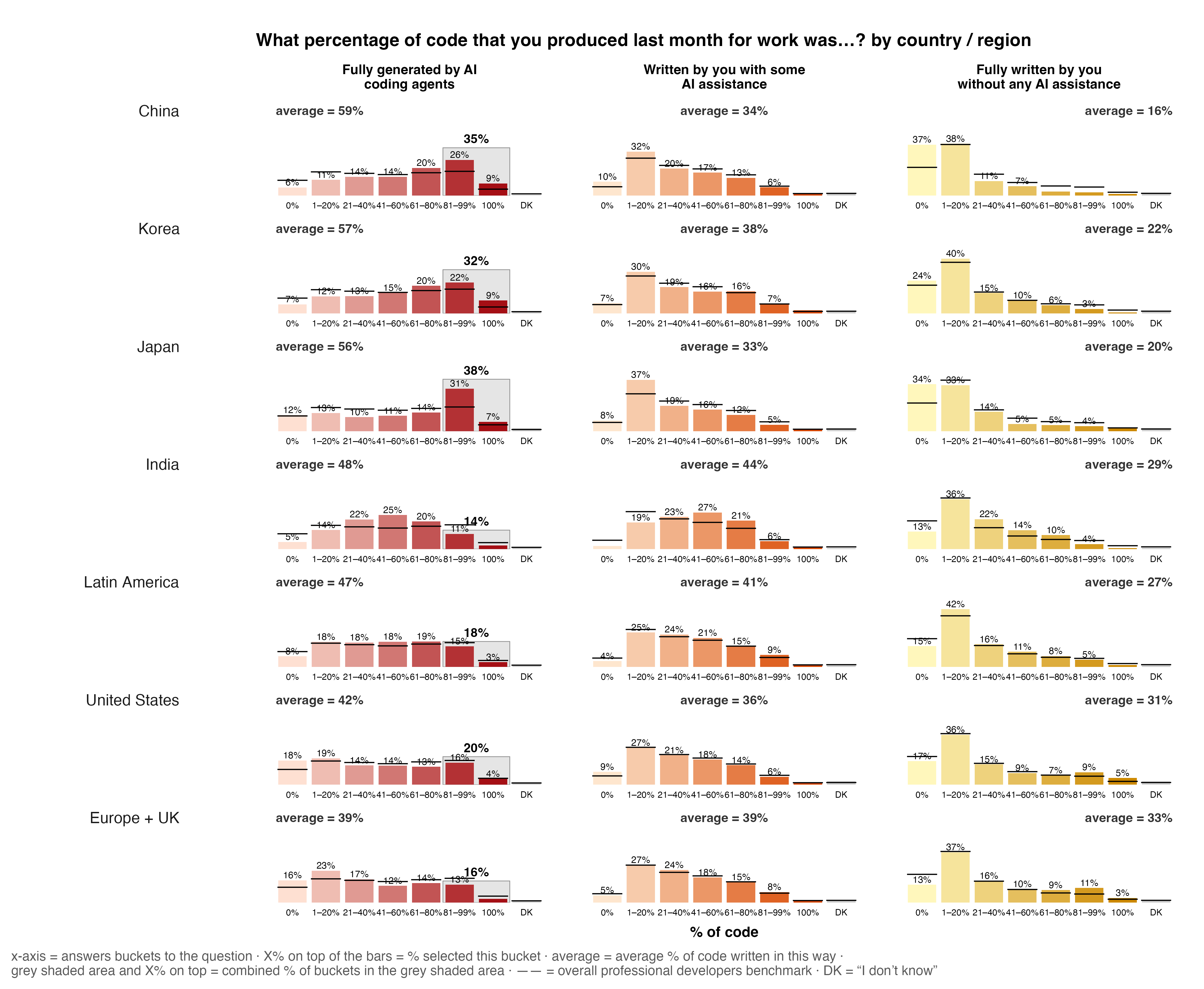
The geographic differences are remarkable. Developers across East Asia, particularly in China, Japan, and South Korea, are leading the charge in agentic coding: About twice as many developers there (32%–35%) generate the vast majority of their code (over 80%) with agents, compared with around 16% of developers in Europe and the UK.地理差异十分显著。东亚地区(特别是中国、日本和韩国)的开发者在智能体编码方面处于领先地位:那里使用智能体生成绝大部分代码(超过 80%)的开发者比例(32%–35%)约为欧洲和英国开发者(约 16%)的两倍。
Segments of developers by AI usage按 AI 使用情况划分的开发者群体
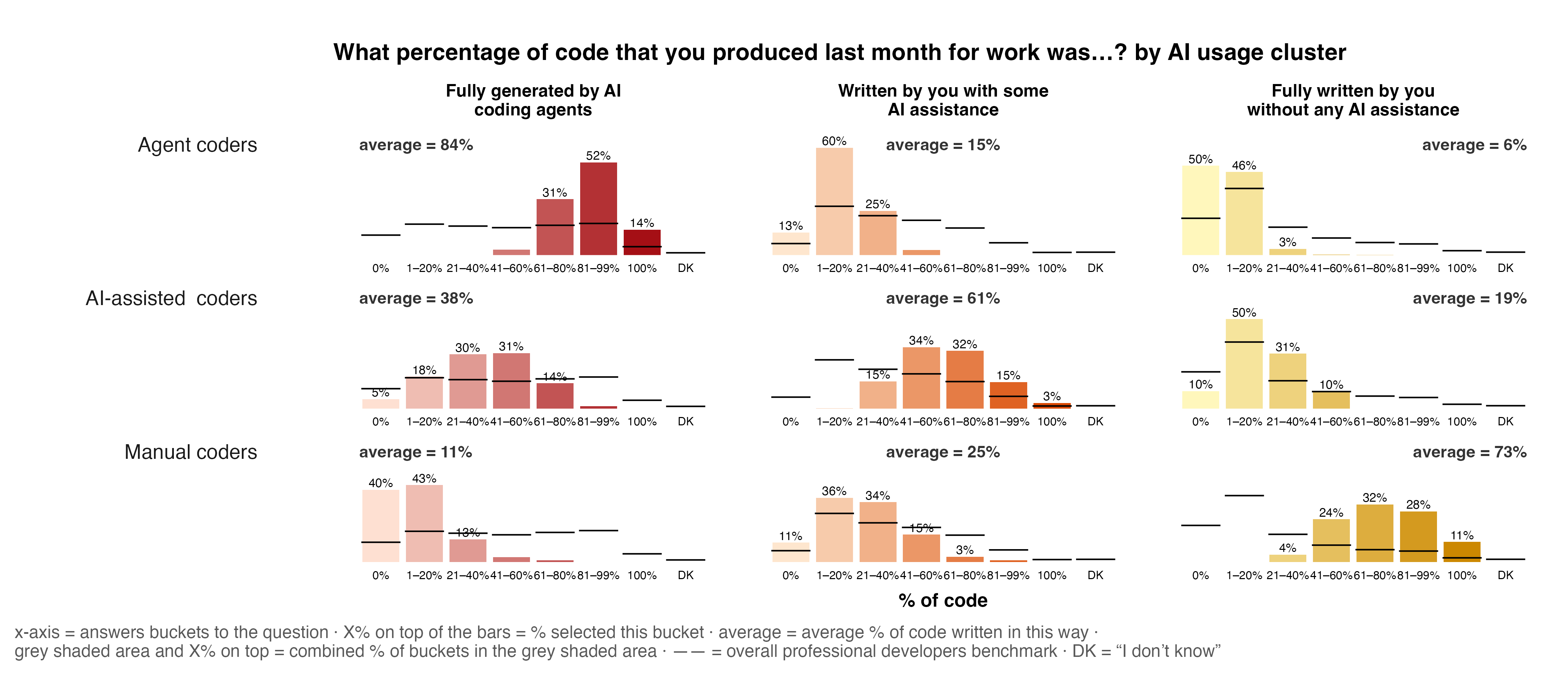
We explored whether developers fall into recognizable groups based on how they write code today. Three profiles emerged: Agentic coders, AI-assisted coders, and manual coders.我们探讨了开发者是否可以根据当前的编码方式划分为不同的群体。最终出现了三种画像:智能体编码者、AI 辅助编码者和手动编码者。
See the methodology notes for more details on how we did this.有关我们如何进行此项分析的更多详情,请参阅方法论说明。
We deliberately use the word “coders” here to highlight that this is about the code generation process, not development as a whole.我们在此特意使用“编码者”一词,以强调这指的是代码生成过程,而非整个开发工作。
Agentic coders (~31% of developers) mostly write code with agents nowadays:智能体编码者(约占开发者的 31%)如今主要使用智能体编写代码:
- On average, 84% of their code is fully agent-generated.平均 84% 的代码完全由智能体生成。
- ~15% is written with some AI assistance.~15% 的代码是在 AI 辅助下编写的。
- ~6% is written manually without AI at all. ~6% 的代码完全手动编写,没有任何 AI 参与。
Despite being the locomotives of agentic coding, only 46%–57% of heavy users of Claude Code and Codex are agentic coders.尽管 Claude Code 和 Codex 的重度用户是智能体编码的推动者,但其中只有 46%–57% 属于智能体编码者。
AI-assisted coders (~47% of developers) haven’t gone full agentic yet, but already write a large portion of their code with agents. They still prefer an AI-assisted development workflow and don’t hesitate to write some code manually if needed:AI 辅助编码者(约占开发者的 47%)尚未完全转向智能体,但已经使用智能体编写了很大一部分代码。他们仍然偏好 AI 辅助的开发工作流,并且在必要时会毫不犹豫地手动编写部分代码:
- On average, 40% of their code is fully agent-generated.平均 40% 的代码完全由智能体生成。
- ~60% is written with AI assistance.~60% 的代码是在 AI 辅助下编写的。
- ~20% is written manually.~20% 的代码是手动编写的。
Manual coders (~23% of developers) write most of their code manually, though they use AI sometimes, mostly in an AI-assisted rather than fully agentic manner:手动编码者(约占开发者的 23%)大部分代码仍手动编写,尽管他们有时会使用 AI,但更多是以 AI 辅助而非完全智能体的方式:
- On average, ~10% of their code is agent-generated.平均 ~10% 的代码由智能体生成。
- ~25% is AI-assisted.~25% 的代码是 AI 辅助编写的。
- ~75% is manually written.~75% 的代码是手动编写的。
Whether you are all-in on agentic workflows or prefer hands-on coding, the shift is clear: Purely manual coding is quickly becoming a thing of the past.
In our previous blog post, based on the same survey data, we explored trends in AI coding agent adoption across the industry and the main players in this market.无论您是全面拥抱智能体工作流,还是偏好亲手编码,这种转变显而易见:纯手动编码正迅速成为过去。在我们基于相同调查数据的上一篇博客文章中,我们探讨了 AI 编码智能体在行业内的普及趋势以及该市场的主要参与者。
We plan to share more materials on agentic development from the Developer Ecosystem Survey 2026 with the community soon. 我们计划很快与社区分享更多来自《2026 开发者生态系统调查》关于智能体开发的内容。
Stay tuned and subscribe to JetBrains Research blog updates below!请保持关注,并在下方订阅 JetBrains 研究博客的更新!
Methodology notes方法论说明
Unrealistic responses – where the sum of the lower bounds of selected answers exceeded 150% or the sum of the upper bounds of selected answers fell below 80% – were not used in this analysis. This filter was applied on top of the regular data-cleaning filters used for Developer Ecosystem Survey data.本次分析剔除了不切实际的回答——即所选答案的下限之和超过 150%,或所选答案的上限之和低于 80% 的数据。此过滤条件是在《开发者生态系统调查》数据常规清洗过滤器的基础上应用的。
We used the midpoint of each answer bucket (0%, 10.5%, 30.5%, 50.5%, 70.5%, 90%, 100%) to calculate averages. The averages across the three categories of how code is written within the same group (e.g. seniors) could exceed 100% because of the bucketed nature of the answers, and respondents’ self-reports may not always be fully accurate.我们使用每个答案区间的中间值(0%、10.5%、30.5%、50.5%、70.5%、90%、100%)来计算平均值。由于答案采用了区间形式,且受访者的自我报告可能并不完全准确,同一群体(例如资深开发者)内三种编码方式的平均值之和可能会超过 100%。
We employed hierarchical cluster analysis with the Ward method and Euclidean distance on unstandardized bucket midpoints (e.g. 0%, 10.5%, 30.5%) to clusterize developers into homogeneous segments based on how they write code.我们采用了分层聚类分析(Ward 方法和欧几里得距离),对非标准化的区间中间值(例如 0%、10.5%、30.5%)进行处理,从而根据开发者的编码方式将其划分为同质群体。
In this report, “professional developers” refers to respondents who reported being involved in coding or programming in any of the following job roles:在本报告中,“专业开发者”指报告称从事以下任何职位并涉及编码或编程的受访者:
- Developer / Programmer / Software Engineer开发者 / 程序员 / 软件工程师
- AI / ML EngineerAI / ML 工程师
- DevOps Engineer / Infrastructure DeveloperDevOps 工程师 / 基础设施开发者
- Architect架构师
- Data Scientist / Data Engineer / Data Analyst数据科学家 / 数据工程师 / 数据分析师
- QA EngineerQA 工程师
Roughly 90% of the sample falls into the Developer / Programmer / Software Engineer job category.样本中约 90% 的受访者属于“开发者 / 程序员 / 软件工程师”类别。
The Developer Ecosystem Survey is localized into eight languages: English, Spanish, Chinese, Japanese, Korean, German, French, and Portuguese. We apply quotas on the required number of responses by region to help achieve accurate global representation. The quotas are proportionate to the number of developers in each region, based on estimates by our Data Science team. The detailed methodology of these estimates is described here.《开发者生态系统调查》本地化为八种语言:英语、西班牙语、中文、日语、韩语、德语、法语和葡萄牙语。我们对各地区的所需回复数量设定了配额,以帮助实现准确的全球代表性。配额与各地区的开发者数量成正比,该数据基于我们数据科学团队的估算。这些估算的详细方法论在此处描述。
The Developer Ecosystem Survey has been statistically reweighted to better represent the global developer population by region, employment status, programming language, and familiarity with JetBrains products (to avoid data skewed toward an excessively JetBrains-familiar audience). You can read about the weighting methodology for the Developer Ecosystem Survey here.《开发者生态系统调查》已进行统计加权,以更好地代表全球开发者群体(按地区、就业状况、编程语言和对 JetBrains 产品的熟悉程度,以避免数据偏向于过度熟悉 JetBrains 的受众)。您可以在此处阅读《开发者生态系统调查》的加权方法论。