Scientific computing in the age of agentic AI智能体 AI 时代的科学计算
A field report shows how scientists are using coding agents to modernize scientific software for genomics and other data-rich fields.一份实地报告展示了科学家们如何利用编码智能体来升级基因组学及其他数据密集型领域的科学软件。
Scientific computing is a core pillar of modern research across academia and industry. Yet the software needed to analyze scientific information has struggled to keep pace with the rapid rate of data generation. Many widely used research tools began as code accompanying a research paper, built by small academic teams with limited engineering experience and minimal time for packaging, testing, optimization, or long-term support. The result is scientific infrastructure that often depends on slow, fragile workflows requiring constant maintenance. These constraints impede the pace of discovery.科学计算是学术界和工业界现代研究的核心支柱。然而,用于分析科学信息的软件却难以跟上数据生成的迅猛速度。许多广泛使用的研究工具最初只是随研究论文发布的代码,由缺乏工程经验、且在打包、测试、优化或长期支持方面投入时间极少的学术小团队构建。这导致科学基础设施往往依赖于缓慢且脆弱的工作流,需要持续的维护。这些局限性阻碍了发现的步伐。
AI agents are beginning to change that equation. By lowering the costs of engineering work and taking on tedious implementation tasks, they can help researchers prototype ideas more quickly, pursue projects that were previously impractical, and more easily maintain software over the long term. As a result, scientific software becomes more efficient and better maintained, freeing researchers to spend more time on discovery.AI 智能体正开始改变这一局面。通过降低工程工作成本并承担繁琐的实现任务,它们可以帮助研究人员更快地进行想法原型设计,开展以前不切实际的项目,并更轻松地长期维护软件。结果是科学软件变得更加高效且维护得更好,让研究人员能腾出更多时间专注于科学发现。
We’re sharing an exploratory field report of eight agent-assisted scientific computing projects primarily in the life sciences; five using Codex alone, and three using a combination of Codex and Claude Code. The report brings together case studies written by the teams behind each project and identifies recurring themes. The projects range from routine maintenance and targeted optimization to large-scale language migrations and GPU-native redesigns. Contributors report that agents significantly accelerated software development and maintenance, in some cases helping small teams take on work that would otherwise have required far more time or specialized engineering support. But they also highlight the persistent challenge of establishing clear, long-term responsibility and stewardship of the resulting tools.我们分享了一份关于八个智能体辅助科学计算项目的探索性实地报告,这些项目主要集中在生命科学领域;其中五个仅使用 Codex,三个结合使用了 Codex 和 Claude Code。该报告汇集了各项目团队撰写的案例研究,并确定了反复出现的主题。项目范围涵盖了日常维护、针对性优化,以及大规模语言迁移和 GPU 原生重构。贡献者们报告称,智能体显著加快了软件开发和维护速度,在某些情况下,帮助小团队完成了原本需要更多时间或专业工程支持的工作。但他们也强调了建立明确的长期责任制和工具管理机制这一持续存在的挑战。
Contributors consistently describe a shift in the researchers’ role from implementation to verification and orchestration: specifying what to build, defining how to measure correctness, and deciding when a project is ready to ship. In this emerging model, the researchers remain in control of the scientific direction and quality bar, but with velocity uplift provided by agentic assistance贡献者们一致描述了研究人员角色的转变:从实施转向验证和编排,即明确构建目标、定义正确性衡量标准,并决定何时发布项目。在这种新兴模式下,研究人员依然掌控科学方向和质量标准,但智能体的协助提升了开发速度。
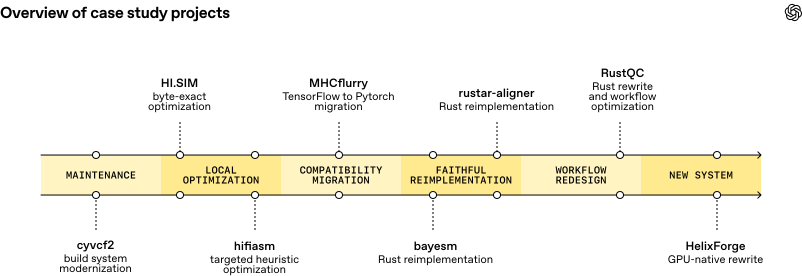
Modernized a widely used library for parsing genomic data升级了一个广泛使用的基因组数据解析库
cyvcf2 is a Python library for reading and writing genomic variant files. GPT‑5.5 replaced the library’s legacy build and packaging system with a modern, unified process designed to make the library easier to install, test, and release.cyvcf2 是一个用于读写基因组变异文件的 Python 库。GPT-5.5 用一个现代化的统一流程取代了该库旧有的构建和打包系统,旨在使其更易于安装、测试和发布。
With coding agents, it's quite easy to go fast; for now, to go far in science, there's still a need for expert guidance, understanding, taste, and care.“有了编码智能体,快速完成任务变得非常容易;但在科学领域要走得更远,依然需要专家的指导、理解、鉴赏力和严谨的态度。”
—Brent Pedersen——Brent Pedersen
Though the projects varied widely in scope, they demonstrated that coding agents are making engineering labor and expertise less of a constraint in scientific computing. Now, the bottleneck is validating an AI agent’s output, which still depends on human judgement.尽管这些项目的范围差异很大,但它们证明了编码智能体正在降低科学计算中对工程劳动力和专业知识的依赖。现在,瓶颈在于验证 AI 智能体的输出,这仍然取决于人类的判断。
Across case studies, agents handled specific, well-scoped requests effectively but could not reliably judge whether their work was scientifically valid or met expectations. Indeed, agents often expressed confidence even when their work contained clear errors. Human reviewers therefore needed to find reliable ways to validate the results. The strongest approaches used an external reference or measurable acceptance target such as exact output agreement, parity with an existing tool, appropriate statistical behavior, or answers established in advance using simulated data.在各案例研究中,智能体能有效处理具体且范围明确的请求,但无法可靠地判断其工作在科学上是否有效或是否符合预期。事实上,即使工作包含明显错误,智能体往往也表现得十分自信。因此,人类审核员需要找到可靠的方法来验证结果。最有效的方法是使用外部参考或可衡量的验收目标,例如精确的输出一致性、与现有工具的对等性、适当的统计行为,或使用模拟数据预先确定的答案。
Another recurring theme was that the projects generally proceeded in stages using feedback-driven iterations rather than as one-shot approaches. Contributors broke down broad goals into smaller changes, then used intermediate benchmarks and test systems to evaluate and refine the agents’ work. Agents often produced initial implementations quickly, but resolving edge cases and subtle numerical differences took much longer. Completing the “last mile” of an implementation often took the most work.另一个反复出现的主题是,项目通常分阶段进行,采用反馈驱动的迭代,而非一蹴而就。贡献者将宏大目标分解为较小的变更,然后利用中间基准和测试系统来评估并完善智能体的工作。智能体通常能快速生成初步实现,但解决边缘情况和细微的数值差异则需要更长时间。完成实现的“最后一公里”往往耗时最多。
Overall, these case studies suggest that agents are enabling researchers to spend less time on implementation and more time directing the scientific work. People define the goal, break down complex projects into manageable chunks, and judge whether results are scientifically valid. By easing longstanding engineering constraints, agents expand what researchers can build while freeing them to focus on the scientific questions and decisions that matter most.总的来说,这些案例研究表明,智能体使研究人员能减少在实现工作上花费的时间,并将更多精力投入到指导科学研究上。人们定义目标,将复杂项目分解为可管理的任务,并判断结果在科学上是否有效。通过缓解长期的工程限制,智能体不仅扩展了研究人员的构建能力,还让他们能专注于最重要的科学问题和决策。
The maintenance gap in research software has long slowed iteration and limited reproducibility and reliability. Published studies of “research code(opens in a new window)” and omics tools(opens in a new window) have found that published software often fails to properly install in a fresh computing setup or run as documented, forcing researchers to spend substantial time on configuration and debugging. Even routine improvements can save researchers time and reduce computing demands, while performance-based refactoring and rewrites can deliver larger gains.研究软件中的维护缺口长期以来减缓了迭代速度,并限制了可重复性和可靠性。对“研究代码(在新窗口中打开)”和组学工具(在新窗口中打开)的已发表研究发现,已发布的软件往往无法在新的计算环境中正确安装或按文档运行,迫使研究人员花费大量时间进行配置和调试。即使是常规改进也能为研究人员节省时间并降低计算需求,而基于性能的重构和重写则能带来更大的收益。
But lower implementation costs also make it easier to produce many similar rewrites, fragmenting users and spreading the expert attention required to keep any one tool reliable. That makes long-term stewardship and attribution essential. Mature scientific software carries undocumented conventions, compatibility requirements, and user trust that translating the source code alone cannot reproduce.但较低的实现成本也使得产生许多类似的重写版本变得更容易,从而导致用户碎片化,并分散了保持工具可靠性所需的专家注意力。这使得长期的管理和归属变得至关重要。成熟的科学软件承载着未记录的惯例、兼容性要求和用户信任,仅仅翻译源代码是无法重现这些内容的。
The case studies illustrate several possible paths forward. Changes to MHCflurry and cyvcf2 were incorporated into their original upstream projects, while rustar-aligner moved under new community stewardship because the original project had been abandoned. Where coordination with existing maintainers is available, it should begin as early as possible. When a separate implementation is necessary, it needs a clear owner and a credible maintenance plan. Without that, today’s modern rewrite can become tomorrow’s abandoned code rather than reliable scientific infrastructure.这些案例研究展示了几种可行的前进路径。MHCflurry 和 cyvcf2 的变更被整合到了其原始上游项目中,而 rustar-aligner 则因原项目被废弃而转入新的社区管理之下。在可能的情况下,应尽早与现有维护者进行协调。当必须进行独立实现时,它需要明确的所有者和可靠的维护计划。否则,今天的现代重写版本可能会成为明天被废弃的代码,而不是可靠的科学基础设施。
This field report is retrospective and exploratory, but the case studies point to a practical shift in how scientific software is developed. Coding agents such as Codex can significantly lower the cost of maintenance, migration, optimization, and new implementations. Their long-term scientific value still depends on human decisions around what to build, how to verify it, and who will maintain it. The deeper change is not simply that researchers can produce more software, but that they can focus more of their effort on defining, validating, and stewarding the tools.本实地报告是回顾性且探索性的,但这些案例研究指向了科学软件开发方式的实际转变。像 Codex 这样的编码智能体可以显著降低维护、迁移、优化和新实现的成本。其长期的科学价值仍然取决于人类在构建什么、如何验证以及由谁维护方面的决策。更深层的变化不仅在于研究人员能生产更多软件,而在于他们能将更多精力集中在定义、验证和管理这些工具上。
These case studies show that agents can already accelerate the pace of iteration in scientific computing. As coding agents improve, researchers will be able to spend less time keeping analysis pipelines running and more time advancing their fields.这些案例研究表明,智能体已经能够加快科学计算的迭代步伐。随着编码智能体的进步,研究人员将能够减少维持分析流水线运行的时间,并将更多时间用于推动各自领域的进步。
- 20262026
- Software & Engineering软件与工程