Artificial Intelligence人工智能
Multi-agent social intelligence with Strands Agents and Amazon Bedrock使用 Strands Agents 和 Amazon Bedrock 的多智能体社交情报
Your prospects leave trails across multiple sources: a founder asks “What should I use for X?” in r/SaaS while their product launches on Hacker News. Stack Overflow questions spike. A GitHub repo crosses 2,400 stars. Each signal alone is noise, but correlated across sources, they reveal a prospect ready to buy. Multi-agent systems built with Strands Agents and Amazon Bedrock AgentCore can automate this social intelligence at scale.你的潜在客户在多个来源留下痕迹:创始人在 r/SaaS 上问“我应该用 X 做什么?”,同时他们的产品在 Hacker News 上发布。Stack Overflow 问题激增。GitHub 仓库超过 2400 星。每个信号单独看都是噪音,但跨来源关联后,它们揭示了一个准备购买的潜在客户。使用 Strands Agents 和 Amazon Bedrock AgentCore 构建的多智能体系统可以大规模自动化这种社交情报。
Thrad.ai is building the advertising infrastructure for AI, introducing paid ads in LLMs. Their platform lets chat interfaces monetize through ads and lets brands advertise in them. They faced an especially signal-rich version of this problem. Tracking these patterns manually doesn’t scale, and generic outreach lacks the context that makes email worth opening. Thrad.ai’s sales team spent 30 to 45 minutes researching each lead across six sources before writing one outreach email.Thrad.ai 正在构建 AI 的广告基础设施,在 LLM 中引入付费广告。他们的平台让聊天界面通过广告变现,并让品牌在其中投放广告。他们面临一个信号特别丰富的版本问题。手动追踪这些模式无法规模化,而通用外联缺乏让邮件值得打开的上下文。Thrad.ai 的销售团队在写一封外联邮件之前,平均花 30 到 45 分钟跨六个来源研究每个潜在客户。
A single AI agent can’t solve this: the signal diversity is too broad, the source APIs too varied, and the analysis too nuanced for one model to handle well. With multi-agent orchestration, you assign each source to a specialist agent, then fuse results through a dedicated analysis agent that spots cross-source patterns.单个 AI 智能体无法解决这个问题:信号多样性太广,来源 API 差异太大,分析过于细致,一个模型难以处理。通过多智能体编排,你可以将每个来源分配给一个专业智能体,然后通过一个专门的智能体融合结果,该智能体负责识别跨来源模式。
This post shows how Thrad.ai deployed a multi-agent system with Strands Agents and Amazon Bedrock AgentCore that automates the pipeline from prospect discovery through personalized email generation. The post compares two orchestration patterns (Swarm and Graph) with head-to-head benchmarks on latency, cost, and email quality. You’ll also learn how the system scores prospects using weighted criteria, intent classification, and temporal decay, plus governance controls for production deployment.本文展示了 Thrad.ai 如何使用 Strands Agents 和 Amazon Bedrock AgentCore 部署了一个多智能体系统,该系统实现了从潜在客户发现到个性化邮件生成的自动化流程。文章比较了两种编排模式(Swarm 和 Graph),并提供了延迟、成本和邮件质量的头对头基准测试。你还将了解系统如何使用加权标准、意图分类和时间衰减来评分潜在客户,以及生产部署的治理控制。
You can apply these patterns to competitive intelligence, candidate sourcing, and market research. A companion repository is available to help you follow along.你可以将这些模式应用于竞争情报、候选人搜寻和市场研究。附带了一个配套仓库,帮助你跟进。
Prerequisites前提条件
This post assumes familiarity with Python, AWS Cloud Development Kit (AWS CDK) basics, and large language model (LLM) concepts.本文假设你熟悉 Python、AWS Cloud Development Kit (AWS CDK) 基础和大型语言模型 (LLM) 概念。
- AWS account with Amazon Bedrock access (Claude Sonnet 4.6 model enabled) and Amazon Bedrock AgentCore.拥有 Amazon Bedrock 访问权限(已启用 Claude Sonnet 4.6 模型)和 Amazon Bedrock AgentCore 的 AWS 账户。
- Permissions for Amazon DynamoDB, AWS Lambda, AWS Secrets Manager, and AWS CDK.Amazon DynamoDB、AWS Lambda、AWS Secrets Manager 和 AWS CDK 的权限。
- Python 3.12+, Node.js 18+Python 3.12+、Node.js 18+
strands-agents>=1.25.0,bedrock-agentcore[strands-agents]>=1.2.1,pydantic>=2.12.5strands-agents>=1.25.0、bedrock-agentcore[strands-agents]>=1.2.1、pydantic>=2.12.5- Approximately 60 minutes for hands-on deployment, approximately $3 to $5 (Amazon Bedrock model invocations).动手部署大约需要 60 分钟,成本约 3 到 5 美元(Amazon Bedrock 模型调用)。
- Important: Deployed resources (DynamoDB tables, Lambda functions, AgentCore services) incur charges while running. Complete the Clean up steps after finishing the tutorial to avoid ongoing costs.重要提示:已部署的资源(DynamoDB 表、Lambda 函数、AgentCore 服务)在运行时会产生费用。完成教程后,请执行清理步骤以避免持续产生费用。
Note: You can follow this post conceptually without deploying. To run the code yourself, you’ll need the preceding prerequisites.注意:你可以通过概念理解本文而无需实际部署。要亲自运行代码,你需要满足上述前提条件。
Full setup guide: README.md完整设置指南:README.md
Solution overview解决方案概览
With this architecture illustrated in Figure 1, you can turn raw social signals into personalized outreach automatically. Four specialized agents handle discovery, enrichment, scoring, and email generation, each with its own tools and strict output validation.通过图 1 所示的架构,你可以自动将原始社交信号转化为个性化外联。四个专业智能体分别负责发现、丰富、评分和邮件生成,每个都有自己的工具和严格的输出验证。
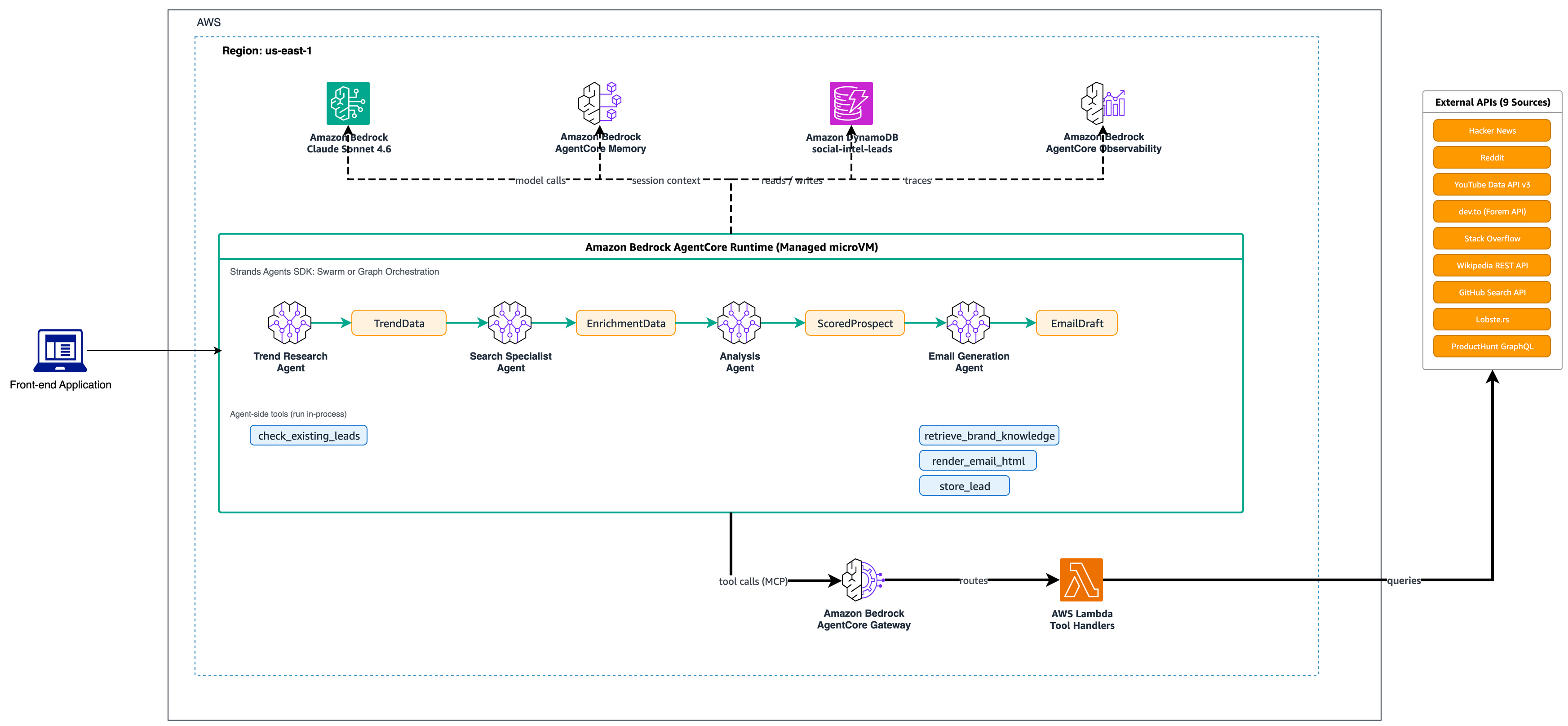
Four-agent pipeline with Amazon Bedrock AgentCore Runtime, Gateway, Memory, and Observability四智能体流水线,配备 Amazon Bedrock AgentCore 运行时、网关、内存和可观测性
The following table describes each agent’s role, tools, and the AgentCore services it uses.下表描述了每个智能体的角色、工具及其使用的 AgentCore 服务。
| Agent | Role | Tools | AgentCore Services |
| Trend Research | Discovers trending launches and buying-intent signals | Hacker News, YouTube, dev.to, ProductHunt, Reddit, Stack Overflow APIs | Runtime, Gateway |
| Search Specialist | Enriches prospect profiles with context | Wikipedia, GitHub, Lobste.rs, Stack Overflow APIs | Runtime, Gateway |
| Analysis | Scores prospect-trend pairs (0-100) | Scoring engine, ICP matcher | Runtime, Memory |
| Email Generation | Drafts personalized outreach | Brand knowledge retrieval, lead storage | Runtime, Gateway, Memory |
Two agents start data collection in parallel. The Trend Research Agent queries six sources (Hacker News, YouTube, dev.to, ProductHunt, Reddit, Stack Overflow) for trending launches and buying-intent signals. Meanwhile, the Search Specialist Agent enriches each prospect via Wikipedia, GitHub, Lobste.rs, and Stack Overflow.两个智能体并行开始数据收集。趋势研究智能体查询六个来源(Hacker News、YouTube、dev.to、ProductHunt、Reddit、Stack Overflow),寻找热门发布和购买意图信号。同时,搜索专家智能体通过 Wikipedia、GitHub、Lobste.rs 和 Stack Overflow 丰富每个潜在客户信息。
After both agents finish, the Analysis Agent scores each prospect-trend pair from 0 to 100 using Claude Sonnet 4.6 on Amazon Bedrock. The agents use a global inference profile (global.anthropic.claude-sonnet-4-6), which routes requests to the nearest available Region. This avoids region-specific model ARNs in IAM policies and streamlines multi-Region deployment. High-scoring prospects flow to the Email Generation Agent, which drafts personalized email messages tied to specific trends and validates each draft against brand guidelines.两个智能体完成后,分析智能体使用 Amazon Bedrock 上的 Claude Sonnet 4.6 对每个潜在客户-趋势对进行 0 到 100 的评分。智能体使用全局推理配置文件(global.anthropic.claude-sonnet-4-6),该配置将请求路由到最近可用区域。这避免了 IAM 策略中特定区域的模型 ARN,并简化了多区域部署。高分潜在客户流向邮件生成智能体,该智能体起草与特定趋势相关的个性化邮件,并根据品牌指南验证每封草稿。
Each agent owns one responsibility, one set of tools, and one Pydantic-validated output contract. Pydantic is a Python data validation library that enforces type-safe schemas at runtime. If an agent returns data in the wrong shape, the system catches it before the next agent sees it.每个智能体拥有一个职责、一组工具和一个经过 Pydantic 验证的输出契约。Pydantic 是一个 Python 数据验证库,在运行时强制执行类型安全模式。如果智能体返回格式错误的数据,系统会在下一个智能体看到之前捕获它。
The Reddit tool scans five subreddits (r/SaaS, r/startups, r/devtools, r/selfhosted, r/Entrepreneur) and uses keyword pattern matching to classify posts into four intent categories: recommendation-seeking, competitor frustration, product launch, and purchase intent. When a Hacker News launch also appears in a Reddit “what tool should I use?” thread, that prospect scores higher.Reddit 工具扫描五个子版块(r/SaaS、r/startups、r/devtools、r/selfhosted、r/Entrepreneur),并使用关键词模式匹配将帖子分为四个意图类别:寻求推荐、对竞争对手不满、产品发布和购买意图。当 Hacker News 上的发布也出现在 Reddit 的“我应该用什么工具?”帖子中时,该潜在客户得分更高。
The scoring relies on signal triangulation: a prospect needs correlated evidence from at least two independent sources. The Trend Research Agent first calls check_existing_leads to skip prospects already in the pipeline. A trending Hacker News post with no Reddit discussion, no Stack Overflow activity, and zero GitHub stars likely reflects a promotional push. The system filters it before spending tokens on analysis.评分依赖于信号三角定位:潜在客户需要来自至少两个独立来源的相关证据。趋势研究智能体首先调用 check_existing_leads 来跳过已在流程中的潜在客户。一个热门的 Hacker News 帖子如果没有 Reddit 讨论、Stack Overflow 活动和 GitHub 星标,很可能只是推广。系统会在花费代币分析之前将其过滤掉。
The Analysis Agent applies five weighted criteria: topical alignment (25%), timing relevance (20%), engagement potential (20%), intent signals (20%), and data quality (15%). Ideal customer profile (ICP) matching adds up to 10 bonus points for developer tools with open source presence and B2B focus. Temporal decay sharpens the score: signals under 24 hours old get 1.5x weight, signals over 7 days get 0.5x.分析智能体应用五个加权标准:主题对齐(25%)、时间相关性(20%)、参与潜力(20%)、意图信号(20%)和数据质量(15%)。理想客户档案 (ICP) 匹配为具有开源存在和 B2B 重点的开发工具最多增加 10 分奖励。时间衰减使评分更精准:24 小时内的信号权重为 1.5 倍,超过 7 天的信号权重为 0.5 倍。
Strands orchestration: Swarm vs. GraphStrands 编排:Swarm 与 Graph
Now comes the central design decision: how do four agents coordinate? Strands Agents provides two orchestration patterns. Thrad.ai built both and compared them against the same 50-prospect workload. The following sections walk through each pattern, then present benchmark results.现在到了核心设计决策:四个智能体如何协调?Strands Agents 提供了两种编排模式。Thrad.ai 构建了这两种模式,并针对相同的 50 个潜在客户工作负载进行了比较。以下章节逐一介绍每种模式,然后展示基准测试结果。
Swarm: Autonomous handoffsSwarm:自主交接
Figure 2 illustrates how agents are passing control via the handoff_to_agent tool with shared context. In Swarm orchestration, agents pass control dynamically using a handoff_to_agent tool. The Trend Research Agent discovers prospects and hands off to Search Specialist for enrichment. Search Specialist passes to Analysis for scoring. If data is sparse, Analysis can hand back to Trend Research for additional context. Agents share a common working memory.图 2 展示了智能体如何通过 handoff_to_agent 工具在共享上下文中传递控制权。在 Swarm 编排中,智能体使用 handoff_to_agent 工具动态传递控制权。趋势研究智能体发现潜在客户,然后交给搜索专家进行丰富。搜索专家传递给分析智能体进行评分。如果数据稀疏,分析智能体可以交回给趋势研究智能体获取更多上下文。智能体共享一个共同的工作记忆。
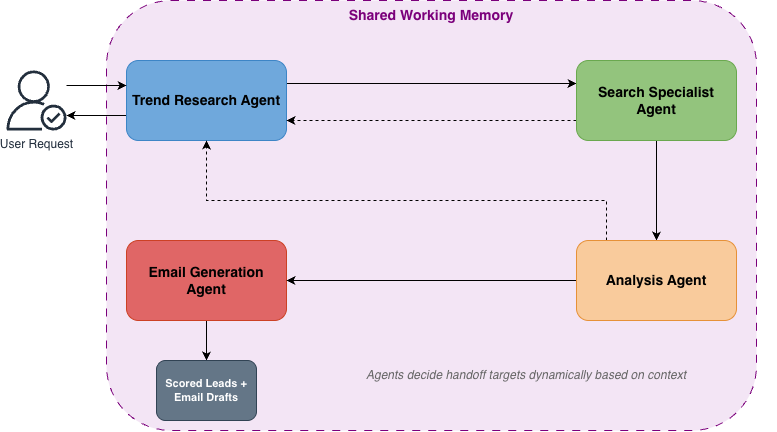
Dynamic agent-to-agent transfers with shared working memory带共享工作记忆的动态智能体间传输
Swarm agents act as self-organizing peers with shared context, where each agent decides when to hand off to a specialist. Trend Research discovers a prospect and hands off to Search Specialist for enrichment, and Search Specialist passes to Analysis for scoring.Swarm 智能体充当自组织的对等节点,共享上下文,每个智能体决定何时交给专家。趋势研究发现潜在客户后交给搜索专家进行丰富,搜索专家再传递给分析智能体进行评分。
If data is thin, Analysis hands back to Trend Research to receive more context. This bidirectional handoff lets agents request additional context when needed.如果数据不充分,分析智能体交回给趋势研究以获取更多上下文。这种双向交接允许智能体在需要时请求更多上下文。
The following code shows how to configure a Swarm with safety bounds:以下代码展示了如何配置带安全边界的 Swarm:
The repetitive handoff parameters matter. Without them, two agents can ping-pong across each other indefinitely. A window of 8 with a minimum of 3 unique agents forces forward progress.重复交接参数很重要。没有它们,两个智能体可能无限地相互来回。一个大小为 8 的窗口,至少包含 3 个不同的智能体,可以强制向前推进。
Swarm works best when prospect complexity varies and agents benefit from re-engaging earlier stages. However, execution paths are harder to predict, and token consumption runs higher from handoff-reasoning overhead.当潜在客户复杂度变化且智能体从重新参与早期阶段中受益时,Swarm 效果最佳。然而,执行路径更难预测,由于交接推理开销,代币消耗更高。
Graph: Structured workflowGraph:结构化工作流
Figure 3 illustrates how a directed graph starts with parallel research and search entry points, then converges at analysis, with a conditional edge to email. In Graph orchestration, agents follow a fixed directed workflow. Trend Research and Search Specialist run in parallel as entry points. Analysis waits for both to finish before running. A conditional edge gates Email Generation, which only runs if the prospect scores 60 or higher.图 3 展示了一个有向图如何以并行研究和搜索入口点开始,然后在分析处汇聚,并有一条条件边指向邮件。在 Graph 编排中,智能体遵循固定的有向工作流。趋势研究和搜索专家作为入口点并行运行。分析等待两者都完成后才运行。一条条件边控制邮件生成,仅当潜在客户得分 60 或以上时才执行。

Parallel entry, all-dependencies-complete gating, and conditional score threshold并行入口、所有依赖完成门控、条件分数阈值
The Graph pattern wires agents into a fixed workflow with explicit, one-way edges. Trend Research and Search Specialist run in parallel, cutting data-gathering time in half. Analysis waits for both to finish. Email runs only if the prospect scores 60 or higher, acting as a policy gate.Graph 模式将智能体连接成具有显式单向边的固定工作流。趋势研究和搜索专家并行运行,将数据收集时间减半。分析等待两者完成。邮件仅在潜在客户得分 60 或以上时运行,充当策略门控。
The following code shows how to define a Graph with parallel entry points and conditional edges:以下代码展示了如何定义具有并行入口点和条件边的 Graph:
Graph shines when the workflow is repeatable and auditability matters. Every run follows the same path, so you can reproduce failures by replaying the same input. The limitation is that it can’t dynamically loop back without explicit feedback edges. If an agent needs more context, you’ll need to add a dedicated feedback edge in the directed acyclic graph (DAG) definition.当工作流可重复且可审计性重要时,Graph 表现出色。每次运行都遵循相同路径,因此你可以通过重放相同输入来重现失败。限制是它无法在没有显式反馈边的情况下动态循环返回。如果智能体需要更多上下文,你需要在有向无环图 (DAG) 定义中添加专门的反馈边。
Head-to-head results头对头结果
Both patterns ran three times against 50 Hacker News prospects. Two reviewers scored email relevance on a 1 to 10 rubric (specificity, tone, accuracy).两种模式各对 50 个 Hacker News 潜在客户运行了三次。两位评审员按照 1 到 10 的评分标准(具体性、语气、准确性)对邮件相关性进行评分。
| Metric | Swarm | Graph |
| Avg latency per prospect | 45s | 32s |
| P95 latency | 78s | 38s |
| Avg tokens per prospect | ~12,000 | ~8,500 |
| Email relevance (human-rated) | 8.2 | 7.6 |
| Cost per prospect (est.) | ~$0.08 | ~$0.06 |
Business impact: For a 1,000-prospect batch, Graph saves approximately 3.6 hours of processing time and $20 in token costs compared to Swarm.业务影响:对于 1000 个潜在客户的批次,与 Swarm 相比,Graph 节省了约 3.6 小时的处理时间和 20 美元的代币成本。
Swarm produced higher-quality email messages (8.2 vs. 7.6) because agents looped back for more context when data was sparse, while Graph cost 25% less per prospect with tighter latency bounds. Thrad.ai chose Graph for nightly batch processing and Swarm for weekly deep-dives on high-value prospects.Swarm 产生了更高质量的邮件(8.2 vs 7.6),因为当数据稀疏时智能体会循环返回获取更多上下文,而 Graph 每个潜在客户成本低 25%,延迟范围更窄。Thrad.ai 选择 Graph 用于夜间批处理,而 Swarm 用于每周对高价值潜在客户进行深入分析。
How to decide: Choose Graph when the workflow is repeatable and you need predictable latency. Choose Swarm when input quality varies and agents need to adapt. You can run both in the same code base, switched by a configuration flag.如何决策:当工作流可重复且需要可预测延迟时,选择 Graph。当输入质量变化且智能体需要适应时,选择 Swarm。你可以在同一个代码库中运行两者,通过配置标志切换。
Deploying on Amazon Bedrock AgentCore在 Amazon Bedrock AgentCore 上部署
Production workloads need session isolation, capacity management, and observability that go beyond local prototyping. Amazon Bedrock AgentCore handles these as managed services. The CDK stack (client-side orchestration code that defines your infrastructure) deploys four services using aws-cdk-lib/aws-bedrock-agentcore-alpha L2 constructs:生产工作负载需要会话隔离、容量管理和可观测性,这些超出了本地原型。Amazon Bedrock AgentCore 将这些作为托管服务处理。CDK 堆栈(定义基础设施的客户端编排代码)使用 aws-cdk-lib/aws-bedrock-agentcore-alpha L2 结构部署四个服务:
- Runtime hosts agents in isolated microVMs (lightweight virtual machines) with AWS Identity and Access Management (IAM) authentication and lifecycle controls (15-min idle timeout, 8-hour max lifetime).运行时将智能体托管在隔离的 microVM(轻量级虚拟机)中,具有 AWS Identity and Access Management (IAM) 身份验证和生命周期控制(15 分钟空闲超时,8 小时最长生命周期)。
- Gateway provides a single Model Context Protocol (MCP) endpoint for the nine tools. MCP is a standard protocol for LLM-tool communication. Agents discover tools dynamically at startup via the Strands
MCPClient.网关为九个工具提供单一的 Model Context Protocol (MCP) 端点。MCP 是 LLM-工具通信的标准协议。智能体在启动时通过 Strands MCPClient 动态发现工具。 - Memory stores short-term context within sessions and long-term semantic data across sessions. Optional; agents degrade gracefully without it.内存存储会话内的短期上下文和跨会话的长期语义数据。可选;没有它,智能体可以优雅降级。
- Observability captures distributed traces via OpenTelemetry (an open standard for telemetry data) with span-level latency and token counts. Integrates with Amazon CloudWatch and third-party services.可观测性通过 OpenTelemetry(遥测数据的开放标准)捕获分布式跟踪,包括跨度级延迟和代币计数。与 Amazon CloudWatch 和第三方服务集成。
Thrad.ai found that YouTube API calls accounted for 40% of total latency. The trace data led the team to add get_with_retry with exponential backoff to HTTP calls.Thrad.ai 发现 YouTube API 调用占总延迟的 40%。跟踪数据促使团队在 HTTP 调用中添加了带有指数退避的 get_with_retry。
The companion README for this blog post and AgentCore documentation provides the full CDK stack, Gateway setup, and deployment walkthrough.本文的配套 README 和 AgentCore 文档提供了完整的 CDK 堆栈、网关设置和部署演练。
Walkthrough: A real run演练:实际运行
Here’s what a Graph run produces against the current Hacker News feed:以下是对当前 Hacker News 内容进行 Graph 运行的结果:
Here’s an example email generated for Prospect A:以下是为潜在客户 A 生成的示例邮件:
Prospect A scored 88 because of cross-source signals (HN + Reddit + dev.to), 2,400 GitHub stars matching ICP criteria, and all signals under 48 hours old (1.5x temporal weight). Prospect C scored below 60 and was skipped, saving ~3,000 tokens. The Graph pattern processed all 50 prospects in under 30 minutes.潜在客户 A 得分为 88,原因是跨来源信号(HN + Reddit + dev.to)、2400 个 GitHub 星标符合 ICP 标准,以及所有信号在 48 小时内(1.5 倍时间权重)。潜在客户 C 得分低于 60,被跳过,节省了约 3000 个代币。Graph 模式在 30 分钟内处理了所有 50 个潜在客户。
What we learned经验教训
Building and benchmarking both orchestration patterns revealed several insights for production multi-agent systems.构建和基准测试两种编排模式揭示了生产多智能体系统的一些见解。
Intent signals beat passive trends: Adding Reddit intent detection increased prospects scoring above 80 by 22% in our tests. A prospect asking “What tool should I use for X?” converts at higher rates than one trending passively.意图信号优于被动趋势:在我们的测试中,添加 Reddit 意图检测使得分超过 80 的潜在客户增加了 22%。一个问“我应该用什么工具做 X?”的潜在客户转化率高于被动趋势的客户。
Temporal decay helps prevent stale outreach: Signals under 24 hours old get 1.5x weight, while signals over 7 days get 0.5x. A Stack Overflow surge from yesterday starts a conversation. One from last month is noise.时间衰减有助于防止过时的外联:24 小时内的信号权重为 1.5 倍,超过 7 天的信号权重为 0.5 倍。昨天 Stack Overflow 的激增可以开启对话。上个月的则是噪音。
Pick the pattern based on the job: Swarm wins on quality when data is sparse. Graph wins on cost and predictability for batch work. Running both in the same system, switched by a configuration flag, gives you flexibility without maintaining separate code bases.根据任务选择模式:当数据稀疏时,Swarm 在质量上胜出。对于批处理工作,Graph 在成本和可预测性上胜出。在同一个系统中运行两者,通过配置标志切换,可以提供灵活性而无需维护单独的代码库。
Governance and human-in-the-loop治理与人工干预
When agents take on more decision-making, you’ll need guardrails. The system implements controls at three levels:当智能体承担更多决策时,你需要护栏。系统在三个层面实施控制:
- Policy gates via conditional edges: The Analysis-to-Email edge checks the relevance score. The system logs prospects below 60 but skips email generation. You can extend this pattern to require human approval before email generation by adding a review node.通过条件边实施策略门控:分析到邮件的边检查相关性分数。系统记录低于 60 分的潜在客户,但跳过邮件生成。你可以扩展此模式,通过添加审查节点要求在生成邮件前获得人工批准。
- Scoped tool access: Each agent receives only the tools it needs. The Email Agent gets
store_leadandretrieve_brand_knowledge. Trend Research getscheck_existing_leadsplus discovery tools. An agent can’t invoke tools outside its scope.限定作用域的工具访问:每个智能体只获得它需要的工具。邮件智能体获得 store_lead 和 retrieve_brand_knowledge。趋势研究获得 check_existing_leads 加上发现工具。智能体不能调用其作用域外的工具。 - Swarm safety bounds: Repetitive handoff detection stops loops.
max_handoffsandexecution_timeoutcap autonomous behavior. These guardrails help prevent runaway token spend.Swarm 安全边界:重复交接检测可阻止循环。max_handoffs 和 execution_timeout 对自主行为设限。这些护栏有助于防止代币消耗失控。
Conclusion结论
You now have a blueprint for building multi-agent social intelligence systems with Strands Agents and Amazon Bedrock AgentCore. With the Swarm and Graph patterns, you can match your orchestration strategy to your workload’s needs. These techniques extend beyond sales intelligence:你现在有了使用 Strands Agents 和 Amazon Bedrock AgentCore 构建多智能体社交情报系统的蓝图。通过 Swarm 和 Graph 模式,你可以将编排策略匹配到工作负载需求。这些技术超越了销售情报:
- Competitive intelligence: Replace discovery tools with competitor monitoring. The same multi-signal fusion detects launches and economic shifts.竞争情报:用竞争对手监控替换发现工具。相同的多信号融合可以检测发布和经济变化。
- Candidate sourcing: Replace sales outreach with recruiting. GitHub contributions, Stack Overflow activity, and dev.to articles are strong candidate signals.候选人搜寻:用招聘替换销售外联。GitHub 贡献、Stack Overflow 活动和 dev.to 文章是强有力的候选人信号。
- Content curation: Replace email generation with content recommendation. Intent signals identify what your audience cares about right now.内容策展:用内容推荐替换邮件生成。意图信号识别你的受众当前关心什么。
“Working with the AWS PACE team helped us turn what was honestly a messy, multi-source problem into something we could actually run in production. With Strands Agents and Amazon Bedrock AgentCore, we’ve reduced a lot of the manual research while improving the timing and relevance of our outreach.“与 AWS PACE 团队合作,帮助我们把这个本来杂乱的多源问题变成了实际可以在生产环境运行的东西。借助 Strands Agents 和 Amazon Bedrock AgentCore,我们减少了大量手动研究,同时提高了外联的时机和相关性。
What’s been especially useful in practice is being able to use both Graph and Swarm depending on the job. Graph lets us process large batches quickly and cheaply, while Swarm helps us go deeper on higher-value leads where extra context actually makes a difference.”在实践中特别有用的是能够根据任务同时使用 Graph 和 Swarm。Graph 让我们快速低成本地处理大批量数据,而 Swarm 帮助我们在更高价值的线索上深入挖掘,额外上下文确实能带来影响。”
— Marco Visentin, Co-founder & CTO of Thrad.ai—— Marco Visentin,Thrad.ai 联合创始人兼 CTO
Next steps后续步骤
To deploy and customize:要部署和自定义:
- Clone the companion repository. Deploy the infrastructure with
cdk deploy --all. Configure API keys in AWS Secrets Manager.克隆配套仓库。使用 cdk deploy --all 部署基础设施。在 AWS Secrets Manager 中配置 API 密钥。 - Swap data sources by registering new Lambda targets in
infra/gateway_stack.py.通过在 infra/gateway_stack.py 中注册新的 Lambda 目标来更换数据源。
To evaluate Swarm vs. Graph:要评估 Swarm 与 Graph:
- Run
python scripts/benchmark.py --prospects 50.运行 python scripts/benchmark.py --prospects 50。 - Compare trace outputs in CloudWatch against your latency and quality requirements.将 CloudWatch 中的跟踪输出与你的延迟和质量要求进行比较。
Clean up清理
To avoid ongoing charges, delete the deployed resources when you are done experimenting:为避免持续费用,请在完成实验后删除已部署的资源:
Confirm the deletion when prompted. This removes DynamoDB tables, Lambda functions, Secrets Manager secrets, and AgentCore services. Warning: This action permanently deletes all stored lead data in DynamoDB. Export any data you need to retain before running the destroy command. Verify deletion in the AWS CloudFormation console by confirming all stacks are removed.在提示时确认删除。这将删除 DynamoDB 表、Lambda 函数、Secrets Manager 密钥和 AgentCore 服务。警告:此操作会永久删除 DynamoDB 中存储的所有潜在客户数据。在运行删除命令之前,请导出任何需要保留的数据。在 AWS CloudFormation 控制台中确认所有堆栈已删除,以验证删除。
Related resources相关资源
- Multi-Agent collaboration patterns with Strands Agents and Amazon Nova.使用 Strands Agents 和 Amazon Nova 的多智能体协作模式。
- AI agents in enterprises: Best practices with Amazon Bedrock AgentCore.企业中的 AI 智能体:使用 Amazon Bedrock AgentCore 的最佳实践。
- Customize agent workflows with advanced orchestration techniques using Strands Agents.使用 Strands Agents 的高级编排技术自定义智能体工作流。
- Amazon Bedrock AgentCore Documentation. GitHub: Companion repository.Amazon Bedrock AgentCore 文档。GitHub:配套仓库。