Artificial Intelligence人工智能
Building trade assistant: How Jefferies optimized front office trading operations with AI构建交易助手:Jefferies 如何利用人工智能优化前台交易运营
If you manage a front office trading desk at investment banks, you know the challenge: traders need real-time insights into client behavior, trade patterns, and market trends from vast amounts of data to make split-second decisions. However, they rarely have the time during the day, nor the coding ability, to build and maintain systems capable of delivering those insights. With millions of rows of data spread across multiple visualization tools, achieving end-to-end visibility is difficult. Traditional approaches force traders to rely on subject matter experts for analysis and collaborate with IT teams to build custom dashboards. The process can take days or weeks. The result is a widening gap between the data available and the decisions it should be informing.如果您是投资银行前台交易台的管理者,您一定了解其中的挑战:交易员需要从海量数据中实时洞察客户行为、交易模式和市场趋势,以便做出瞬息万变的决策。然而,他们在白天很少有时间,也没有足够的编程能力来构建和维护能够提供这些洞察的系统。面对分布在多个可视化工具中的数百万行数据,实现端到端的可见性非常困难。传统方法迫使交易员依赖主题专家进行分析,并与 IT 团队协作构建自定义仪表板。这个过程可能需要几天甚至几周的时间。结果就是可用数据与其应支持的决策之间的差距不断扩大。
Jefferies, a global full-service investment banking firm, recognized this challenge as an opportunity to apply agentic AI to optimize how its equities trading desks operate. By building an agentic AI trade assistant on AWS, Jefferies set out to put the power of real-time data analysis directly in traders’ hands without the requirement of coding, waiting in IT queues, and with no compromise on accuracy.全球全方位服务投资银行 Jefferies 将这一挑战视为应用智能体人工智能(Agentic AI)来优化其股票交易台运营的契机。通过在 AWS 上构建智能体人工智能交易助手,Jefferies 旨在让交易员无需编程、无需排队等待 IT 支持,且在不牺牲准确性的前提下,直接获得实时数据分析能力。
In this post, we explore how Jefferies overcame these challenges with a solution built on Strands Agents, an agent harness SDK for building AI agents that can reason, plan, and act by orchestrating calls to foundation models (FMs) and external tools. The solution uses large language models (LLMs), Amazon Bedrock, and Amazon Bedrock Knowledge Bases. It also uses Model Context Protocol (MCP), an open standard that helps AI agents securely connect to diverse data sources and tools through a unified interface. We cover the solution overview, the rationale for selecting the underlying technology stack, lessons learned, and the business impact the solution created at Jefferies.在本文中,我们将探讨 Jefferies 如何利用基于 Strands Agents 的解决方案克服这些挑战。Strands Agents 是一款用于构建人工智能智能体的 SDK,它通过编排对基础模型(FM)和外部工具的调用,使智能体具备推理、规划和行动能力。该解决方案使用了大语言模型(LLM)、Amazon Bedrock 和 Amazon Bedrock Knowledge Bases。它还采用了模型上下文协议(MCP),这是一种开放标准,可帮助人工智能智能体通过统一接口安全地连接到各种数据源和工具。我们将介绍解决方案概览、选择底层技术栈的理由、经验教训以及该解决方案为 Jefferies 带来的业务影响。
Solution overview解决方案概览
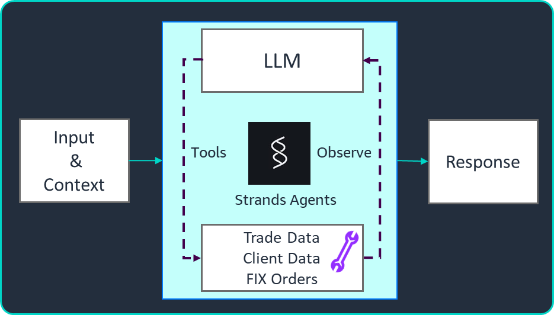
The Front Office trade assistant represents a shift in how Capital Markets’ Front Office Equity traders interact with data. At the core of the solution is a domain-specific agent that drives conversation with traders through natural language text. A set of MCP tools lets the agent connect with data sources, including trade data repositories, Financial Information Exchange (FIX) message files, and in-memory databases. When a trader submits a query to the trade assistant, Amazon Bedrock invokes an LLM (Anthropic Claude) to interpret the natural language intent, generate the corresponding SQL, and run it against underlying data sources to surface the response. The solution has a conversational interface, which allows traders to drill down on topics and explore data insights conversationally. The solution maintains conversation context to provide relevant insights and suggestions for deeper analysis over the entire lifetime of the session.前台交易助手代表了资本市场前台股票交易员与数据交互方式的转变。该解决方案的核心是一个特定领域的智能体,通过自然语言文本与交易员进行对话。一套 MCP 工具使智能体能够连接到各种数据源,包括交易数据存储库、金融信息交换(FIX)消息文件和内存数据库。当交易员向交易助手提交查询时,Amazon Bedrock 会调用大语言模型(Anthropic Claude)来解读自然语言意图,生成相应的 SQL,并在底层数据源上运行以呈现响应。该解决方案具有对话式界面,允许交易员深入探讨主题并以对话方式挖掘数据洞察。解决方案会维护对话上下文,从而在整个会话期间提供相关的见解和更深入的分析建议。
How the solution works解决方案如何工作
The solution integrates with Jefferies’ existing trading infrastructure through an eight-step process depicted in the following architecture diagram. From a security perspective, the solution uses Amazon Bedrock Guardrails to provide content moderation, personally identifiable information (PII) filtering to align the solution with Jefferies policies, and row-level data entitlements to help prevent accidental access to customer-sensitive data through intelligent access controls. It also uses conversation logging for audit trails to meet compliance requirements.该解决方案通过下图中描述的八步流程与 Jefferies 现有的交易基础设施集成。从安全角度来看,该解决方案使用 Amazon Bedrock Guardrails 提供内容审核、个人身份信息(PII)过滤以符合 Jefferies 的政策,并利用行级数据授权通过智能访问控制防止意外访问客户敏感数据。它还使用对话日志进行审计跟踪,以满足合规性要求。
The user interaction begins with the Jefferies front-end trading interface, which now includes an embedded AI assistant widget. When a trader poses a question, the request flows through a carefully orchestrated workflow.用户交互始于 Jefferies 的前端交易界面,该界面现已嵌入人工智能助手小部件。当交易员提出问题时,请求将通过精心编排的工作流进行处理。
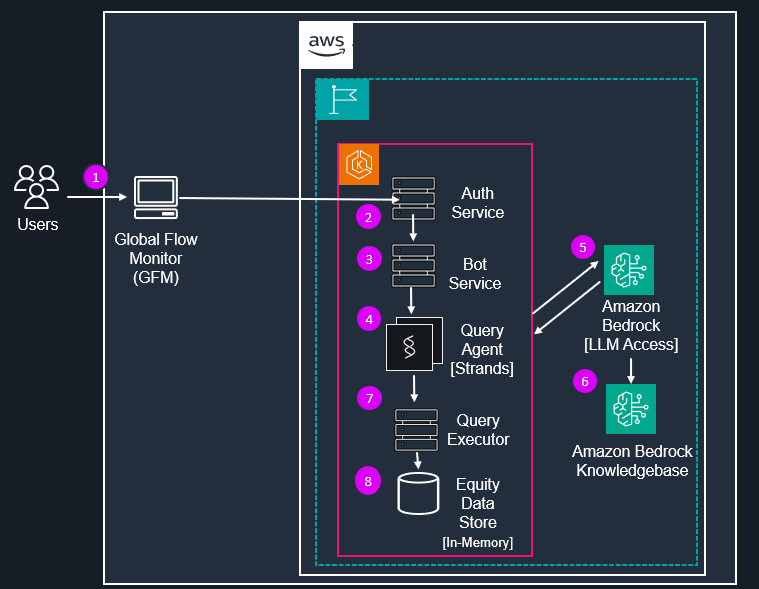
- UI Widget: First, the trader logs in using their credentials on Jefferies’ on-premises Business Intelligence system: Global Flow Monitor (GFM). Once a trader logs into GFM, they have a UI widget to interact with the Trade Assistant Agent.UI 小部件:首先,交易员使用其凭据登录 Jefferies 的本地商业智能系统:Global Flow Monitor (GFM)。交易员登录 GFM 后,即可通过 UI 小部件与交易助手智能体进行交互。
- The Authentication Service uses Amazon Elastic Kubernetes Service (Amazon EKS). The service verifies that only allowed traders can access sensitive trading data.身份验证服务使用 Amazon Elastic Kubernetes Service (Amazon EKS)。该服务确保只有获得授权的交易员才能访问敏感交易数据。
- Bot Service builds and manages the user session, maintaining context across multiple queries.机器人服务构建并管理用户会话,在多次查询中保持上下文。
- The Query Agent (Strands) serves as the intelligent orchestration layer of the solution. When a trader poses a natural language question, the agent first queries the Amazon Bedrock Knowledge Bases, which uses Amazon Titan Embeddings for semantic retrieval to surface relevant database schemas, table relationships, and query patterns. With this context, Claude Sonnet reasons over the trader’s intent and generates a syntactically correct SQL query. The agent then evaluates its available Model Context Protocol (MCP) tools to determine the right data source for execution, whether that’s the in-memory grid for real-time positions or a historical data store for time-series analysis.查询智能体(Strands)充当解决方案的智能编排层。当交易员提出自然语言问题时,智能体会首先查询 Amazon Bedrock Knowledge Bases,后者使用 Amazon Titan Embeddings 进行语义检索,以呈现相关的数据库模式、表关系和查询模式。有了这些上下文,Claude Sonnet 会对交易员的意图进行推理,并生成语法正确的 SQL 查询。随后,智能体会评估其可用的模型上下文协议(MCP)工具,以确定执行查询的最佳数据源,无论是用于实时头寸的内存网格,还是用于时间序列分析的历史数据存储。
- Amazon Bedrock provides the Query Agent with access to an LLM for planning and executing the agent’s steps. The LLM’s advanced reasoning capabilities enable natural language understanding, SQL generation, and multi-step tool orchestration. The team also chose Amazon Bedrock for its flexibility to choose different LLMs as the trade assistant evolves.Amazon Bedrock 为查询智能体提供对大语言模型的访问权限,用于规划和执行智能体的步骤。大语言模型的高级推理能力实现了自然语言理解、SQL 生成和多步工具编排。团队选择 Amazon Bedrock 也是因为其灵活性,能够随着交易助手的发展选择不同的大语言模型。
- Amazon Bedrock Knowledge Bases provides a managed Retrieval Augmented Generation (RAG) pipeline that stores embedded representations of the underlying data model metadata (table schemas, column definitions, and query patterns). When the Query Agent receives a trader’s question, it retrieves relevant schema context from the Knowledge Base to inform accurate SQL construction.Amazon Bedrock Knowledge Bases 提供了一个托管的检索增强生成(RAG)管道,用于存储底层数据模型元数据(表模式、列定义和查询模式)的嵌入式表示。当查询智能体收到交易员的问题时,它会从知识库中检索相关的模式上下文,从而辅助构建准确的 SQL。
- Query Executor queries the underlying data once the Query Agent identifies the right data source and creates the SQL query. The query executor intercepts user requests and injects SQL filters to provide row-level security for data access. The LLM chooses the visualization to display, and we used a markdown UI library to render the visualizations.查询执行器:一旦查询智能体确定了正确的数据源并创建了 SQL 查询,查询执行器就会查询底层数据。查询执行器会拦截用户请求并注入 SQL 过滤器,以提供行级安全的数据访问控制。大语言模型会选择要显示的视觉效果,我们使用了 Markdown UI 库来呈现这些可视化内容。
- Data Stores: The actual data sources queried by the Query Executor, including in-memory, SQL databases, and FIX messages that contain the underlying trade and execution data.数据存储:查询执行器实际查询的数据源,包括内存数据库、SQL 数据库以及包含底层交易和执行数据的 FIX 消息。
Let’s explore the rationale behind our selection of Strands Agents and MCP tools-based architecture.让我们探讨一下选择 Strands Agents 和基于 MCP 工具架构的理由。
Strands AgentsStrands Agents
Strands Agents is an open source agent harness SDK that takes a model-driven approach to building and running AI agents in a few lines of code. Strands scales from straightforward to complex agent use cases, and from local development to deployment in production. It simplifies agent development by embracing the capabilities of LLMs to plan, chain thoughts, call tools, and reflect. With Strands, developers can define a prompt and a list of tools in code to build an agent, then test it locally and deploy it to the cloud. Strands plans the agent’s next steps and executes tools using the advanced reasoning capabilities of models. For more complex agent use cases, developers can customize their agent’s behavior in Strands. For example, you can specify how tools are selected, customize how context is managed, choose where session state and memory are stored, and build multi-agent applications.Strands Agents 是一款开源智能体开发 SDK,它采用模型驱动的方法,只需几行代码即可构建和运行人工智能智能体。Strands 可从简单的用例扩展到复杂的智能体用例,并支持从本地开发到生产环境部署。它利用大语言模型的规划、思维链、调用工具和反思能力,简化了智能体开发。使用 Strands,开发人员可以在代码中定义提示词和工具列表来构建智能体,然后在本地测试并部署到云端。Strands 会规划智能体的后续步骤,并利用模型的高级推理能力执行工具。对于更复杂的智能体用例,开发人员可以在 Strands 中自定义智能体的行为。例如,您可以指定工具的选择方式、自定义上下文的管理方式、选择会话状态和内存的存储位置,以及构建多智能体应用程序。
Model Context Protocol (MCP) tools模型上下文协议(MCP)工具
The solution implements a Model-Context-Protocol (MCP) tool-based architecture where each data source is exposed as a distinct tool that Strands Agents can invoke. This approach delivers three advantages that position the system for long-term success. First, the approach provides extensibility by enabling new data sources to be added as additional tools, requiring no restructuring of the core architecture, a design choice the team made deliberately to accommodate future functional expansion. Second, it provides separation of concerns by encapsulating the logic for interacting with each specific system within its own tool, which makes the overall architecture more maintainable and testable. Third, the design offers flexibility by allowing the Strands Agent to dynamically select which tools to use based on each query, enabling workflows that span multiple data sources.该解决方案实现了基于模型上下文协议(MCP)工具的架构,其中每个数据源都作为 Strands Agents 可以调用的独立工具公开。这种方法带来了三个优势,为系统的长期成功奠定了基础。首先,该方法通过允许添加新的数据源作为附加工具提供了可扩展性,无需重构核心架构,这是团队为适应未来功能扩展而特意做出的设计选择。其次,它通过将与每个特定系统交互的逻辑封装在各自的工具中,实现了关注点分离,使整体架构更易于维护和测试。第三,该设计通过允许 Strands Agent 根据每次查询动态选择要使用的工具,提供了灵活性,从而实现了跨多个数据源的工作流。
Multi-source data processing多源数据处理
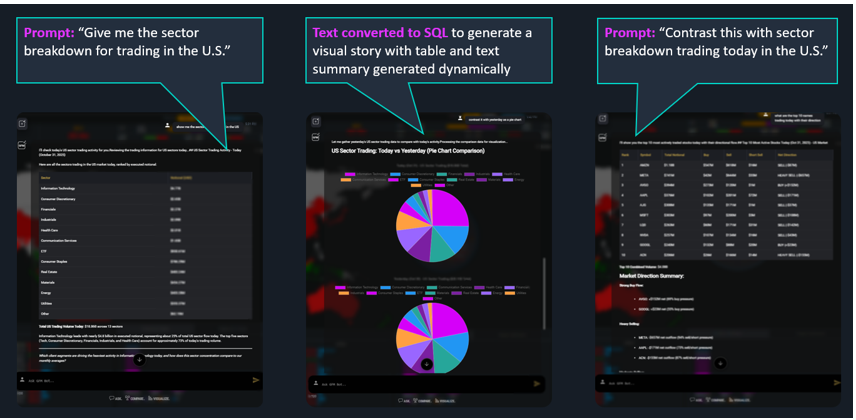
The solution provides an intuitive user experience. A trader can type a question like the one on the screen: “Give me the sector breakdown for trading in the U.S.” Behind the scenes, the assistant uses an LLM to generate the appropriate SQL query, runs it against the relevant data sources hosted in our in-memory data grid, and retrieves the results instantly.该解决方案提供了直观的用户体验。交易员可以输入类似屏幕上的问题:“给我看看美国市场的行业交易细分。” 在后台,助手会使用大语言模型生成适当的 SQL 查询,针对托管在我们内存数据网格中的相关数据源运行它,并立即检索结果。
The trade assistant goes beyond simple data retrieval. It can generate dynamic visualizations, converting text queries into SQL that produces visual stories with charts and graphs. When traders need to compare today’s sector trading with yesterday’s activity, the assistant automatically generates pie charts with color-coded legends, making it straightforward to spot trends and anomalies quickly.交易助手不仅仅是简单的数据检索。它还可以生成动态可视化效果,将文本查询转换为 SQL,从而制作出带有图表和图形的视觉故事。当交易员需要比较今天与昨天的行业交易情况时,助手会自动生成带有颜色编码图例的饼图,从而轻松快速地发现趋势和异常。
Lessons learned经验教训
Throughout the journey to deliver the Front Office trade assistant agent, the Jefferies team uncovered several key lessons that shaped its enterprise AI strategy and implementation roadmap. These insights serve as valuable guidance for capital markets organizations building agentic AI applications at scale.在交付前台交易助手智能体的整个过程中,Jefferies 团队总结了几个关键经验,这些经验塑造了其企业人工智能战略和实施路线图。这些见解为大规模构建智能体人工智能应用的资本市场组织提供了宝贵的指导。
First, the team mitigated the risk of hallucinations by deliberately not relying on LLMs to generate visualizations. Instead, they implemented a hybrid approach in which the LLM handles natural language understanding and query generation while dedicated visualization engines render the actual charts and graphs. This separation of concerns preserves data accuracy while maintaining the conversational interface traders expect.首先,团队通过刻意不依赖大语言模型生成可视化内容,降低了幻觉风险。相反,他们实施了一种混合方法,即由大语言模型处理自然语言理解和查询生成,而专门的可视化引擎负责渲染实际的图表和图形。这种关注点分离既保持了数据准确性,又维护了交易员所期望的对话式界面。
Second, the team used in-memory databases to maximize response times. Traders require split-second insights into client behavior, trade patterns, and market trends. Without this architectural choice, queries against the underlying dataset would have introduced unacceptable latency for real-time trading decisions.其次,团队使用内存数据库来最大化响应速度。交易员需要对客户行为、交易模式和市场趋势进行瞬息万变的洞察。如果没有这一架构选择,针对底层数据集的查询将导致实时交易决策无法接受的延迟。
Third, the team learned to expect user behavior to evolve. Real-world usage proved dynamic. Traders interacted with the system in unexpected ways, and their patterns shifted over time. Investing in observability and user feedback loops proved essential for adapting quickly to these changing behaviors. Finally, the team adopted a deliberate language strategy. They relied on Python for LLM interactions and rapid experimentation, given its rich artificial intelligence and machine learning (AI/ML) landscape. They implemented complex business processing in Java to capitalize on its performance characteristics for high-throughput data processing and integration with existing trading systems.第三,团队认识到用户行为会不断演变。现实世界的使用证明了这一点。交易员以意想不到的方式与系统进行交互,他们的模式也随时间而改变。事实证明,投资于可观测性和用户反馈循环对于快速适应这些不断变化的行为至关重要。最后,团队采取了审慎的语言策略。鉴于 Python 丰富的人工智能和机器学习(AI/ML)生态,他们依赖 Python 进行大语言模型交互和快速实验。他们在 Java 中实现了复杂的业务处理,以利用其在高吞吐量数据处理和与现有交易系统集成方面的性能优势。
Business impact业务影响
Since launch, the trade assistant solution has delivered measurable efficiency gains across global sales and trading operations, allowing traders to redirect time toward client relationships and strategic decision-making rather than manual data wrangling. These efficiency gains translate directly into a competitive advantage, as trading desks can now dedicate more capacity to onboarding clients and deepening existing relationships. The solution delivers a personalized experience by adapting to each client’s query using MCP tools to access structured, unstructured, and in-memory data sources and dynamically generating graphs and charts in response. Beyond the trading desk, the solution has materially reduced the IT time and effort previously consumed by repetitive dashboard creation, freeing technology teams to focus on higher-value strategic initiatives. Perhaps most notably, the ability to securely query millions of rows of equities trading data using natural language has democratized data access. This fosters a data-driven culture where decisions are informed by real-time analytics rather than intuition or delayed reports.自发布以来,交易助手解决方案在全球销售和交易运营中带来了可衡量的效率提升,使交易员能够将时间转向客户关系和战略决策,而不是手动整理数据。这些效率提升直接转化为竞争优势,因为交易台现在可以投入更多精力来开发客户并深化现有关系。该解决方案通过使用 MCP 工具访问结构化、非结构化和内存数据源,并动态生成图表和图形作为响应,从而适应每个客户的查询,提供个性化体验。在交易台之外,该解决方案大大减少了以前耗费在重复仪表板创建上的 IT 时间和精力,使技术团队能够专注于更高价值的战略计划。最值得注意的是,能够使用自然语言安全地查询数百万行股票交易数据,实现了数据访问的民主化。这培养了一种数据驱动的文化,在这种文化中,决策是由实时分析而不是直觉或延迟报告来支持的。
Looking ahead展望未来
Jefferies’ roadmap signals the scalability and ambition of this agentic AI approach. The team plans to roll out the Trade Assistant globally for multiple product types and desks, enhance audit capabilities with code generation tools that use natural language processing (NLP), and add Amazon Bedrock AgentCore features to their enterprise AI system. These investments show a commitment to expanding AI-powered capabilities across the organization. The integration with existing Equities business intelligence (BI) applications and the ability to query multiple structured, unstructured, and in-memory data sources positions Jefferies at the forefront of AI-driven trading innovation.Jefferies 的路线图显示了这种智能体人工智能方法的可扩展性和雄心。团队计划在全球范围内为多种产品类型和交易台推出交易助手,利用自然语言处理(NLP)的代码生成工具增强审计能力,并将 Amazon Bedrock AgentCore 功能添加到其企业人工智能系统中。这些投资表明了在整个组织内扩展人工智能驱动能力的承诺。与现有股票商业智能(BI)应用程序的集成,以及查询多种结构化、非结构化和内存数据源的能力,使 Jefferies 处于人工智能驱动交易创新的前沿。
Conclusion结论
In this post, we walked through how Jefferies and AWS collaborated to build an agentic AI trade assistant that transforms how traders interact with equities data across global sales and trading operations. The Jefferies Equities Trade Assistant exemplifies how agentic AI is reshaping capital markets by turning every trader into a data scientist capable of extracting sophisticated insights through simple conversation. These agentic AI systems act as intelligent collaborators that understand context, learn from interactions, and proactively guide users toward better outcomes. The shift from reactive data retrieval to proactive intelligence marks a new era in trading operations. As this technology scales globally and across asset classes, it promises to redefine competitive advantage in front office operations for years to come.在本文中,我们介绍了 Jefferies 与 AWS 如何合作构建智能体人工智能交易助手,从而改变交易员在全球销售和交易运营中与股票数据交互的方式。Jefferies 股票交易助手展示了智能体人工智能如何通过将每位交易员变成能够通过简单对话提取复杂洞察的数据科学家,从而重塑资本市场。这些智能体人工智能系统充当智能协作者,能够理解上下文、从交互中学习,并主动引导用户获得更好的结果。从被动数据检索到主动智能的转变标志着交易运营的新时代。随着这项技术在全球和跨资产类别中的扩展,它有望在未来几年重新定义前台运营的竞争优势。
To get started building your own agentic AI applications, explore Strands Agents, learn more about the MCP integration patterns used in this solution, or contact your AWS account team to discuss engagement tailored to your use case.要开始构建您自己的智能体人工智能应用程序,请探索 Strands Agents,深入了解本解决方案中使用的 MCP 集成模式,或联系您的 AWS 客户团队讨论为您量身定制的参与方案。