

The State of AI Impact in Engineering: Q2 2026工程领域 AI 影响现状:2026 年第二季度
Data from 500+ teams reveals that AI is delivering measurable velocity gains, but velocity alone isn't the story.来自 500 多个团队的数据显示,AI 正在带来可衡量的速度提升,但仅凭速度并不能说明全部问题。

Welcome to the latest issue of Engineering Enablement, a weekly newsletter sharing research and perspectives on developer productivity.欢迎阅读最新一期的 Engineering Enablement,这是一份每周分享开发者生产力研究与观点的通讯。
🗓 Join me and Brian Houck on July 23 for a readout of this report, where we’ll discuss new findings from DX’s data on AI tool usage, spend, and impact across 500+ organizations. Register here.🗓 欢迎在 7 月 23 日加入我和 Brian Houck 的报告解读会,我们将讨论 DX 关于 500 多家机构 AI 工具使用情况、支出及影响的最新数据发现。点击此处注册。
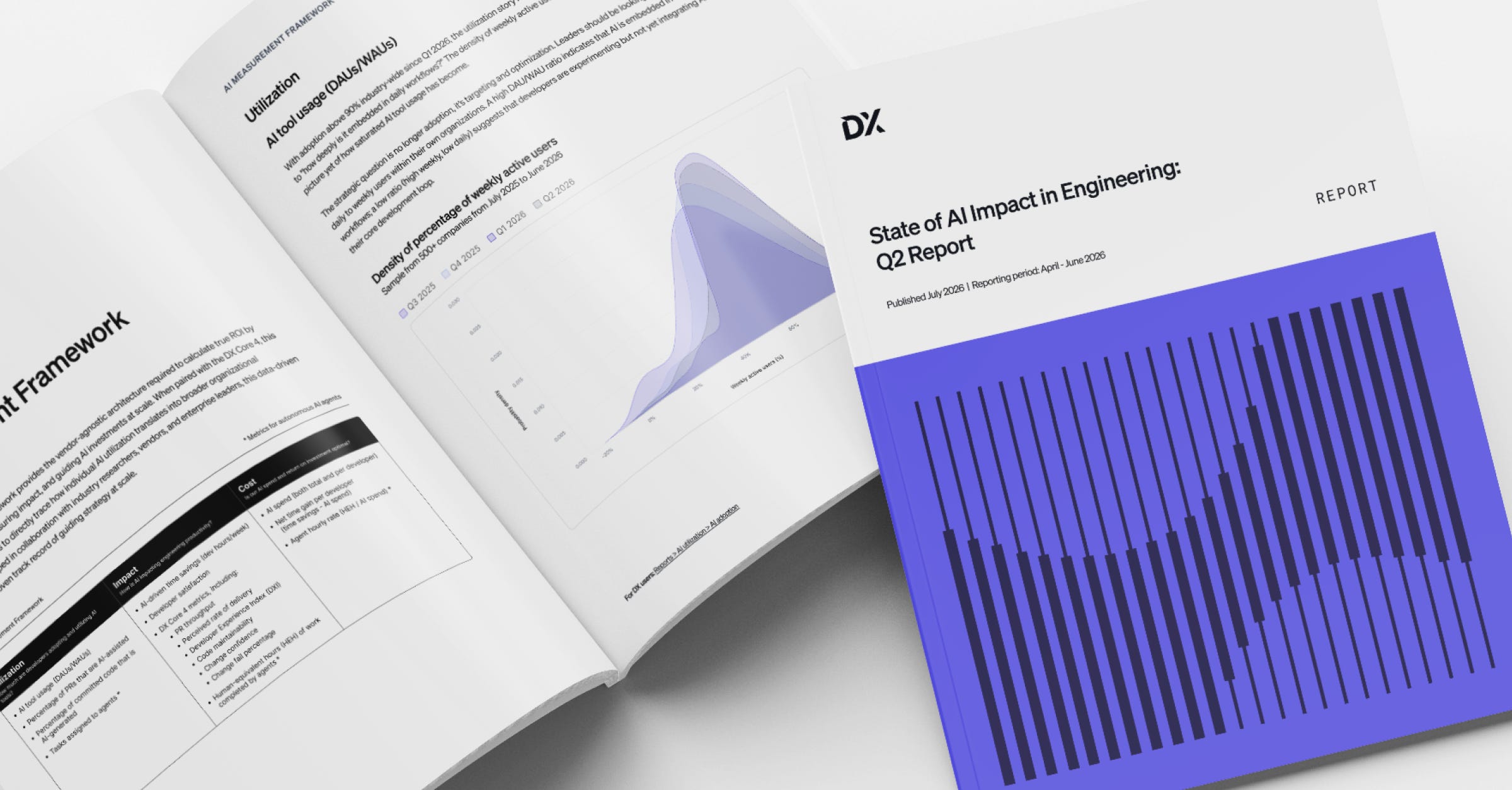
We are excited to announce our Q2 2026 AI impact report.我们很高兴发布 2026 年第二季度 AI 影响报告。
When we first began tracking the impact of AI on engineering teams, our primary goal was to measure AI cohorts against historical baselines to answer the question of what happens to software output after adoption. With industry-wide AI adoption exceeding 90%, comparing AI users against a non-user control group is no longer a viable measurement strategy.当我们最初开始追踪 AI 对工程团队的影响时,主要目标是将 AI 使用群体与历史基准进行对比,以回答软件产出在采用 AI 后会发生什么的问题。随着行业内 AI 采用率超过 90%,将 AI 用户与非用户对照组进行比较已不再是一种可行的衡量策略。
Engineering leaders are now under immense pressure to justify exponentially-increasing AI budgets. The data from our Q2 report reveals that while AI is delivering objective gains in velocity, those gains are highly uneven.工程领导者目前面临着巨大的压力,需要证明呈指数级增长的 AI 预算是否合理。我们二季度的报告数据显示,虽然 AI 在提升速度方面确实带来了客观收益,但这些收益极不均衡。
Download the full analysis here.点击此处下载完整分析报告。
In the new report, we’ve uncovered a number of critical trends, including:在新报告中,我们发现了若干关键趋势,包括:
1. Over 50% of code is now generated by AI. This metric has accelerated rapidly, increasing from 34% in Q1 2026 to 52% in Q2 2026. This steep trajectory indicates that once AI tools are deployed, the code they generate rapidly scales across codebases, frequently moving through reviews, dependencies, and shared workflows.1. 超过 50% 的代码现由 AI 生成。这一指标增长迅速,从 2026 年第一季度的 34% 上升至第二季度的 52%。这种陡峭的增长轨迹表明,一旦部署了 AI 工具,其生成的代码就会在代码库中迅速扩展,并频繁地流经审查、依赖项和共享工作流。
2. Quality may be declining. During the same period that AI adoption has increased, median pull request sizes have nearly doubled. Increases in PR size can serve as an early indicator of technical debt, as higher code volumes generally correlate with increased complexity and potential for bugs. This trend can also introduce additional friction in the review process, as more lines of code generated means more lines of code to review.2. 质量可能正在下降。在 AI 采用率增长的同一时期,合并请求(PR)的中位数规模几乎翻了一番。PR 规模的增加可能是技术债务的早期指标,因为更高的代码量通常与复杂性的增加和潜在的 Bug 相关。这一趋势还可能在审查过程中引入额外的阻力,因为生成的代码行数越多,需要审查的代码行数也就越多。
3. Some aspects of developer experience are declining. The Developer Experience Index (DXI) dropped from 67 to 65 over four quarters. AI is improving some aspects of the developer experience—documentation quality, code maintainability, onboarding speed—while creating new friction in others: larger PRs, slower reviews, less incremental delivery. In aggregate, the net effect is currently negative. Velocity metrics alone will tell you things are improving. Developer experience metrics will tell you whether that’s actually true.3. 开发者体验的某些方面正在下滑。开发者体验指数(DXI)在四个季度内从 67 降至 65。AI 在改善开发者体验的某些方面——如文档质量、代码可维护性、入职速度——的同时,也在其他方面制造了新的阻力:更大的 PR、更慢的审查、更少的增量交付。总体而言,目前的净效应是负面的。仅凭速度指标会告诉你情况正在好转,但开发者体验指标会告诉你这是否属实。
4. AI is making codebases easier to understand, but it’s also making the code it generates harder to trust. The Q2 data highlights a striking divergence between two historically correlated software quality metrics. Specifically, from Q1 2026, Code Maintainability improved by 3.8%, whereas Change Confidence decreased by 6.1%. Code Maintainability indicates how easily developers can understand the codebase, while Change Confidence measures their trust that modifications won’t cause production failures. Traditionally, highly maintainable code results in higher confidence when making changes. However, this data reveals a new tension: although AI helps developers understand the code in front of them, they exhibit less trust in the code they are pushing to production.4. AI 让代码库更易于理解,但也让生成的代码更难被信任。二季度数据突显了两个历史上相关联的软件质量指标之间的显著分歧。具体而言,自 2026 年第一季度以来,代码可维护性提高了 3.8%,而变更信心度却下降了 6.1%。代码可维护性衡量开发者理解代码库的难易程度,而变更信心度则衡量他们对修改代码不会导致生产故障的信任程度。传统上,高可维护性的代码会带来更高的变更信心。然而,该数据揭示了一种新的张力:尽管 AI 帮助开发者理解眼前的代码,但他们对自己推送到生产环境的代码却表现出更少的信任。
5. Saved time isn’t converting into innovation. AI users are now saving an estimated 4 to 6 hours per week. However, the innovation ratio, defined as the percentage of time spent on building new features versus maintenance and overhead, has remained flat over the same period of study. This flat trend indicates that the time saved by AI is not currently converting into increased capacity for creating new value. Leaders should keep a close eye on this metric over time. Ideally, innovation ratio will increase as AI frees up engineers to work on more new features.5. 节省的时间并未转化为创新。AI 用户现在每周平均节省 4 到 6 小时。然而,在同一研究期间,创新比率(即用于构建新功能的时间与维护及开销时间的百分比)保持平稳。这一平稳趋势表明,AI 节省的时间目前并未转化为创造新价值的额外能力。领导者应长期密切关注这一指标。理想情况下,随着 AI 将工程师从繁琐工作中解放出来去开发更多新功能,创新比率应该会提高。
6. AI spend is accelerating faster than outcomes. Median quarterly organizational AI spend climbed from ~$1.5K to ~$44K over four quarters. Tech-sector spend increased nearly 28x. These numbers will draw scrutiny. Leaders who cannot connect this investment to downstream outcomes (feature velocity, innovation ratio, quality) may face increasingly difficult budget conversations in the back half of 2026.6. AI 支出的增长速度快于成果。组织每季度的 AI 支出中位数在四个季度内从约 1,500 美元攀升至约 44,000 美元。科技行业的支出增长了近 28 倍。这些数字将引发审查。无法将此投资与下游成果(功能交付速度、创新比率、质量)挂钩的领导者,在 2026 年下半年可能会面临日益艰难的预算讨论。
What this means for leaders这对领导者意味着什么
The Q2 2026 data indicates that the industry is shifting from base AI deployment to evaluating concrete return on investment. As AI expenditures accelerate, engineering leaders must shift their focus from simply acquiring AI tools to optimizing the surrounding development pipelines and resolving systemic bottlenecks. To achieve true ROI, leaders must ensure that saved hours are reinvested into product innovation rather than absorbed by existing organizational friction.2026 年第二季度的数据表明,行业正从基础的 AI 部署转向评估具体的投资回报率。随着 AI 支出加速,工程领导者必须将重心从单纯获取 AI 工具,转移到优化周边开发流水线和解决系统性瓶颈上来。为了实现真正的投资回报,领导者必须确保节省下来的时间被重新投入到产品创新中,而不是被现有的组织阻力所抵消。
To explore the full data and benchmark your team against 500+ organizations on measures of throughput, quality, and AI tooling cost, download the full report here.如需探索完整数据,并根据吞吐量、质量和 AI 工具成本等指标将您的团队与 500 多家组织进行对比,请点击此处下载完整报告。
That’s it for this week. Thanks for reading.本周内容就是这些。感谢阅读。
-Justin-Justin


