The new GPT-5.6 family: Luna, Terra, Sol全新的 GPT-5.6 系列:Luna、Terra 和 Sol
9th July 20262026 年 7 月 9 日
OpenAI’s latest flagship model hit general availability this morning, and comes in three sizes: Luna, Terra, and Sol (from smallest to largest).OpenAI 最新的旗舰模型已于今早全面开放使用,共有三种规格:Luna、Terra 和 Sol(按从小到大的顺序排列)。
The new models are priced per 1M input/output tokens as Luna $1/$6, Terra $2.50/$15, Sol $5/$30. For comparison, the Claude Opus series are $5/$25 and the Claude Fable 5 is $10/$50, but price-per-million tokens doesn’t tell us much now that the number of reasoning tokens can differ so much between models for the same task.新模型的定价为每百万输入/输出 token:Luna 为 1 美元/6 美元,Terra 为 2.50 美元/15 美元,Sol 为 5 美元/30 美元。作为对比,Claude Opus 系列定价为 5 美元/25 美元,Claude Fable 5 为 10 美元/50 美元。不过,鉴于不同模型在处理同一任务时所需的推理 token 数量差异巨大,单纯对比每百万 token 的价格已不再具备太大的参考意义。
All three models have a February 16th 2026 knowledge cutoff, a million token context window, and 128,000 maximum output tokens.这三款模型均具备 2026 年 2 月 16 日的知识截止日期,支持 100 万 token 的上下文窗口,以及 128,000 个 token 的最大输出长度。
OpenAI’s biggest benchmark claim concerns long-running agentic performance, with one benchmark showing all three models outperforming Claude Fable 5:OpenAI 此次基准测试的核心亮点在于长周期智能体(agentic)的表现,其中一项测试显示三款模型均优于 Claude Fable 5:
We trained GPT-5.6 to get more useful work from every token. On Agents’ Last Exam, an evaluation of long-running professional workflows across 55 fields, GPT-5.6 Sol sets a new high of 53.6, eclipsing Claude Fable 5 (adaptive reasoning) by 13.1 points. Even at medium reasoning, it beats Fable 5 by 11.4 points at roughly one-quarter the estimated cost. That efficiency extends to smaller models, which are essential to making intelligence more abundant and affordable: GPT-5.6 Terra and GPT-5.6 Luna outperform Fable 5 at around one-sixteenth the cost.我们对 GPT-5.6 进行了训练,使其能从每个 token 中获取更多有效工作。在涵盖 55 个领域的长周期专业工作流评估“智能体最终考试”(Agents’ Last Exam)中,GPT-5.6 Sol 创下了 53.6 分的新高,比 Claude Fable 5(自适应推理)高出 13.1 分。即便在中等推理水平下,它也以约四分之一的预估成本领先 Fable 5 达 11.4 分。这种效率提升也延伸到了小型模型上,这对实现更普及、更经济的智能至关重要:GPT-5.6 Terra 和 GPT-5.6 Luna 在成本仅为 Fable 5 十六分之一的情况下,性能依然胜出。
Amusingly, one self-reported benchmark that Fable 5 crushed the GPT-5.6 family on was SWE-Bench Pro, where Fable 5 got 80% compared to GUT-5.6 Sol getting 64.6%. This may help explain why OpenAI chose to publish this article yesterday specifically calling out SWE-Bench Pro for problems they found while auditing that benchmark:有趣的是,在 Fable 5 表现优于 GPT-5.6 系列的自测基准 SWE-Bench Pro 中,Fable 5 获得了 80% 的得分,而 GPT-5.6 Sol 仅为 64.6%。这或许能解释为什么 OpenAI 昨天专门发布了一篇文章,指出他们在审计该基准测试时发现了一些问题:
In light of these results, we estimate that ~30% of SWE-bench Pro tasks are broken, and advise that model developers carefully examine results鉴于这些结果,我们估计约 30% 的 SWE-bench Pro 任务存在缺陷,并建议模型开发者仔细审查相关结果。
I’ve had some early access to GPT-5.6 Sol—it’s definitely very competent, though so far it hasn’t struck me as better than Fable at the kind of complex coding tasks I’ve been using with Anthropic’s model.我已提前试用了 GPT-5.6 Sol——它确实非常强大,但就我目前在 Anthropic 模型上进行的复杂编码任务而言,它给我的感觉并不比 Fable 更出色。
As usual, the model guidance for using GPT-5.6 has the most interesting details. There are a bunch of new API features that I need to explore (and probably add support for in LLM), including:和往常一样,GPT-5.6 的模型使用指南包含了最有趣的细节。其中有许多新的 API 功能我需要深入研究(并可能在 LLM 中增加支持),包括:
- Programmatic Tool Calling allows the models to “compose and run JavaScript that orchestrates tool calls”—which sounds to me like it could help bridge the gap between MCPs and full terminal sessions that can compose CLI utilities in useful ways. Also reminiscent of the dynamic filtering mechanism Anthropic added to their web search tool, which allows code execution against web results as part of a single model turn.程序化工具调用(Programmatic Tool Calling)允许模型“编写并运行 JavaScript 来编排工具调用”——在我看来,这有助于填补 MCP 与能够以实用方式组合 CLI 工具的完整终端会话之间的鸿沟。这也让人联想到 Anthropic 在其网页搜索工具中添加的动态过滤机制,它允许在单次模型交互中针对搜索结果执行代码。
- Multi-agent lets the model “spin up subagents for parallel, focused work”—the sub-agent pattern now baked into the core API.多智能体(Multi-agent)功能让模型能够“启动子智能体进行并行、专注的工作”——现在这种子智能体模式已直接内置于核心 API 中。
- Prompt cache breakpoints brings the Claude model of prompt caching to OpenAI, letting you be explicit about where the cache breakpoints are rather than relying on the API to detect them automatically. Personally I much prefer automatic detection (still supported by OpenAI), but presumably there are optimization cost savings to be had here if you put the work in.提示词缓存断点(Prompt cache breakpoints)将 Claude 的提示词缓存模式引入了 OpenAI,让你能够明确指定缓存断点的位置,而不必依赖 API 自动检测。就我个人而言,我更喜欢自动检测(OpenAI 仍然支持),但如果你愿意投入精力,想必可以借此进一步优化成本。
- You can now set detail: original on image requests to avoid resizing the image at all before it is processed.现在你可以在图像请求中设置 detail: original,从而避免图像在处理前被缩放。
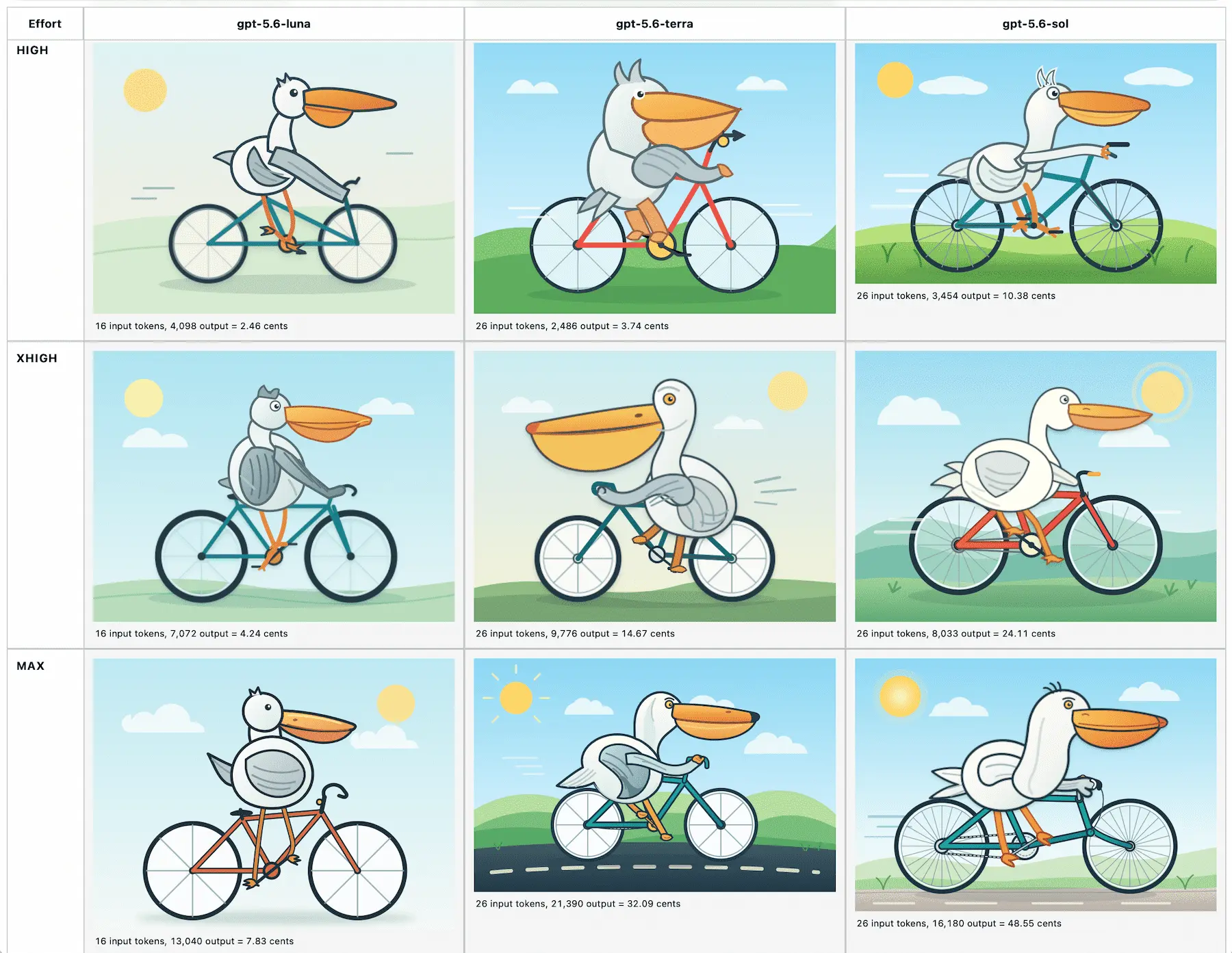
Here’s a full page with 18 different pelicans—for reasoning efforts none, low, medium, high, xhigh, and max across the three different models. It also lists their token and calculated costs—the least expensive was gpt-5.6-luna at effort none for 0.71 cents, the most expensive was gpt-5.6-sol at max reasoning level for 48.55 cents.这里有一张包含 18 种不同鹈鹕的完整页面,展示了三款模型在无、低、中、高、超高和最大推理级别下的表现。页面还列出了它们的 token 消耗和计算成本——最便宜的是 gpt-5.6-luna(无推理级别),仅需 0.71 美分;最贵的是 gpt-5.6-sol(最大推理级别),为 48.55 美分。
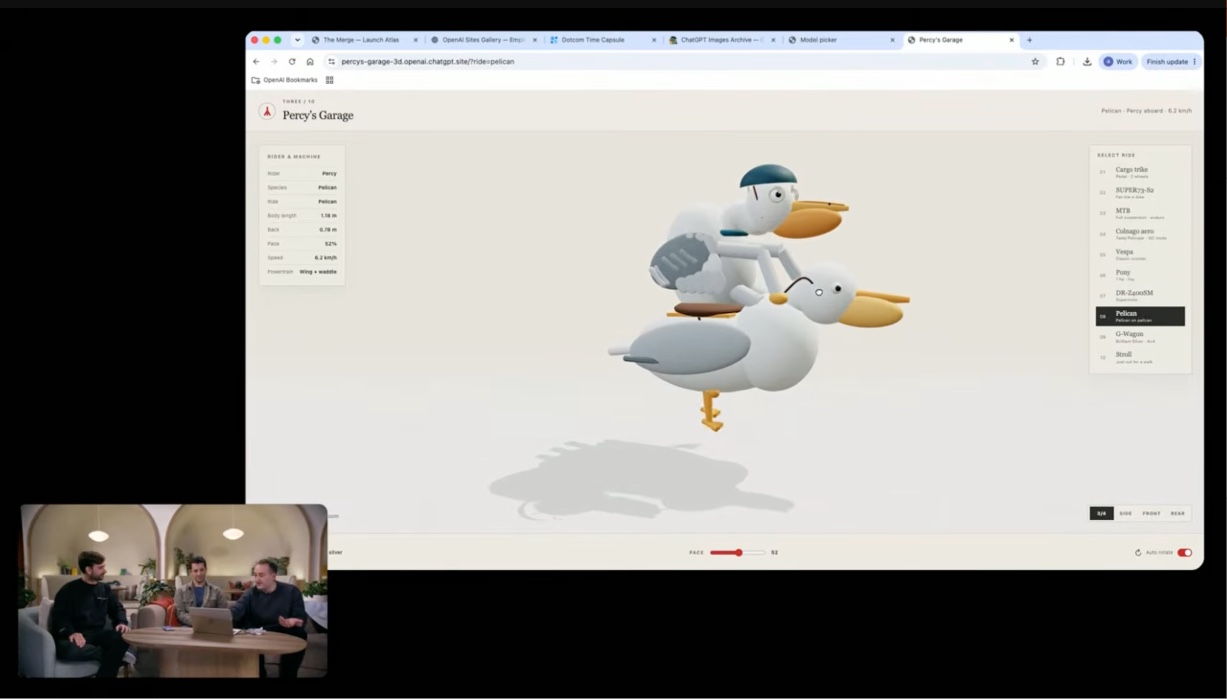
In further pelican news, if you jump to 17:50 in their livestream from this morning you’ll see OpenAI’s own demo of 3D pelicans riding a tricycle, a bicycle, a pony, and another pelican!关于鹈鹕的更多消息:如果你跳转到今天早上直播的 17:50 处,就能看到 OpenAI 演示的 3D 鹈鹕骑三轮车、自行车、小马,甚至骑在另一只鹈鹕身上的画面!
More recent articles
- sqlite-utils 4.0, now with database schema migrations - 7th July 2026
- sqlite-utils 4.0rc2, mostly written by Claude Fable (for about $149.25) - 5th July 2026