Learn how the Claude Code team defines agentic loops, with practical guidance on progressing from turn-based to goal-based, time-based, and proactive loops—and when to use each.
Learn how the Claude Code team defines agentic loops, with practical guidance on progressing from turn-based to goal-based, time-based, and proactive loops—and when to use each.
There’s a lot of talk right now about "designing loops" instead of prompting your coding agent. If you spend some time on X trying to pin down what a loop actually is, you'll come across multiple different answers. 近来江湖上议论纷纷,言必称“设计循环”(designing loops),反倒不再只提如何给编码代理下指令了。若你在 X 上细细寻访,想弄清“循环”究竟为何物,怕是会听到五花八门的答案。
On the Claude Code team, we define loops as agents repeating cycles of work until a stop condition is met. We categorize a few different types of loops based on:Claude Code 团队对此有番定见:所谓循环,便是让代理反复施展手段,直至达成预设的止境。我们将这些循环分门别类,考量标准有四:
We’ll cover the main loop types, when to use each, and how to maintain code quality while managing token usage. Not all tasks require complex loops; start with the simplest solution and use these patterns selectively. 下文便要拆解这几种主流循环,细说其用法,并教你如何在把控 Token 消耗的同时,稳住代码质量。并非所有任务都需大费周章,当从最简处入手,择需而用。

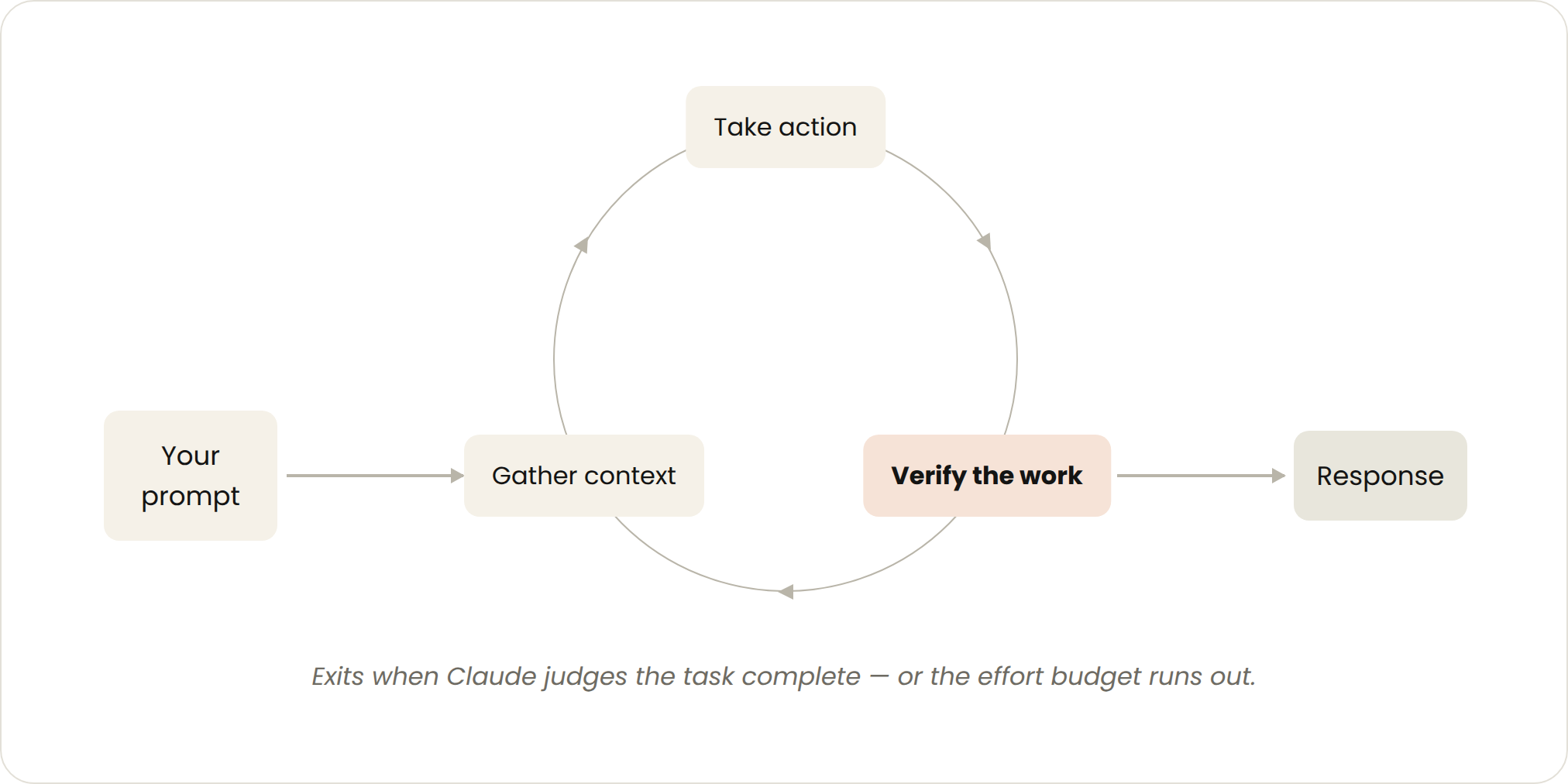
Every prompt you send starts a manual loop with you directing each turn. Claude gathers context, takes action, checks its work, repeats if needed, and responds. We call this the agentic loop.你每发一条指令,便开启了一个手动循环,由你亲自把控每一轮的进退。Claude 收集背景、付诸行动、自查成果、必要时反复迭代,最后给出回复。此乃代理循环之本。
For example, ask Claude to create a like button. It reads your code, makes the edit, runs the tests, and hands back something it believes works. You then manually check the work, and write the next prompt.譬如,你让 Claude 加个“点赞”按钮。它读代码、作修改、跑测试,交出成品。你过目之后,再下下一道指令。
You can improve the verification step by encoding your manual steps as a SKILL.md so Claude can check more of its own work, end-to-end. This should include tools or connectors to allow Claude to see, measure or interact with the result. The more quantitative the checks are, the easier it is for Claude to self-verify. 你可将手动校验的步骤编入 SKILL.md,化作 Claude 的一项“技能”,让它能更全面地自查。这其中应包含工具或连接器,以便 Claude 能观测、度量并与结果交互。校验越是量化,Claude 自查便越是顺手。
For example, in your SKILL.md file you may specify:例如,在 SKILL.md 文件中,你可这般设定:
---
name: verify-frontend-change
description: Verify any UI change end-to-end before declaring it done.
---

# Verifying frontend changes
Never report a UI change as complete based on a successful edit alone. Verify it the way a human reviewer would:

1. Start the dev server and open the edited page in the browser.

2. Interact with the change directly. For a new control (button, input, toggle): click it, confirm the expected state change, and screenshot before/after.

3. Check the browser console: zero new errors or warnings.

4. Use the Chrome Devtools MCP, run a performance trace and audit Core Web Vitals.

If any step fails, fix the issue and rerun from step 1 — do not hand back partially verified work.
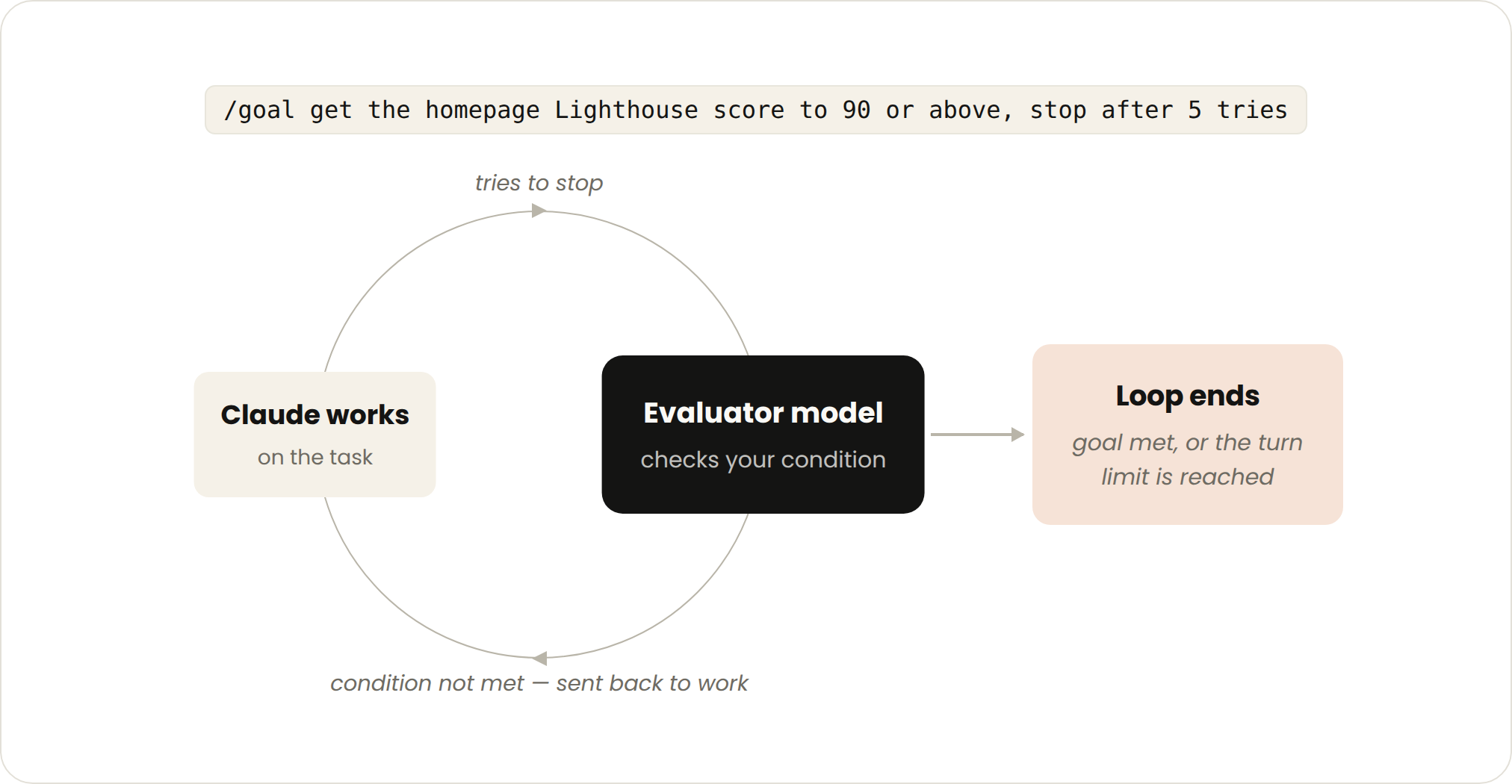
Sometimes, a single turn is not enough, especially for more complex tasks. Agents do better when they can iterate. You can extend how long Claude keeps iterating by defining what done looks like with /goal.遇上复杂任务,单轮往返往往不够,需让代理反复磨砺。你可用 /goal 明确何为“功成”,以此延长 Claude 的迭代时限。
When you define the success criteria, Claude doesn’t have to make a determination on what is “good enough” and end the loop early. Each time Claude tries to stop, an evaluator model checks your condition and sends it back to work until the goal is met or a number of turns you define is reached.有了标准,Claude 便不必纠结于“是否足够好”而过早收手。每当它想停下,评估模型便会核对你的条件,若未达标,便将其遣回继续,直至目标达成或轮次耗尽。
This is why deterministic criteria, such as number of tests passed or clearing a certain score threshold, are so effective.正因如此,像测试通过数、分数阈值这类确定的标准,才最为管用。
For example:例如:
/goal get the homepage Lighthouse score to 90 or above, stop after 5 tries.Some agentic work is recurring: the task stays the same and only the inputs change. For example, summarizing Slack messages every morning. Other work depends on external systems, and a simple way to interface with one is to check it on an interval and react to what changed. For example, a PR which may receive code reviews or fail CI.有些代理工作是常态化的:任务不变,仅输入有别。如每日清晨汇总 Slack 消息。另一些则依赖外部系统,最简单的交互法便是定期巡检,见变则动。如 PR 收到代码评审或 CI 失败时。
For these, you can trigger when Claude runs with `/loop` which re-runs a prompt on an interval. For example:对此,可用 `/loop` 按固定间隔重跑指令。例如:
/loop 5m check my PR, address review comments, and fix failing CI`/loop` runs on your computer, so if you turn it off, it stops. You can move the loop to the cloud by creating a routine with `/schedule`. `/loop` 运行在你的本地,关机即止。若想移至云端,可用 `/schedule` 创建常规任务。
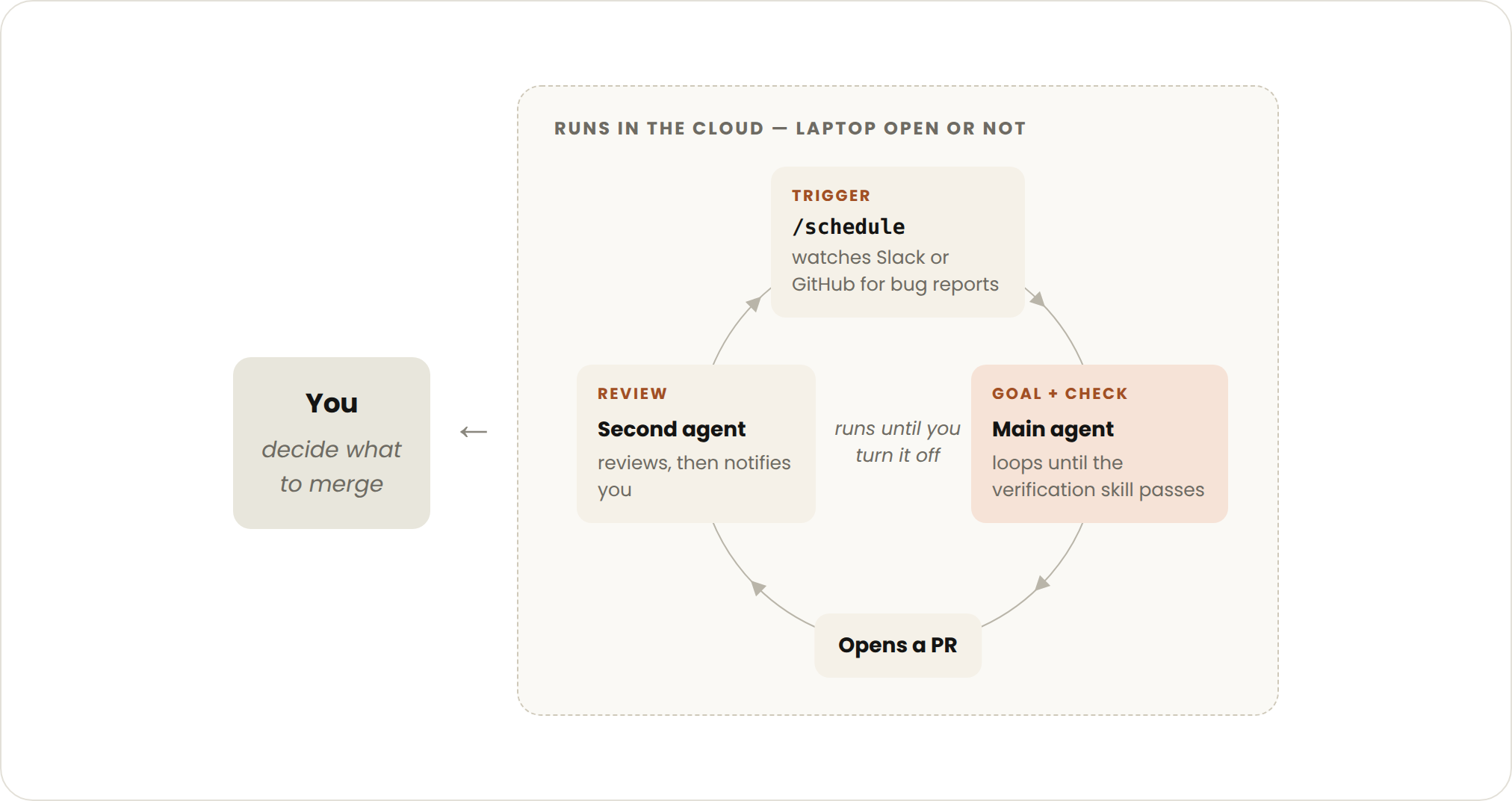
The primitives above, along with other Claude Code features like auto mode and dynamic workflows (research preview) can be composed into a loop for long-running work. 将上述原语,辅以 Claude Code 的自动模式(auto mode)及动态工作流(研究预览版),便可编织成处理长久任务的循环。
For example, to handle incoming feedback, you can use:譬如处理反馈,可组合如下:
Putting it together, a prompt could look like this:综上所述,指令可写成这样:
/schedule every hour: check #project-feedback for bug reports. /goal: don't stop until every report found this run is triaged, actioned, and responded to. When fixing a bug, use a workflow to explore three solutions in parallel worktrees and have a judge adversarially review them.The quality of a loop’s output depends on the system around it. When designing the system:循环产出的好坏,全系于系统之周全。设计系统时,当记:
When an individual result doesn’t meet the standard, don’t stop at fixing the individual issue, try to encode it to improve the system for all future iterations.若单次结果不遂人意,切莫只改这一个 Bug,当将其编码入库,以优化整个系统,惠及后续迭代。
To manage token usage, loops should have clear boundaries: 为省 Token,循环须有明确边界:
To summarize: 总而言之:
To get started with loops, look at the work you already do. Pick one task where you’re the bottleneck and ask which piece you could hand off: can you write the verification check? Is the goal clear enough? Does the work arrive on a schedule?欲用循环,先审视手头琐事。挑一件你觉得最耗神、最易卡壳的任务,问问自己:哪部分能交出去?能否写出校验准则?目标是否够明确?任务是否按期而至?
Once you have an idea, run the loop, observe the results like where it stalls or over-reaches, and don’t be afraid to iterate on it.有了念头,便去跑跑看。观察它在哪儿停滞、在哪儿越界,莫怕迭代,反复打磨便是。
For more information, read the Claude Code docs on running agents in parallel, as well as the loop, schedule, goal, and dynamic workflows pages. 欲知更多,请参阅 Claude Code 文档中有关并行代理、循环、日程、目标及动态工作流的章节。
This article was written by Delba de Oliveira and Michael Segner本文由 Delba de Oliveira 与 Michael Segner 撰写。
Get the developer newsletter
Product updates, how-tos, community spotlights, and more. Delivered monthly to your inbox.