

Dear friends,亲爱的朋友们,
“Loop engineering” is a hot buzzphrase after mentions of it by Boris Cherny (Claude Code’s creator) and Peter Steinberger (OpenClaw's creator) went viral on social media. Loops are now a key part of how we get AI agents to iterate at length to build software. In this letter, I’d like to share my 3 key loops, shown in the image below, for building 0-to-1 products. These loops guide not just how I build software, but also how I decide what software to build. “循环工程”在Boris Cherny(Claude Code的创建者)和Peter Steinberger(OpenClaw的创建者)在社交媒体上提及后,成为了热门流行词。循环现在是我们让AI代理长时间迭代构建软件的关键部分。在这封信中,我想分享我在构建从0到1的产品时使用的三个关键循环,如下图所示。这些循环不仅指导我如何构建软件,也指导我决定构建什么软件。
Agentic coding loop: Given a product specification and optionally a set of evals (that is, a dataset against which to measure performance), we can have an AI agent write code, test its work, and keep iterating until the code is bug-free and meets its specification. This idea of closing the loop took off around the end of last year, and it has been a game changer in enabling coding agents to work longer productively without human intervention. For example, over the weekend, I was building an app for my daughter to practice typing, and my coding agent could easily work for around an hour, using a web browser to check what it had built multiple times before getting back to me, without needing my intervention. 代理编码循环:给定产品规格和可选的一组评估(即用于衡量性能的数据集),我们可以让AI代理编写代码、测试其工作,并持续迭代,直到代码无错误且符合规格。这种闭环的想法在去年年底开始流行,它极大地改变了编码代理能够长时间自主高效工作的能力。例如,上周末,我在为女儿构建一个打字练习应用,我的编码代理可以轻松工作大约一个小时,多次使用网络浏览器检查构建结果,然后才回来找我,无需我的干预。
The engineering loop executes quickly. Every few minutes, the coding agent might build and test a new version of the software. I hear frequently from developers who are finding new ways to engineer more effective engineering loops. This is an active area of invention! 工程循环执行得很快。每隔几分钟,编码代理可能会构建并测试一个新版本的软件。我经常听到开发者们正在寻找新的方法来设计更有效的工程循环。这是一个活跃的发明领域!
Developer feedback loop: In this loop, a developer examines the current product and steers the coding agent to improve it. Last year, a lot of developers (including me) were acting as the QA (quality assurance) function for our coding agents, manually finding bugs and then asking the agent to fix them. But with coding agents much more able to test their own code, the amount of time we need to spend on this function has decreased significantly. This allows us to make higher-level product decisions, such as what key features to offer, where the UI needs improvement, and so on. 开发者反馈循环:在这个循环中,开发者检查当前产品并引导编码代理进行改进。去年,很多开发者(包括我)都在为编码代理充当QA(质量保证)角色,手动发现错误然后要求代理修复。但随着编码代理测试自身代码的能力大大增强,我们花在这个功能上的时间显著减少。这使我们能够做出更高级别的产品决策,例如提供哪些关键功能、UI需要改进的地方等等。
The developer-feedback loop operates over time intervals between tens of minutes and hours — that's how frequently a developer might review a product and give feedback. In the case of the typing app, I changed my mind a few times about the visual design, what cat costumes she can unlock as she learns (she loves cats), and the user flow for a grown-up to log in and steer the child's learning experience.开发者反馈循环的操作时间间隔在几十分钟到几小时之间——这是开发者审查产品并给出反馈的频率。以打字应用为例,我多次改变了视觉设计、她学习时可以解锁的猫咪服装(她喜欢猫),以及成年人登录并引导孩子学习体验的用户流程。
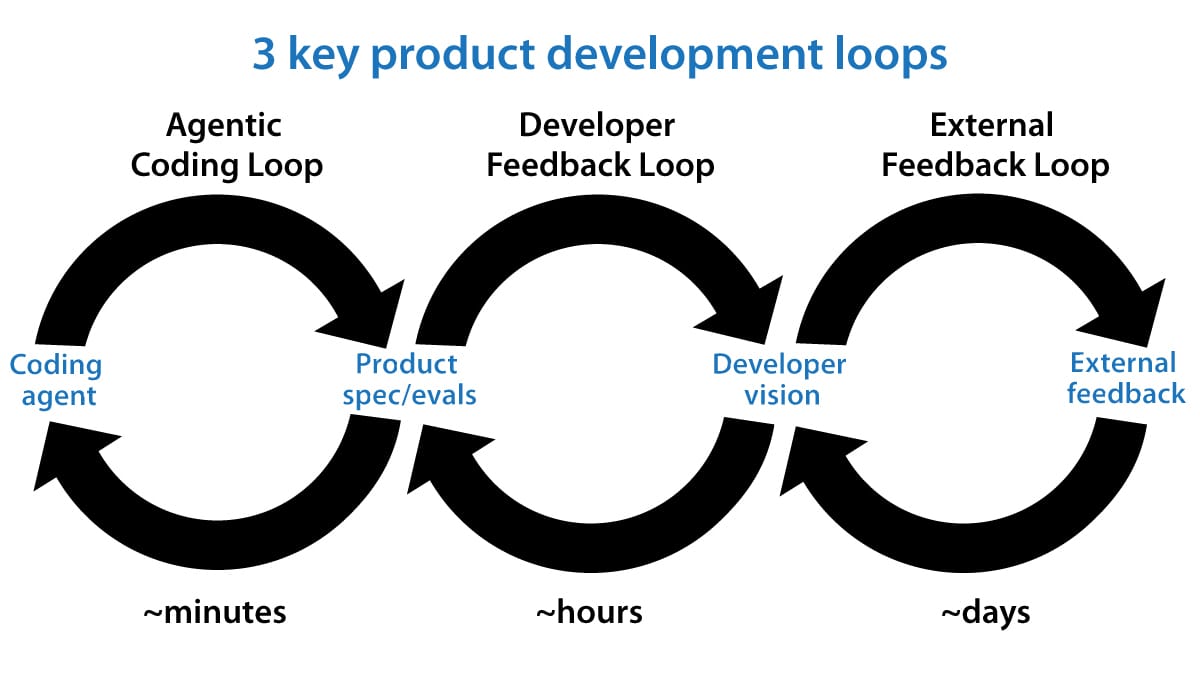
When a developer has a clear vision for what to build, it is still a lot of work to translate that vision into a specification for a coding agent to implement. Further, after the developer has seen an implementation, they might update (or perhaps clarify) the spec to steer it toward what they want. If you find that the system repeatedly runs into certain problems, building a set of evals for the agent becomes useful.当开发者对要构建的内容有清晰愿景时,将这一愿景转化为编码代理可实现的规格仍然需要大量工作。此外,在看到实现后,开发者可能会更新(或澄清)规格以引导其朝着期望的方向发展。如果发现系统反复遇到某些问题,为代理构建一套评估就会变得有用。
AI-native teams are increasingly using AI to help shape product direction, for example, automating the gathering and analysis of usage data, summarizing written and verbal customer feedback, or carrying out competitive analysis. However, for pretty much all the products I’m involved in, I see humans as having a significant context advantage over current AI systems — we know a lot more than the AI system about the users and the context the product has to operate in — and thus humans play a critical role. Many people describe this human contribution as “taste,” but I prefer to think of it as humans having a context advantage, since that gives us a clearer path to helping AI systems get better. This also speaks to why this step can’t be automated: So long as the human knows something the AI does not, human-in-the-loop is needed to to inject that knowledge into the system. AI原生团队越来越多地使用AI来帮助塑造产品方向,例如自动化收集和分析使用数据、总结书面和口头客户反馈,或进行竞争分析。然而,对于我参与的所有产品,我认为人类相对于当前AI系统具有显著的上下文优势——我们对用户和产品运行环境的了解远多于AI系统——因此人类扮演着关键角色。许多人将这种人类贡献描述为“品味”,但我更倾向于将其视为人类拥有上下文优势,因为这为我们帮助AI系统变得更好提供了更清晰的路径。这也说明了为什么这一步无法自动化:只要人类知道AI不知道的事情,就需要人在回路中将这些知识注入系统。
External feedback loop: This includes a wide range of tactics like asking a few friends for feedback, launching to alpha testers, or putting the code into production with A/B testing. These tactics are usually slow, rarely taking less than hours and sometimes taking days or even weeks. This data informs the developer vision, which in turn continues to drive the detailed product spec, which in turn drives the coding agent. 外部反馈循环:这包括广泛的策略,如向几位朋友征求反馈、向Alpha测试者发布,或通过A/B测试将代码投入生产。这些策略通常很慢,很少少于几小时,有时甚至需要几天或几周。这些数据为开发者愿景提供信息,进而驱动详细的产品规格,再驱动编码代理。
With coding agents speeding up software development, more engineers are starting to play a partial product management role. For many engineers who are growing into this role, the hardest part is shaping the product vision and striking a balance between building (bridging the gap between vision and spec) and getting user feedback to evolve the vision. It is important to do both!随着编码代理加速软件开发,越来越多的工程师开始扮演部分产品管理角色。对于许多正在成长为此角色的工程师来说,最困难的部分是塑造产品愿景,并在构建(弥合愿景与规格之间的差距)和获取用户反馈以发展愿景之间取得平衡。两者都很重要!
I will write more about how to do this in future letters, but for now, I find it encouraging that engineers are playing an expanded role (just as product managers and designers now do more engineering). 我将在未来的信中更多讨论如何做到这一点,但目前,我发现工程师们正在扮演更广泛的角色(正如产品经理和设计师现在做更多工程工作一样),这令人鼓舞。
Keep building!继续构建!
Andrew Andrew
A MESSAGE FROM DEEPLEARNING.AI来自DEEPLEARNING.AI的消息
Stop watching your terminal. Learn to teach your agent to call you when it needs your input. Join the free 7-Day Voice AI Builder Challenge today. 别再盯着终端了。学会教你的代理在需要你的输入时呼叫你。立即加入免费的7天语音AI构建者挑战。
News新闻
Top Agentic Performance, Low Cost顶级代理性能,低成本
Z.ai released an open-weights model that rivals proprietary leaders for autonomous agentic tasks.Z.ai发布了一个开放权重的模型,在自主代理任务上与专有领导者相媲美。
What’s new: GLM-5.2, the latest in a series of large language models that are optimized for coding, including an input context far larger than its predecessor’s.新动态:GLM-5.2,一系列针对编码优化的大型语言模型的最新版本,包括比其前身大得多的输入上下文。
- Input/output: Text in (up to 1 million tokens), text out (up to 128,000 tokens, 103 tokens per second)输入/输出:文本输入(最多100万个token),文本输出(最多128,000个token,每秒103个token)
- Architecture: Mixture-of-experts transformer, 753 billion parameters total, 40 billion parameters active per token架构:混合专家Transformer,总计7530亿参数,每个token激活400亿参数
- Features: Two reasoning levels (high, max), function calling, structured output, context caching (reuses inputs so repeated parts of prompts are not recomputed)特性:两个推理级别(高、最大),函数调用,结构化输出,上下文缓存(重用输入,因此提示的重复部分不会重新计算)
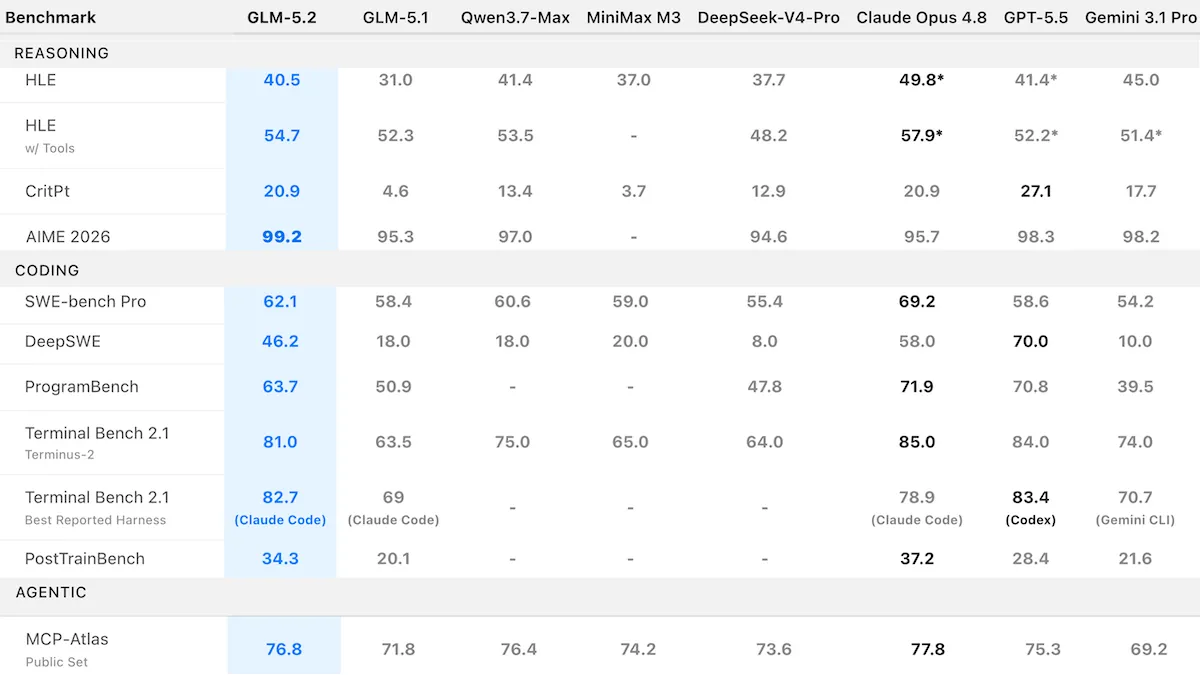
- Performance: First among open models (third among all currently available models) on Artificial Analysis’s Intelligence Index v4.1, leads all models on PostTrainBench (a test of long-running agentic coding), second on Arena.ai Code Arena WebDev leaderboard性能:在Artificial Analysis的Intelligence Index v4.1上,开放模型中排名第一(所有当前可用模型中排名第三),在PostTrainBench(长时间运行的代理编码测试)上领先所有模型,在Arena.ai Code Arena WebDev排行榜上排名第二
- Availability/price: Weights available for commercial and noncommercial uses under MIT license via Hugging Face, API $1.40/$0.26/$4.40 per million input/cached/output tokens, GLM Coding Plans $12.60 to $112 per month可用性/价格:权重在MIT许可下可用于商业和非商业用途,通过Hugging Face提供,API每百万输入/缓存/输出token分别为$1.40/$0.26/$4.40,GLM编码计划每月$12.60至$112
- Undisclosed: Training data and methods specific to GLM-5.2未披露:GLM-5.2的训练数据和方法
How it works: GLM-5.2 builds on GLM-5. The team modified the earlier model’s implementation of DeepSeek sparse attention to reduce the processing required, making it practical to expand the input context to 1 million tokens from GLM-5’s 200,000 tokens.工作原理:GLM-5.2基于GLM-5构建。团队修改了早期模型对DeepSeek稀疏注意力的实现,以减少处理需求,从而将输入上下文从GLM-5的200,000个token扩展到100万个token。
- Z.ai trained GLM-5.2 specifically on long-running agentic tasks such as deep research, code deployment and performance optimization, and complex debugging.Z.ai专门针对长时间运行的代理任务训练了GLM-5.2,例如深度研究、代码部署和性能优化,以及复杂调试。
- Earlier GLM models learned via Group Relative Policy Optimization, a reinforcement learning method that dispenses greater rewards for attempts to complete a task that outperform the average of several attempts. However, GLM-5.2’s tasks ran long enough that the team divided individual attempts into pieces, so they couldn’t average them easily. Instead, the team switched to Proximal Policy Optimization, which judges each attempt individually via a critic model.早期的GLM模型通过组相对策略优化(一种强化学习方法,对优于多次尝试平均值的任务完成尝试给予更大奖励)进行学习。然而,GLM-5.2的任务运行时间很长,团队将单个尝试分成多个部分,因此无法轻松平均。相反,团队切换到了近端策略优化,通过一个评论家模型单独评判每次尝试。
- During reinforcement learning, a coding task usually is graded based on a pass-fail check. But an agentic process, instead of solving a problem, can pass such tests by using tools to, for instance, fetch reference solutions from GitHub. GLM-5.2 resorted to such reward hacking more frequently than GLM-5.1 did. To address this, the team added a rule-based filter that flagged suspect tool calls, used a separate language model to judge whether each flagged call shortcutted the task, and blocked such calls by feeding GLM-5.2 dummy data so training could continue.在强化学习过程中,编码任务通常根据通过/失败检查进行评分。但代理过程不是解决问题,而是可以通过使用工具(例如从GitHub获取参考解决方案)来通过这些测试。GLM-5.2比GLM-5.1更频繁地采用这种奖励黑客行为。为了解决这个问题,团队添加了一个基于规则的过滤器来标记可疑的工具调用,使用单独的语言模型判断每个标记的调用是否绕过了任务,并通过向GLM-5.2提供虚拟数据来阻止此类调用,以便训练可以继续。
- To reduce the computation required to process attention over longer contexts, the model uses a sparse attention indexer — a component that, for each new token, selects which earlier tokens to attend to — once every four layers instead of every layer, reusing its output for the other three layers. The company says this cuts per-token computation by 2.9 times within 1-million-token context. This approach modifies an earlier method called IndexCache.为了减少处理长上下文注意力所需的计算量,该模型使用了一个稀疏注意力索引器——一个为每个新token选择要关注的早期token的组件——每四层使用一次,而不是每层都使用,将其输出重用于其他三层。该公司表示,这将在100万token上下文中将每个token的计算量减少2.9倍。这种方法修改了早期称为IndexCache的方法。
- To generate tokens faster, a small draft model proposes several tokens at once and the main model accepts or rejects them in a process called speculative decoding. GLM-5.2 accepts 5.47 tokens compared to GLM-5.1’s 4.56, a 20 percent gain.为了更快地生成token,一个小型草稿模型一次提出多个token,主模型在称为推测解码的过程中接受或拒绝它们。GLM-5.2接受5.47个token,而GLM-5.1为4.56个,提升了20%。
Performance: GLM-5.2 posted the strongest performance of any open-weights model in Artificial Analysis’s tests. It ran close to the leading proprietary models from Anthropic and OpenAI on several agentic benchmarks, edging ahead of some and trailing others narrowly.性能:GLM-5.2在Artificial Analysis的测试中取得了所有开放权重模型中最强的性能。在多个代理基准测试中,它与Anthropic和OpenAI的领先专有模型接近,有些略胜一筹,有些则略微落后。
- On Artificial Analysis’s Intelligence Index, a composite of 9 evaluations of economically useful tasks, GLM-5.2 set to max reasoning (51) ranked first among open-weights models, behind Claude Opus 4.8 set to max reasoning (56) and GPT-5.5 set to xhigh reasoning (55) but well ahead of DeepSeek V4 Pro set to max reasoning and MiniMax-M3 set to unspecified reasoning (tied at 44).在Artificial Analysis的Intelligence Index(一个由9项经济有用任务评估组成的综合指标)上,GLM-5.2设置为最大推理(51)在开放权重模型中排名第一,落后于设置为最大推理的Claude Opus 4.8(56)和设置为xhigh推理的GPT-5.5(55),但远领先于设置为最大推理的DeepSeek V4 Pro和设置为未指定推理的MiniMax-M3(并列44)。
- On the Arena.ai Code Arena’s WebDev leaderboard, which ranks models according to human votes on web development tasks, GLM-5.2 set to max reasoning (1,593 Elo) ranked second behind Claude Fable 5 (1,654 Elo) and ahead of all variants of Claude Opus 4 and GPT-5.5.在Arena.ai Code Arena的WebDev排行榜上,该排行榜根据人类对Web开发任务的投票对模型进行排名,GLM-5.2设置为最大推理(1,593 Elo)排名第二,仅次于Claude Fable 5(1,654 Elo),领先于Claude Opus 4和GPT-5.5的所有变体。
- On PostTrainBench, a test that asks an agent to fine-tune four large language models and evaluates their performance on seven benchmarks, GLM-5.2 set to max reasoning (34.3 percent) narrowly topped Claude Opus 4.8 set to max reasoning (34.1 percent) and Claude Fable 5 set to max reasoning (30.7 percent).在PostTrainBench上,一个要求代理微调四个大型语言模型并在七个基准上评估其性能的测试中,GLM-5.2设置为最大推理(34.3%)以微弱优势领先于设置为最大推理的Claude Opus 4.8(34.1%)和设置为最大推理的Claude Fable 5(30.7%)。
- On AA-Briefcase, an Artificial Analysis benchmark introduced in June 2026 that scores agents’ ability to generate business documents such as spreadsheets, presentations, and memos, GLM-5.2 set to max reasoning (1,266 Elo) led all open-weights models and placed third overall behind Claude Fable 5 (1,587 Elo) and Claude Opus 4.8 set to max reasoning (1,356 Elo).在AA-Briefcase上,一个Artificial Analysis于2026年6月推出的基准测试,评估代理生成电子表格、演示文稿和备忘录等商业文档的能力,GLM-5.2设置为最大推理(1,266 Elo)在所有开放权重模型中领先,总体排名第三,仅次于Claude Fable 5(1,587 Elo)和设置为最大推理的Claude Opus 4.8(1,356 Elo)。
Behind the news: High-performance, open-weights models become more attractive as the U.S. government and U.S. companies tighten the screws on AI technology developed within the country. Z.ai released GLM-5.2 only one day after the U.S. government restricted access to Anthropic’s Claude Fable 5 and Claude Mythos 5 to citizens, and Anthropic suspended access to Claude Fable 5.新闻背景:随着美国政府和美国公司加强对国内AI技术的限制,高性能开放权重模型变得更具吸引力。Z.ai发布GLM-5.2仅在美国政府限制Anthropic的Claude Fable 5和Claude Mythos 5仅限公民使用,以及Anthropic暂停访问Claude Fable 5的一天之后。
Why it matters: Beyond GLM-5.2’s open license, the low cost of Z.ai’s API gives developers an additional incentive to adopt it. Developers who find Claude Opus 4.8 or GPT-5.5 too pricey can obtain similar agentic and coding capabilities for as little as a quarter of the cost, according to Artificial Analysis’ assessment of cost per intelligence.为何重要:除了GLM-5.2的开放许可外,Z.ai API的低成本为开发者提供了额外的采用动力。根据Artificial Analysis对每智能成本的评估,认为Claude Opus 4.8或GPT-5.5过于昂贵的开发者,可以以低至四分之一的成本获得类似的代理和编码能力。
We’re thinking: Open weights continue to close in on top closed models. GLM-5.2’s outstanding performance on web-dev and post-training tasks suggests that advanced agentic capabilities are available to anyone with sufficiently advanced hardware, free of charge.我们的思考:开放权重继续缩小与顶级封闭模型的差距。GLM-5.2在Web开发和训练后任务上的出色表现表明,任何拥有足够先进硬件的人都可以免费获得高级代理能力。
AI Degrees on the RiseAI学位日益增多
Universities in the U.S. are rapidly rolling out undergraduate majors, minors, and specializations in artificial intelligence to meet the growing demand for AI expertise.美国大学正在迅速推出人工智能本科专业、辅修和专攻方向,以满足对AI专业知识日益增长的需求。
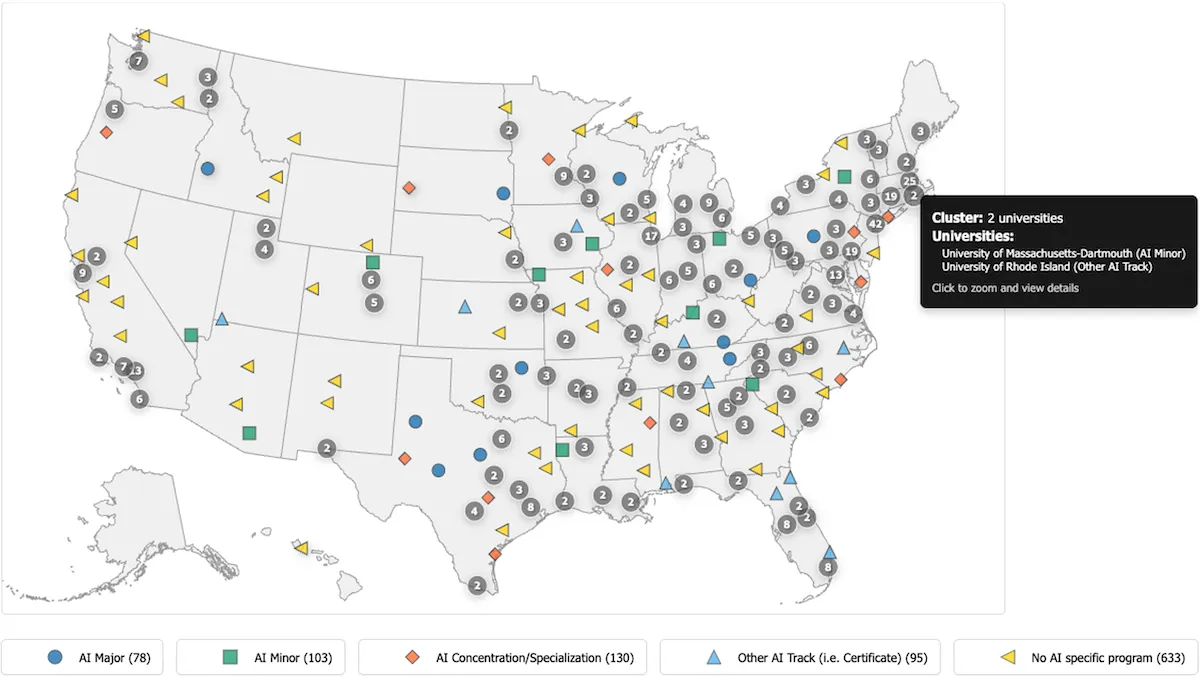
What’s new: There are at least 1,000 AI programs across nearly 584 U.S. colleges and universities, including 78 majors and 103 minors as of April, according to the Center for Inclusive Computing at Northeastern University. These numbers have risen dramatically. In 2021, just five schools offered majors in AI, The New York Times reported. 新动态:根据东北大学包容性计算中心的数据,截至4月,美国近584所学院和大学至少有1,000个AI项目,包括78个专业和103个辅修。这些数字大幅上升。据《纽约时报》报道,2021年只有五所学校提供AI专业。
How it works: Course requirements for a bachelor’s degree in artificial intelligence run the gamut. Some programs are highly technical and math-intensive, while others take a broader, interdisciplinary approach that includes courses in ethics, policy, or domain-specific applications. Some emphasize the theoretical foundations of AI, while others focus on how to build and deploy AI systems in practice.工作原理:人工智能学士学位的课程要求各不相同。有些项目高度技术性和数学密集型,而另一些则采用更广泛的跨学科方法,包括伦理、政策或特定领域应用的课程。有些强调AI的理论基础,而另一些则侧重于如何在实际中构建和部署AI系统。
- Carnegie Mellon University, a university in the state of Pennsylvania with one of the country’s top Computer Science programs, became the first U.S. university to offer a bachelor’s degree in artificial intelligence in 2018. Its curriculum emphasizes mathematical rigor, requiring seven courses in mathematics and statistics, five in computer science and principles of computing and programming, three in artificial intelligence, one in ethics, and additional courses spanning human cognition, perception and language, machine learning, and human-computer interaction.卡内基梅隆大学,一所位于宾夕法尼亚州的大学,拥有美国顶尖的计算机科学项目之一,于2018年成为美国第一所提供人工智能学士学位的大学。其课程强调数学严谨性,要求七门数学和统计学课程、五门计算机科学以及计算和编程原理课程、三门人工智能课程、一门伦理课程,以及涵盖人类认知、感知和语言、机器学习以及人机交互的额外课程。
- The University of Oklahoma Polytechnic Institute’s applied AI degree focuses on practical knowledge. Apart from math and statistics requirements, it requires students to complete 15 AI and computing courses in subjects including robotics, machine learning, reinforcement learning, computer vision, cloud computing, and DevOps.俄克拉荷马大学理工学院的应用AI学位侧重于实践知识。除了数学和统计学要求外,它要求学生完成15门AI和计算课程,涵盖机器人学、机器学习、强化学习、计算机视觉、云计算和DevOps等主题。
- Other AI degrees are more interdisciplinary. Drake University in Iowa offers a bachelor of arts in AI tailored to students in humanities and business. The course requirements are flexible, allowing students to choose from clusters of courses in philosophy, English, computer science, information systems, and psychology. Only two math classes are required for the degree. 其他AI学位更具跨学科性。爱荷华州的德雷克大学提供面向人文学科和商业学生的AI文学学士学位。课程要求灵活,允许学生从哲学、英语、计算机科学、信息系统和心理学等课程群中进行选择。该学位仅需两门数学课程。
- Many schools that don’t provide AI degrees offer specialized AI concentrations. Students on the AI track at Stanford University take seven qualifying courses in fields such as natural language processing, computer vision, and robotics. (Disclosure: Andrew Ng serves as an adjunct professor in Stanford’s Computer Science department.)许多不提供AI学位的学校提供专门的AI方向。斯坦福大学AI方向的学生需要修读七门限定课程,涵盖自然语言处理、计算机视觉和机器人学等领域。(披露:Andrew Ng在斯坦福大学计算机科学系担任兼职教授。)
Behind the news: Some commentators argue that universities have moved too slowly to prepare students for employers that expect AI competency. Others dismiss AI degrees as a fad. However, even some proponents warn that specialized AI degrees may come at the expense of broader computer science foundations, which students may need to adapt in a rapidly evolving field.新闻背景:一些评论者认为大学在培养学生满足雇主对AI能力期望方面行动过于缓慢。其他人则驳斥AI学位是一种时尚。然而,即使是一些支持者也警告说,专门的AI学位可能会以牺牲更广泛的计算机科学基础为代价,而学生可能需要在快速发展的领域中适应这些基础。
Why it matters: Today’s curricula could shape who enters the profession and what skills the next generation of AI engineers brings with them. It’s only natural to expect a standardized, one-size-fits-all education in a field as varied as AI. Some roles in industry resemble traditional software engineering jobs with AI components; others require deeper expertise in machine learning research, distributed systems, or data engineering. There will also always be large gaps between programs designed to prepare students for graduate work and others that assume the bachelor’s will be a terminal degree. 为何重要:今天的课程可能会塑造谁进入这个行业,以及下一代AI工程师带来什么技能。在像AI这样多样化的领域中,期望标准化的、一刀切的教育是很自然的。行业中的一些角色类似于带有AI组件的传统软件工程工作;其他角色则需要更深入的机器学习研究、分布式系统或数据工程专业知识。旨在为学生准备研究生工作的项目与假设学士学位是最终学位的项目之间,也总是存在巨大差距。
We’re thinking: AI is moving so quickly that many universities are struggling to adapt. The established pace of change in academic curricula — in which the faculty learns a topic, proposes new courses, gets approval from a curriculum committee, and perhaps modifies degree requirements — is poorly matched to the rapid pace of change of AI. However, we are glad that universities are moving in this direction, and that a number of innovative faculty and administrators are finding ways to move faster. This will be important to prepare students not only for the jobs of 2026, but for those in many years beyond. 我们的思考:AI发展如此之快,以至于许多大学都在努力适应。学术课程中既定的变革步伐——教师学习一个主题、提出新课程、获得课程委员会批准,或许修改学位要求——与AI的快速变化节奏不相匹配。然而,我们很高兴大学正在朝这个方向前进,并且许多创新的教师和管理人员正在寻找更快行动的方法。这对于培养学生不仅为2026年的工作做好准备,而且为未来多年的工作做好准备至关重要。
Large-Model AI for Apple Devices适用于Apple设备的大型模型AI
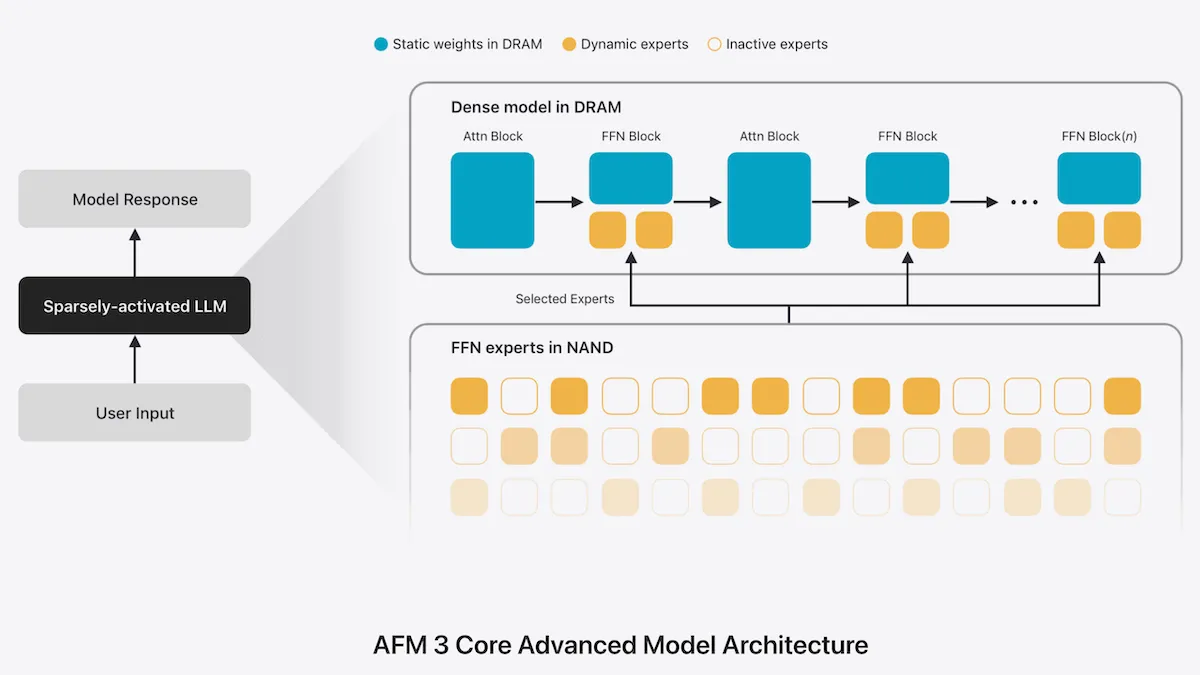
The third generation of Apple Foundation Models — fruit of Apple’s collaboration with Google — introduces a variation on the mixture-of-experts architecture that runs on local devices. 第三代Apple基础模型——Apple与Google合作的成果——引入了一种在本地设备上运行的混合专家架构变体。
What’s new: AFM 3 Core Advanced, a model designed to generate text and speech on some Apple devices, exceeds the processing efficiency of the popular mixture-of-experts architecture while occupying substantially less working memory. (Other models in the AFM 3 family, all of which are custom-built and distilled from unspecified Google Gemini models, include AFM 3 Core, which also runs on Apple devices, and AFM 3 Cloud, AFM 3 Cloud Image, and AFM 3 Cloud Pro, which run on servers.)新动态:AFM 3 Core Advanced,一个设计用于在某些Apple设备上生成文本和语音的模型,其处理效率超过了流行的混合专家架构,同时占用的工作内存大幅减少。(AFM 3系列中的其他模型,均为定制构建并从未指定的Google Gemini模型蒸馏而来,包括也在Apple设备上运行的AFM 3 Core,以及在服务器上运行的AFM 3 Cloud、AFM 3 Cloud Image和AFM 3 Cloud Pro。)
- Input/output: Text, images, speech in; text, speech out输入/输出:文本、图像、语音输入;文本、语音输出
- Architecture: Modified mixture-of-experts transformer (20 billion parameters total, 1 to 4 billion parameters active)架构:改进的混合专家Transformer(总计200亿参数,激活1到40亿参数)
- Availability: Available in fall 2026 with Apple operating system updates to Macs and iPhone 17 Pro/Max/Air phones可用性:2026年秋季随Apple操作系统更新在Mac和iPhone 17 Pro/Max/Air手机上提供
- Features: Text understanding and generation, speech understanding and generation, image understanding, tool use, skills, reasoning, 25 languages特性:文本理解和生成、语音理解和生成、图像理解、工具使用、技能、推理、25种语言
- Undisclosed: input/output size limits, benchmark performance, specific training data and methods未披露:输入/输出大小限制、基准性能、具体训练数据和方法
How it works: AFM 3 Core Advanced is optimized to run on Apple silicon.工作原理:AFM 3 Core Advanced针对在Apple硅片上运行进行了优化。
- Like other models in its family, AFM 3 Core Advanced was trained on a mixture of publicly available information, licensed data, data collected from studies, and generated data. No user data or user interactions with models was included. The training process included pretraining, supervised fine-tuning, and reinforcement learning. 与其系列中的其他模型一样,AFM 3 Core Advanced在公开可用信息、许可数据、研究收集的数据和生成数据的混合数据上进行了训练。未包含用户数据或用户与模型的交互。训练过程包括预训练、监督微调和强化学习。
- An alternative to MoE called Instruction-Following Pruning enables AFM 3 Core Advanced to run more quickly and memory-efficiently. A typical mixture-of-experts model uses routing layers within the model to choose which parts of the network (experts) to activate for each output token. Instead of using routing layers within the model, AFM 3 Core Advanced uses a separate transformer to choose which experts to activate for some or all output tokens. Since the network doesn’t switch experts for every token, it can achieve faster inference than typical mixture-of-experts models of the same size.一种称为指令跟随剪枝的MoE替代方案使AFM 3 Core Advanced能够更快速、更高效地运行。典型的混合专家模型使用模型内的路由层来选择为每个输出token激活网络的哪些部分(专家)。AFM 3 Core Advanced没有使用模型内的路由层,而是使用一个单独的Transformer来选择为部分或全部输出token激活哪些专家。由于网络不会为每个token切换专家,因此它可以实现比相同大小的典型混合专家模型更快的推理。
Results: Apple has not yet published any benchmark results for AFM 3 models yet. It says it will release results later in the year. Like other AFM 3 models, AFM 3 Core Advanced outperformed the previous generation in proprietary measurements of human preference. 结果:Apple尚未发布AFM 3模型的任何基准测试结果。它表示将在今年晚些时候发布结果。与其他AFM 3模型一样,AFM 3 Core Advanced在人类偏好的专有测量中优于上一代。
Behind the news: In January, Apple struck a multi-year agreement with Google to use Gemini models as the basis of its AI models. As part of the AFM 3 launch, Apple Vice President of AI Amar Subramanya revealed that the models were "distillation-based, not a wholesale adoption of Gemini.” Concurrently, Apple announced plans for its Foundation Models Framework to accommodate models from other companies. Developers who are building on Apple hardware will be able to choose between AFM 3 models and alternatives that implement Apple’s LanguageModel protocol, including Anthropic Claude or Google Gemini families.新闻背景:1月,Apple与Google达成了一项多年协议,使用Gemini模型作为其AI模型的基础。作为AFM 3发布的一部分,Apple AI副总裁Amar Subramanya透露,这些模型是“基于蒸馏的,而不是完全采用Gemini”。同时,Apple宣布了其基础模型框架计划,以容纳其他公司的模型。在Apple硬件上进行构建的开发者将能够在AFM 3模型和实现Apple LanguageModel协议的其他模型之间进行选择,包括Anthropic Claude或Google Gemini系列。
Why it matters: AFM 3 Core Advanced’s architecture is a notable accomplishment. A typical mixture of experts requires loading the whole model into active memory (RAM or VRAM), since loading the experts token by token from flash-memory storage is slow. AFM 3 Core Advanced uses the same experts across multiple tokens. This makes it practical to store the model in flash memory — a larger, more capable model that can run on local devices.为何重要:AFM 3 Core Advanced的架构是一项显著成就。典型的混合专家模型需要将整个模型加载到活动内存(RAM或VRAM)中,因为从闪存存储逐个token加载专家速度很慢。AFM 3 Core Advanced在多个token上使用相同的专家。这使得将模型存储在闪存中变得可行——一个更大、能力更强的模型可以在本地设备上运行。
We’re thinking: Constraints on memory and bandwidth make it impractical for most apps to download and run multi-billion-parameter models. So iOS developers have ample incentive to use streamlined models that are designed to run on iOS hardware. Moreover, Apple’s partnership with Google lets it tap into the latter’s expertise at running such models on phones.我们的思考:内存和带宽的限制使得大多数应用下载和运行数十亿参数模型变得不切实际。因此,iOS开发者有充分的动力使用为iOS硬件设计的精简模型。此外,Apple与Google的合作使其能够利用后者在手机上运行此类模型的专业知识。
Biological Molecules as Language生物分子作为语言
Google’s AlphaFold models pioneered the task of finding the shapes of biologically active molecules, opening new pathways for drug development. An open-source team refined AlphaFold 3’s architecture using insights drawn from large language models.Google的AlphaFold模型开创了寻找生物活性分子形状的任务,为药物开发开辟了新途径。一个开源团队利用从大型语言模型中获得的见解改进了AlphaFold 3的架构。
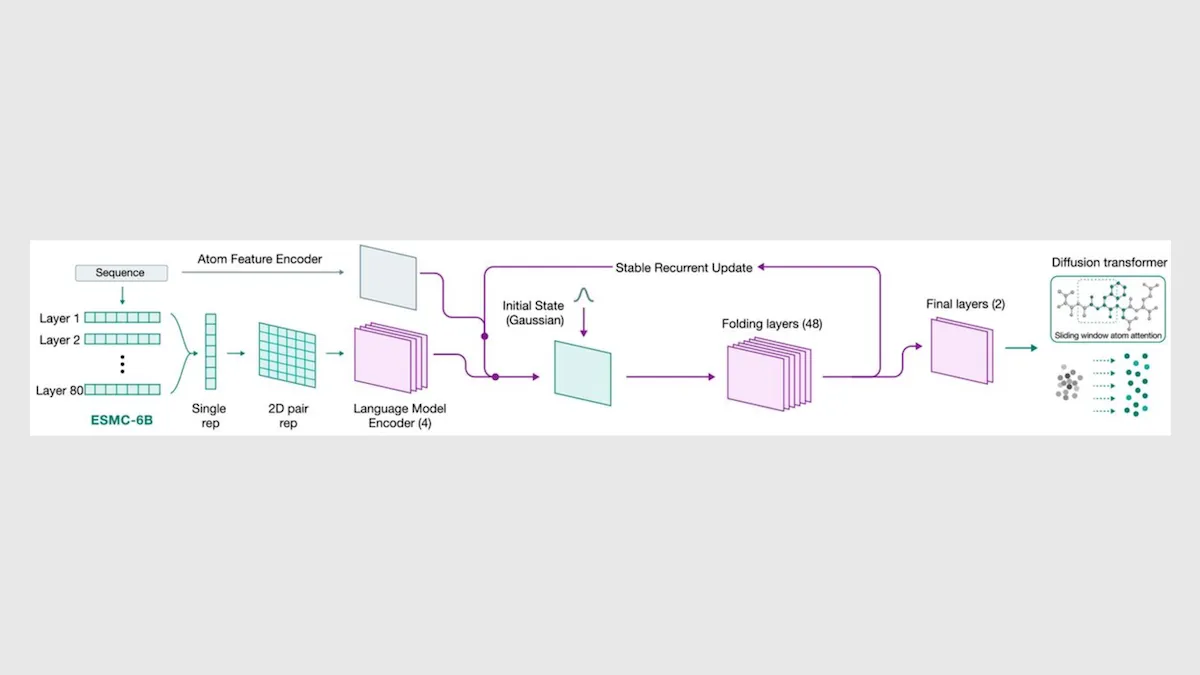
What’s new: A team at the non-profit biomedical research organization Biohub and the independent AI-for-biology lab EvolutionaryScale released ESMFold2, which infers the shapes of biologically active molecules — including proteins, DNA, RNA, and molecules that bind to them — by treating their components like a natural language. Where AlphaFold 3 and ESMFold2 infer molecular shapes by considering characteristics of multiple related molecules that have been aligned for comparison, ESMFold2 can also use a separate transformer to embed individual molecules directly, in the manner of a large language model. In addition to ESMFold2, the team released its embedding model, which is called ESMC.新动态:非营利生物医学研究组织Biohub和独立AI生物学实验室EvolutionaryScale的一个团队发布了ESMFold2,它通过将分子组件视为自然语言来推断生物活性分子的形状——包括蛋白质、DNA、RNA以及与之结合的分子。AlphaFold 3和ESMFold2通过考虑多个已对齐用于比较的相关分子的特征来推断分子形状,而ESMFold2还可以使用单独的Transformer以大型语言模型的方式直接嵌入单个分子。除了ESMFold2,该团队还发布了其嵌入模型,称为ESMC。
- Input/output: Input is an amino-acid sequence that defines proteins, base-pair sequence that defines DNA or RNA, standardized text description (SMILES) of other biologically active molecules, or multiple sequence alignment (MSA) that aligns related amino-acid or base-pair sequences; output is molecular shape and error estimates输入/输出:输入是定义蛋白质的氨基酸序列、定义DNA或RNA的碱基对序列、其他生物活性分子的标准化文本描述(SMILES),或对齐相关氨基酸或碱基对序列的多序列比对(MSA);输出是分子形状和误差估计
- Architecture: Mixed (6.2 billion parameters)架构:混合(62亿参数)
- Performance: Outperforms AlphaFold 3 and other competing models when inputs are not MSAs, comparable to AlphaFold and other competing models when inputs are MSAs性能:当输入不是MSA时,优于AlphaFold 3和其他竞争模型;当输入是MSA时,与AlphaFold和其他竞争模型相当
- Availability: Free via website, weights available for download via HuggingFace, API via Biohub可用性:通过网站免费使用,权重可通过HuggingFace下载,通过Biohub提供API
Key insight: To analyze a given molecule, AlphaFold3 and similar models must also receive an MSA, which requires finding related molecules in existing databases and aligning them properly. But transformer-based large language models are good at producing embeddings based on large amounts of training data, and databases are available to provide vast numbers of sequences and standardized text descriptions of bioactive molecules. A transformer can be trained to embed individual molecules, and the embedding can serve as input instead of an MSA.关键见解:为了分析给定的分子,AlphaFold3和类似模型还必须接收MSA,这需要在现有数据库中查找相关分子并正确对齐。但基于Transformer的大型语言模型擅长基于大量训练数据生成嵌入,并且数据库可以提供大量序列和生物活性分子的标准化文本描述。可以训练Transformer嵌入单个分子,并且该嵌入可以作为输入替代MSA。
How it works: Given a protein, DNA, or RNA sequence or description of a bioactive molecule, ESMFold2 (i) embeds the input in three different ways, including (a) the sequence, (b) its atoms, and (c) an MSA if it receives one. (ii) It produces an embedding that represents the physical distances between amino acids, base pairs, or atoms in a molecule. (iii) It estimates the coordinates of the atoms in the input. And (iv) it estimates its error in those coordinates. It learned to perform these steps using two datasets that match existing sequences and descriptions to their shapes.工作原理:给定蛋白质、DNA或RNA序列或生物活性分子的描述,ESMFold2 (i) 以三种不同方式嵌入输入,包括 (a) 序列、(b) 其原子,以及 (c) 如果收到MSA则嵌入MSA。(ii) 它生成一个表示分子中氨基酸、碱基对或原子之间物理距离的嵌入。(iii) 它估计输入中原子的坐标。(iv) 它估计这些坐标的误差。它使用两个将现有序列和描述与其形状匹配的数据集来学习执行这些步骤。
- Given an input, the system produced three embeddings. (a) To embed amino-acid or base-pair sequences, the system uses ESMC, a transformer model. This model was trained to fill in masked tokens in roughly 2.8 billion sequences in three protein databases. 给定输入,系统生成三个嵌入。(a) 为了嵌入氨基酸或碱基对序列,系统使用ESMC,一个Transformer模型。该模型经过训练,可以在三个蛋白质数据库中大约28亿个序列中填充掩码token。
- (b) A separate transformer embedded the atoms. (c) To embed MSAs, the system uses a pairmixer model that updates each element in a matrix based on the elements in the same row or column of the matrix. In this model, the matrix represents an MSA.(b) 一个单独的Transformer嵌入原子。(c) 为了嵌入MSA,系统使用一个pairmixer模型,该模型根据矩阵中同一行或同一列的元素更新矩阵中的每个元素。在此模型中,矩阵表示一个MSA。
- Given these embeddings, another pairmixer produces an embedding that represents the pairwise distances between amino acids, base pairs, and atoms. The embedding starts as pure noise. During training, it was refined by cycling through the model up to 6 times. (At inference, it cycles 10 times, as this delivered the best performance.)给定这些嵌入,另一个pairmixer生成一个表示氨基酸、碱基对和原子之间成对距离的嵌入。该嵌入最初是纯噪声。在训练期间,通过循环通过模型最多6次进行细化。(在推理时,它循环10次,因为这提供了最佳性能。)
- Given the embedding of distances, embeddings of sequences and atoms, and a noisy point cloud of atoms, the diffusion model removes the noise to deduce the atoms’ positions.给定距离嵌入、序列和原子嵌入以及噪声原子点云,扩散模型去除噪声以推断原子的位置。
- Given the embeddings of distance, sequences, and atoms and the point cloud, a third pairmixer estimates various errors, including the error between the predicted distances and actual distances between pairs of atoms.给定距离、序列和原子的嵌入以及点云,第三个pairmixer估计各种误差,包括预测距离与原子对之间实际距离之间的误差。
Results: The authors tested ESMFold2 using FoldBench, which includes tests of finding the shapes of biologically active molecules in various combinations. Given only proteins as input, ESMFold2 outperformed Chai-1, a molecular model that doesn’t accept MSAs. Given MSAs, it performed similarly to competing models that use MSAs, including AlphaFold3.结果:作者使用FoldBench测试了ESMFold2,该测试包括在各种组合中查找生物活性分子形状的测试。仅给定蛋白质作为输入,ESMFold2优于不接受MSA的分子模型Chai-1。给定MSA,其性能与使用MSA的竞争模型(包括AlphaFold3)相似。
- The team evaluated the ability, given a protein sequence, to deduce its shape according to Local Distance Difference Test (lDDT), which measures similarity between estimated inter-atom distances and ground truth, higher is better. ESMFold2 achieved 0.85 lDDT, while Chai-1 achieved 0.81 lDDT.团队评估了根据局部距离差测试(lDDT)从蛋白质序列推断其形状的能力,该测试测量估计的原子间距离与真实值之间的相似性,越高越好。ESMFold2达到0.85 lDDT,而Chai-1达到0.81 lDDT。
- Testing the same capability given an MSA, ESMFold2 achieved 0.89 lDDT, the same as AlphaFold3 and Protenix-v1.在给定MSA的情况下测试相同能力,ESMFold2达到0.89 lDDT,与AlphaFold3和Protenix-v1相同。
- Given a protein and a DNA molecule that were bound together, the team evaluated the DockQ pass rate, or the similarity between estimated inter-atom distances and ground truth at the points where the molecules touch, higher is better. ESMFold2 (80 percent) slightly outperformed Chai-1 (71 percent). Given the same molecules plus an MSA, ESMFold2 (79 percent) matched Protenix-v1 but underperformed AlphaFold3 (82 percent).给定一个结合在一起的蛋白质和DNA分子,团队评估了DockQ通过率,即分子接触点处估计的原子间距离与真实值之间的相似性,越高越好。ESMFold2(80%)略优于Chai-1(71%)。给定相同分子加上MSA,ESMFold2(79%)与Protenix-v1相当,但低于AlphaFold3(82%)。
Behind the news: ESMFold2 is an update to Biohub’s 2022 ESMFold. It’s bigger and trained on more data. In addition, its architecture incorporates top-performing components proposed in other work, notably AlphaFold3, such as a diffusion model that predicts atom coordinates and a model that estimates error in the system’s output.新闻背景:ESMFold2是Biohub 2022年ESMFold的更新版本。它更大,训练数据更多。此外,其架构整合了其他工作中提出的顶级性能组件,特别是AlphaFold3,例如预测原子坐标的扩散模型和估计系统输出误差的模型。
Why it matters: Using a transformer — essentially a large language model — to embed molecules gives ESMFold2 the ability to process input molecules without requiring an aligned set of biologically related molecules. This capability reduces friction in biological research. It's especially important if a molecule is novel (such as a rapidly evolving viral protein) or synthetic (such as a product of synthetic biology) and if information about related molecules is scarce. Moreover, since the system has open weights, it’s freely available to scientists whatever their means or affiliation.为何重要:使用Transformer(本质上是一个大型语言模型)来嵌入分子,使ESMFold2能够处理输入分子,而无需一组对齐的生物相关分子。这种能力减少了生物学研究中的摩擦。如果分子是新颖的(例如快速进化的病毒蛋白)或合成的(例如合成生物学的产物),并且关于相关分子的信息稀缺,这一点尤其重要。此外,由于系统具有开放权重,无论科学家的资源或隶属关系如何,都可以免费使用。
We're thinking: LLMs have proven the value of applying more processing at inference. ESMFold2’s distance-estimation model uses the same principle, improving performance by cycling its embedding through the model multiple times.我们的思考:LLM已经证明了在推理时应用更多处理的价值。ESMFold2的距离估计模型使用了相同的原理,通过多次循环其嵌入通过模型来提高性能。