If you’ve built an agent, you know that the delta between “it works on my machine” and “it works in production” can be huge. Traditional software assumes you mostly know the inputs and can define the outputs. Agents give you neither: users can say literally anything, and the space of possible behaviors is wide open. That’s why they’re powerful — and why they can also go a little sideways in ways you didn’t see coming.如果你构建过智能体(Agent),你就会知道“在我的机器上运行良好”与“在生产环境中运行良好”之间的差距可能非常巨大。传统软件假设你基本了解输入并能定义输出。而智能体两者都无法保证:用户可以输入任何内容,且可能出现的行为空间极其广阔。这就是它们强大的原因,也是它们有时会以你意想不到的方式“跑偏”的原因。
Over the past 3 years, we’ve watched thousands of teams struggle with this reality. The ones who’ve succeeded in shipping something reliable to production — companies like Clay, Vanta, LinkedIn, and Cloudflare — aren’t following the traditional software playbook. They’re pioneering something new: agent engineering.在过去 3 年里,我们目睹了成千上万个团队在这一现实面前挣扎。那些成功将可靠产品交付到生产环境的公司——如 Clay、Vanta、LinkedIn 和 Cloudflare——并没有遵循传统的软件开发手册。他们正在开创一种全新的领域:智能体工程。
What is agent engineering?什么是智能体工程?
Agent engineering is the iterative process of refining non-deterministic LLM systems into reliable production experiences. It is a cyclical process: build, test, ship, observe, refine, repeat.智能体工程是一个将非确定性大语言模型(LLM)系统打磨为可靠生产体验的迭代过程。这是一个循环往复的过程:构建、测试、发布、观察、优化,然后重复。
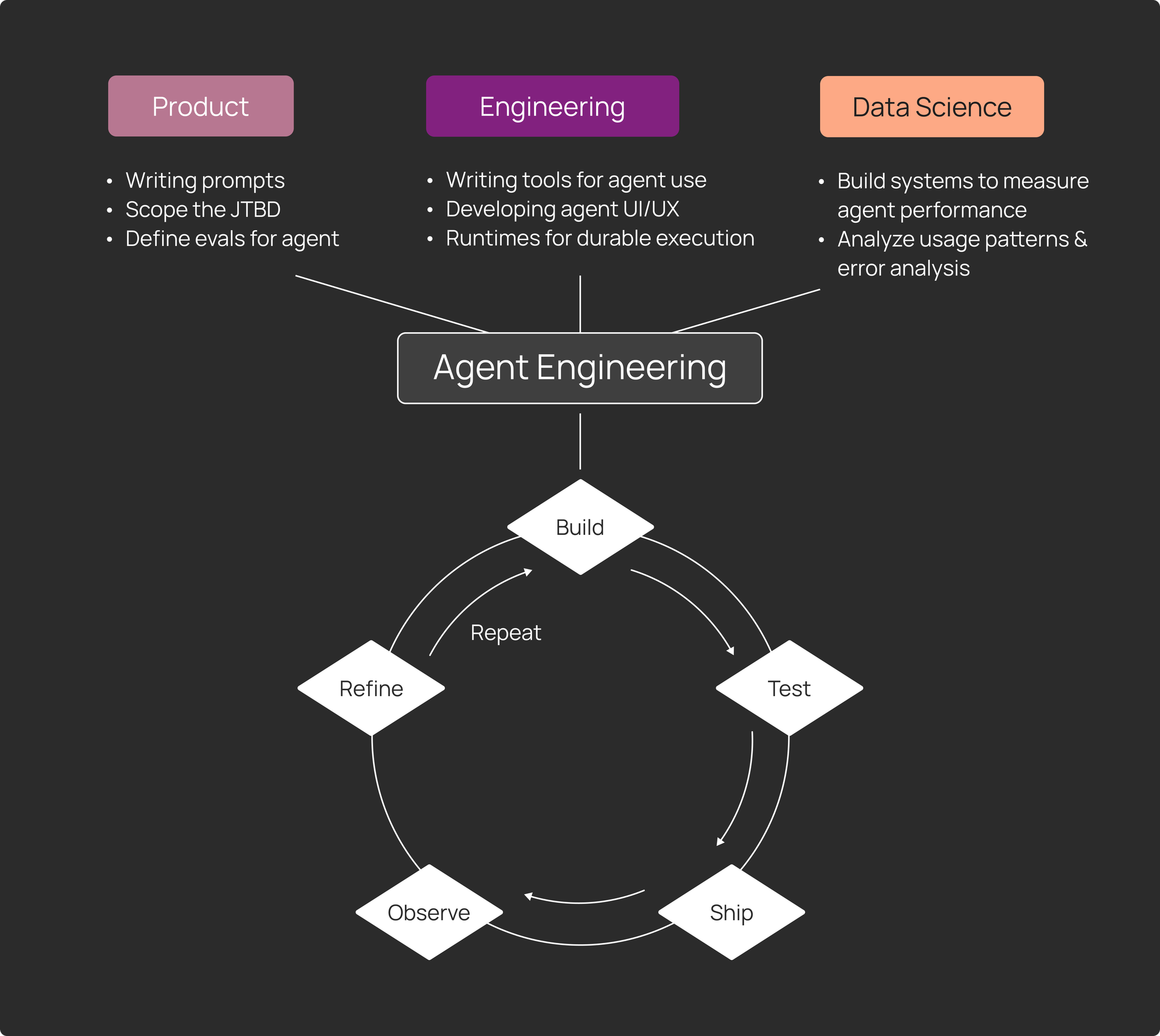
The key here is that shipping isn't the end goal. It’s just the way you keep moving to get new insights and improve your agent. To make improvements that matter, you need to understand what’s happening in production. The faster you move through this cycle, the more reliable your agent becomes.这里的关键在于,发布并不是最终目标。它只是你获取新见解并改进智能体的手段。为了做出有意义的改进,你需要了解生产环境中正在发生什么。你在这个周期中推进得越快,你的智能体就变得越可靠。
We see agent engineering as a new discipline that combines 3 skillsets working together:我们将智能体工程视为一门结合了以下 3 种技能组合的新学科:
- Product thinking defines the scope and shapes agent behavior. This involves:
- Writing prompts that drive agent behavior (often hundreds or thousands of lines). Good communication and writing skills are key here.编写驱动智能体行为的提示词(通常长达数百或数千行)。良好的沟通和写作能力在这里至关重要。
- Deeply understanding the "job to be done" that the agent replicates深入理解智能体所要替代的“待办任务”(job to be done)。
- Defining evaluations that test whether the agent performs as intended by the “job to be done”定义评估标准,以测试智能体是否按照“待办任务”的预期执行。
- Engineering builds the infrastructure that makes agents production-ready. This involves:
- Writing tools for agents to use为智能体编写可使用的工具。
- Developing UI/UX for agent interactions (with streaming, interrupt handling, etc.)开发用于智能体交互的 UI/UX(包括流式传输、中断处理等)。
- Creating robust runtimes that handle durable execution, human-in-the-loop pauses, and memory management.创建稳健的运行时环境,处理持久化执行、人机协作(human-in-the-loop)暂停和内存管理。
- Data science measures and improves agent performance over time. This involves:
- Building systems (evals, A/B testing, monitoring etc.) to measure agent performance and reliability构建系统(评估、A/B 测试、监控等)来衡量智能体的性能和可靠性。
- Analyzing usage patterns and error analysis (since agents have a broader scope of how users use them than traditional software)分析使用模式和错误分析(因为与传统软件相比,用户使用智能体的范围更广)。
Where agent engineering shows up智能体工程的应用场景
Agent engineering isn’t a new job title. Instead, it’s a set of responsibilities that existing teams take on when they’re building systems that reason, adapt, and behave unpredictably. The organizations shipping reliable agents today are extending the skills of engineering, product, and data teams to meet the demands of non-deterministic systems.智能体工程不是一个新的职位名称。相反,它是一组职责,当现有团队构建具备推理、适应能力且行为不可预测的系统时,他们就需要承担这些职责。如今能够交付可靠智能体的组织,正在扩展工程、产品和数据团队的技能,以满足非确定性系统的需求。
Here’s where the practice typically shows up:以下是该实践通常出现的地方:
- Software engineers and ML engineers writing prompts and building tools for agents to use, tracing why an agent made specific tool calls, and refining the underlying models软件工程师和机器学习工程师编写提示词并构建智能体工具,追踪智能体进行特定工具调用的原因,并优化底层模型。
- Platform engineers building agent infrastructure that handles durable execution and human-in-the-loop workflows平台工程师构建处理持久化执行和人机协作工作流的智能体基础设施。
- Product managers writing prompts, defining agent scope, and ensuring the agent solves the right problem产品经理编写提示词、定义智能体范围,并确保智能体解决了正确的问题。
- Data scientists measuring agent reliability and identifying opportunities for improvement数据科学家衡量智能体可靠性并识别改进机会。
These teams embrace rapid iteration, and you'll often see software engineers tracing errors and handing off to PMs to tweak prompts based on those insights, or PMs identifying scope issues that require new tools from engineers. Each recognizes that the real work of hardening an agent happens through this cycle of observing production behavior and systematically refining based on what they learn.这些团队拥抱快速迭代。你经常会看到软件工程师追踪错误并将其移交给产品经理,由产品经理根据这些见解调整提示词;或者产品经理识别出范围问题,需要工程师提供新工具。每个人都认识到,强化智能体的真正工作是通过观察生产行为并根据所学知识进行系统性优化这一循环来实现的。
Why agent engineering, and why now?为什么需要智能体工程,为什么是现在?
Two fundamental shifts have made agent engineering necessary.两个根本性的转变使得智能体工程变得必要。
First, LLMs are powerful enough to handle complex, multi-step workflows. We’ve been seeing it with agents taking on whole jobs, not just tasks. Clay uses agents to handle everything from prospect research to personalized outreach and CRM updates. LinkedIn uses agents to scan massive talent pools for recruiting, ranking candidates and surfacing the strongest matches instantly. We’re starting to cross the threshold where agents are delivering meaningful business value in production.首先,大语言模型已经强大到足以处理复杂的多步骤工作流。我们已经看到智能体开始承担整个工作,而不仅仅是任务。Clay 使用智能体处理从潜在客户研究到个性化外联和 CRM 更新的所有工作。LinkedIn 使用智能体扫描海量人才库进行招聘,对候选人进行排名并即时呈现最匹配的人选。我们正开始跨越智能体在生产环境中提供实质性商业价值的门槛。
Second, that power comes with real unpredictability. Simple LLM apps, though non-deterministic, tend to have more contained behavior. Agents are different. They reason across multiple steps, call tools, and adapt based on context. The same things that make agents useful also make them behave differently than traditional software. This usually means that:其次,这种能力伴随着真正的不确定性。简单的 LLM 应用虽然也是非确定性的,但其行为往往更受控。智能体则不同。它们跨越多个步骤进行推理、调用工具并根据上下文进行调整。使智能体变得有用的特性,同时也使它们的行为与传统软件不同。这通常意味着:
- Every input is an edge case. There's no such thing as a "normal" input when users can ask anything in natural language. When you type in “make it pop” or “do what you did last time but differently”, the agent (just like a human) can interpret the prompts in different ways.每一个输入都是边缘情况。当用户可以用自然语言询问任何事情时,不存在所谓的“正常”输入。当你输入“让它更出彩”或“像上次那样做,但换个方式”时,智能体(就像人类一样)可以以不同的方式解读这些提示词。
- You can’t debug the old way. Because so much logic lives inside the model, you have to inspect each decision and tool call. Small prompt or config tweaks can create huge shifts in behavior.你无法用老方法进行调试。因为大量的逻辑存在于模型内部,你必须检查每一个决策和工具调用。微小的提示词或配置调整都可能导致行为的巨大变化。
- “Working” isn’t binary. An agent can have 99.99% uptime while still being off the rails and broken. There aren’t always simple yes/no answers to the questions that matter, like: is the agent making the right calls? Using tools the right way? Following the intent behind your instructions?“运行正常”不是二元对立的。一个智能体可能拥有 99.99% 的正常运行时间,但仍然可能完全失控。对于重要的问题,并不总是有简单的“是/否”答案,例如:智能体是否做出了正确的调用?是否以正确的方式使用了工具?是否遵循了你指令背后的意图?
When you put this all together — agents running real, high impact workflows yet behaving in ways that traditional software can’t solve — there’s an opportunity and the need for a new discipline. Agent engineering lets you harness the power of LLMs while building systems you can actually trust in production.综上所述——智能体运行着真实且高影响力的工作流,但其行为方式又是传统软件无法解决的——这带来了一个新学科的机遇和需求。智能体工程让你能够利用大语言模型的力量,同时构建出你在生产环境中真正可以信任的系统。
What does agent engineering look like in practice?智能体工程在实践中是什么样的?
Agent engineering operates on a different principle than traditional software development. To achieve a reliable agent system, shipping is how you learn, not what you do after learning.智能体工程遵循与传统软件开发不同的原则。为了实现可靠的智能体系统,发布是你学习的方式,而不是学习之后才做的事情。
We’ve seen successful eng teams follow a cadence for agent development that looks something like this:我们看到成功的工程团队遵循一种类似于以下的智能体开发节奏:
- Build your agent’s foundation. Start with designing your agent's foundation, whether it's a simple LLM call with tools or a complex multi-agent system. Your architecture depends on how much workflow (deterministic step-by-step processes) versus agency (LLM-driven decisions) you need.构建智能体的基础。从设计智能体的基础开始,无论是简单的带工具 LLM 调用,还是复杂的多智能体系统。你的架构取决于你需要多少工作流(确定性的分步过程)与智能(LLM 驱动的决策)。
- Test based on scenario you can imagine. Test your agent against example scenarios to catch obvious issues with prompts, tool definitions, and workflows. Unlike traditional software where you can map out user flows, you can't anticipate every way users will interact with natural language input. Shift your mindset from "test exhaustively, then ship" to "test reasonably, ship to learn what actually matters.”基于你能想象到的场景进行测试。针对示例场景测试你的智能体,以捕捉提示词、工具定义和工作流中的明显问题。与传统软件可以规划用户流程不同,你无法预见用户与自然语言输入交互的所有方式。将你的思维方式从“详尽测试,然后发布”转变为“合理测试,通过发布来了解真正重要的事情”。
- Ship to see real-world behavior. Once you ship, you’ll immediately start seeing inputs you hadn’t considered and every production trace shows what your agent actually needs to handle.发布以观察真实世界的行为。一旦发布,你将立即开始看到你未曾考虑过的输入,每一次生产追踪都会显示你的智能体实际需要处理的内容。
- Observe. Trace every every interaction to see the full conversation, every tool called, and the exact context that informed each decision the agent made. Run evals over your production data to measure agent quality, whether you care about accuracy, latency, user satisfaction, or other criteria.观察。追踪每一次交互,查看完整的对话、调用的每一个工具,以及告知智能体每一个决策的确切上下文。在生产数据上运行评估,以衡量智能体质量,无论你关心的是准确性、延迟、用户满意度还是其他标准。
- Refine. Once you’ve identified patterns in what's failing, refine by editing prompts and modifying tool definitions. It’s all continuous, as you can add problematic cases back to your set of example scenarios for regression testing.优化。一旦你识别出失败模式,通过编辑提示词和修改工具定义来进行优化。这一切都是持续的,因为你可以将有问题的案例添加回你的示例场景集中,用于回归测试。
- Repeat. Ship your improvements and watch what’s changing in production. Each cycle teaches you something new about how users are interacting with your agent and what reliability actually means in your context.重复。发布你的改进并观察生产环境中的变化。每一个周期都会让你学到关于用户如何与你的智能体交互,以及在你的背景下“可靠性”真正意味着什么的新知识。
A new standard for engineering工程的新标准
The teams shipping reliable agents today share one thing: they've stopped trying to perfect agents before launch and started treating production as their primary teacher. In other words, tracing every decision, evaluating at scale, and shipping improvements in days instead of quarters.如今交付可靠智能体的团队有一个共同点:他们已经停止在发布前试图完善智能体,转而将生产环境视为他们的主要导师。换句话说,追踪每一个决策,进行大规模评估,并在几天而不是几个季度内发布改进。
Agent engineering is emerging because the opportunity demands it. Agents can now handle workflows that previously required human judgment, but only if you can make them reliable enough to trust. There is no shortcut, just the systematic work of iteration. The question isn't whether agent engineering will become standard practice. It's how quickly your team can adopt it to unlock what agents can do.智能体工程的兴起是因为机遇需要它。智能体现在可以处理以前需要人类判断的工作流,但前提是你必须使它们足够可靠以值得信任。没有捷径,只有系统性的迭代工作。问题不在于智能体工程是否会成为标准实践,而在于你的团队能多快采用它来释放智能体的潜力。