How OpenTelemetry traces LLM Calls, Agent Reasoning, and MCP ToolsOpenTelemetry 如何追踪 LLM 调用、代理推理和 MCP 工具

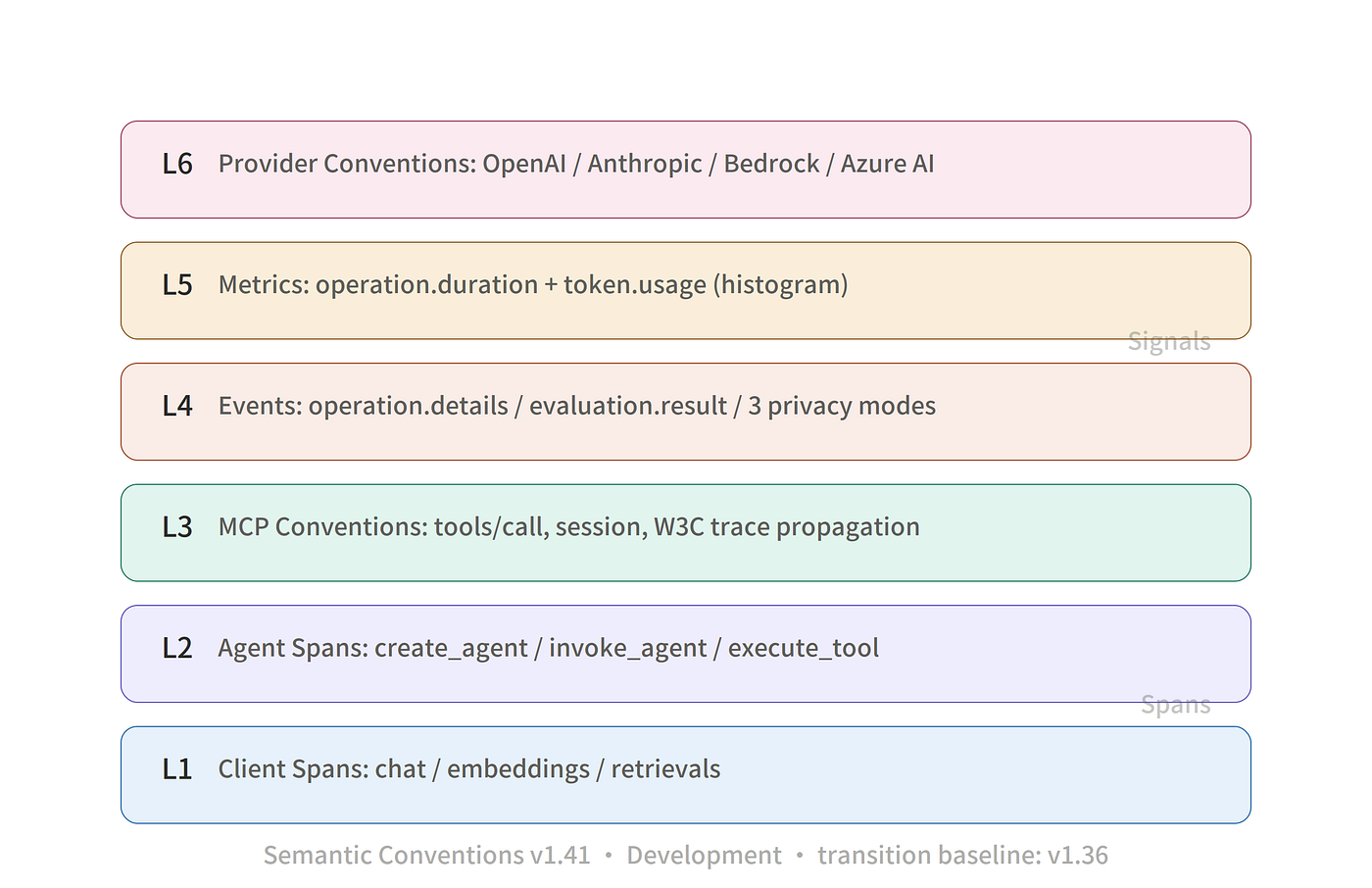
OpenTelemetry GenAI Semantic Conventions standardize observability for LLM apps, agent orchestration, MCP tool calling, content capture, and quality evaluation. This article goes through all six layers: what each one defines, why it’s designed that way, and how mature it is.OpenTelemetry GenAI 语义约定为 LLM 应用、代理编排、MCP 工具调用、内容捕获和质量评估标准化可观测性。本文将逐层介绍六个层面:每层定义了什么、为何如此设计以及成熟度如何。
Observability for LLM applications doesn’t work like traditional microservices. An LLM call produces far more telemetry than an HTTP request, but the harder problem is the shape of that data. Prompts and completions are large text blobs. Tool call parameters take a different structure every time. An agent’s multi-step reasoning can’t be captured in a fixed schema. And beyond the usual “which model was called and how long did it take,” you also need to know how many tokens were consumed, how much the call cost, and whether the answer was any good.LLM 应用的可观测性不同于传统微服务。一次 LLM 调用产生的遥测数据远多于一次 HTTP 请求,更难处理的是数据的形态。提示词和完成内容是大块文本,工具调用参数每次结构都不同,代理的多步推理无法用固定模式捕获。除了“调用了哪个模型、耗时多久”,还需要知道消耗了多少 token、调用费用以及答案是否有效。
Traditional OTel semantic conventions don’t cover any of this. http.request.method and db.system.name are meaningless for LLM calls. The community needed a dedicated spec.传统的 OTel 语义约定并未覆盖这些。http.request.method 和 db.system.name 对 LLM 调用毫无意义。社区需要一个专门的规范。
In April 2024, OpenTelemetry formed the GenAI Special Interest Group (GenAI SIG) under the Semantic Conventions SIG[1]. The original scope was LLM client call tracing. Since then it has expanded to cover agent orchestration, MCP tool calling, content capture, and quality evaluation: six layers in all. As of this writing, the OTel docs site shows Semantic Conventions v1.41.0[2], with the latest GitHub release at v1.41.1 (a k8s codegen fix only, no GenAI changes)[3].2024 年 4 月,OpenTelemetry 在语义约定 SIG 下成立了 GenAI 特别兴趣组(GenAI SIG)[1]。最初的范围是 LLM 客户端调用追踪。此后扩展至代理编排、MCP 工具调用、内容捕获和质量评估,共六层。截至撰写本文时,OTel 文档站显示语义约定 v1.41.0[2],最新的 GitHub 发布为 v1.41.1(仅修复 k8s 代码生成,无 GenAI 更改)[3]。
Each layer below covers what the spec defines, why it’s designed that way, and where it stands in maturity. If you read our earlier piece on Agent Observability, this is the spec companion: how the community is standardizing around the challenges that article described.下面每一层都会说明规范定义了什么、为何如此设计以及成熟度如何。如果你阅读过我们之前的《代理可观测性》文章,这就是该规范的配套说明:社区如何围绕文章中描述的挑战进行标准化。
How the Spec Evolved: From Early Days to v1.41规范演进:从早期到 v1.41
When GenAI SIG kicked off in April 2024, the goal was straightforward: define a standard set of attributes for LLM client calls (model name, token usage, latency) so that different instrumentation libraries produce consistent telemetry. Early versions introduced gen_ai.system, gen_ai.request.model, and a pair of histogram metrics.GenAI SIG 于 2024 年 4 月启动时,目标很明确:为 LLM 客户端调用(模型名称、token 使用量、延迟等)定义一套标准属性,使不同的仪器库产生一致的遥测。早期版本引入了 gen_ai.system、gen_ai.request.model 以及一对直方图指标。
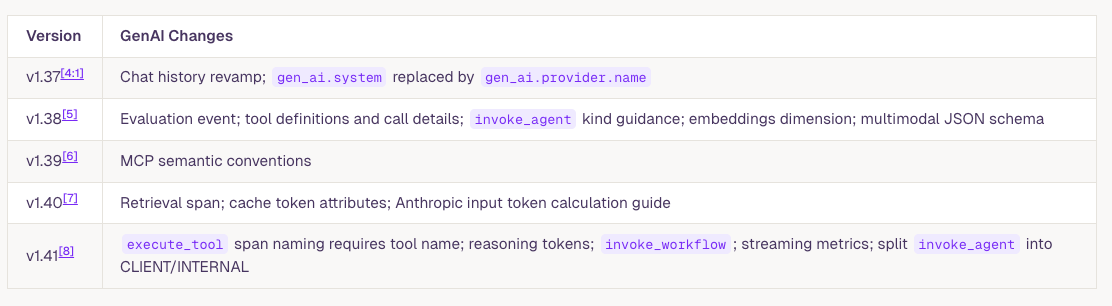
v1.37 was the turning point. It overhauled how chat history is recorded[4]. The old per-message events (one event per message) were replaced by three aggregated attributes (gen_ai.system_instructions, gen_ai.input.messages, gen_ai.output.messages) stored either on the span or in a new gen_ai.client.inference.operation.details event. The reason was practical: per-message events flooded multi-turn conversations with fine-grained events that were painful to query and correlate.v1.37 是转折点。它彻底改写了聊天历史的记录方式[4]。旧的每条消息事件(每条消息一个事件)被三个聚合属性(gen_ai.system_instructions、gen_ai.input.messages、gen_ai.output.messages)取代,这些属性存放在 span 上或新建的 gen_ai.client.inference.operation.details 事件中。原因在于实践:每条消息事件会在多轮对话中产生大量细粒度事件,查询和关联非常痛苦。
Every subsequent release has included GenAI changes:此后每个发布版本都包含了 GenAI 的更改:
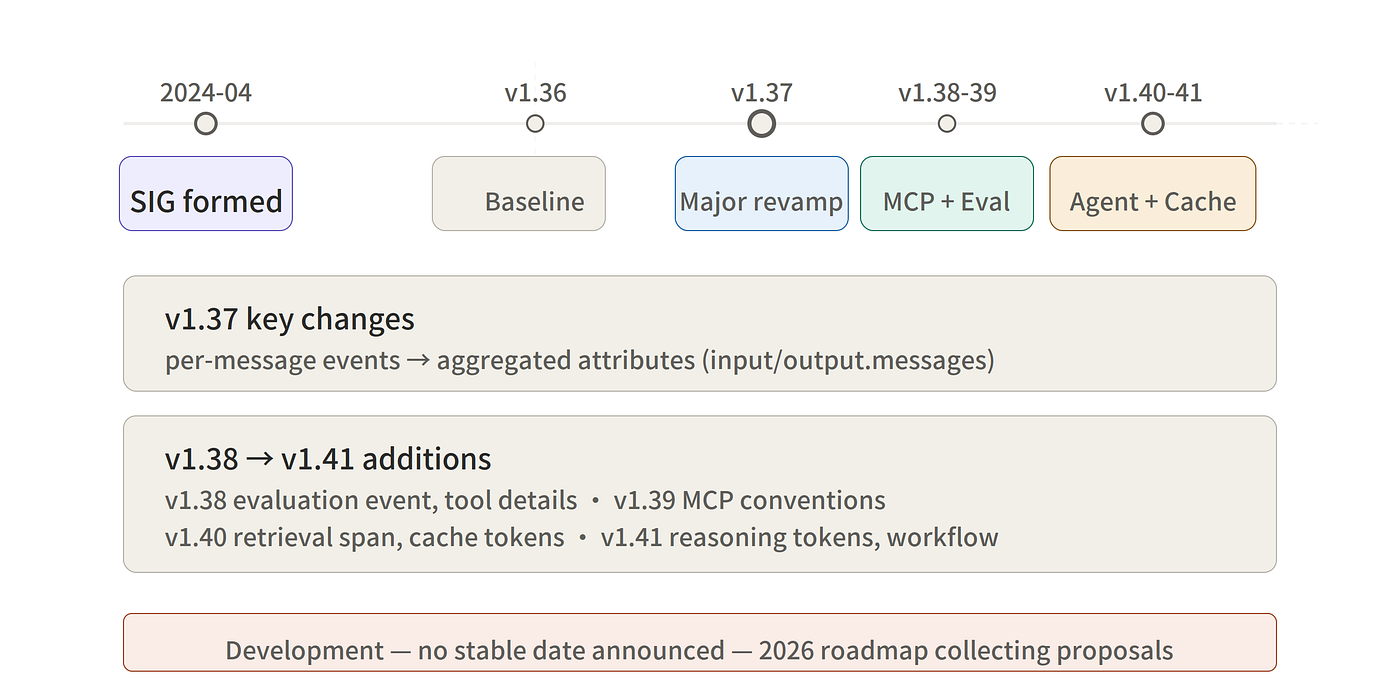
As of May 2026, the GenAI and MCP semantic conventions remain in Development status[2:1]. The docs say it plainly: “This transition plan will be updated to include stable version before the GenAI conventions are marked as stable.” No public timeline for stabilization. The 2026 Semantic Conventions Roadmap[9] is collecting proposals from each sub-SIG, but nothing’s committed.截至 2026 年 5 月,GenAI 和 MCP 语义约定仍处于 Development 状态[2:1]。文档直白说明:“在 GenAI 约定标记为 stable 之前,将更新此迁移计划以包含 stable 版本。”尚未公布公开的稳定时间表。2026 年语义约定路线图[9]正在收集各子 SIG 的提案,但尚未有任何承诺。
Attribute names and structures may still change. The core concepts have settled though, and the spec provides OTEL_SEMCONV_STABILITY_OPT_IN to manage version transitions. Building on the spec today is a reasonable bet.属性名称和结构仍可能变化。核心概念已经基本确定,规范提供 OTEL_SEMCONV_STABILITY_OPT_IN 用于管理版本迁移。基于当前规范进行构建是一个合理的选择。
Layer 1: Client Spans — Standardizing Model Calls层 1:客户端 Span —— 标准化模型调用
This is the base layer of the spec. It defines the spans produced when application code calls a GenAI model[10].这是规范的基础层。它定义了应用代码调用 GenAI 模型时产生的 span[10]。
Inference推理
Each LLM call generates a span with gen_ai.operation.name set to chat, text_completion, or generate_content (for multimodal). Span kind is CLIENT, since models typically run on remote services.每次 LLM 调用会生成一个 span,gen_ai.operation.name 设置为 chat、text_completion 或 generate_content(多模态)。Span 类型为 CLIENT,因为模型通常运行在远程服务上。
Core attributes:核心属性:
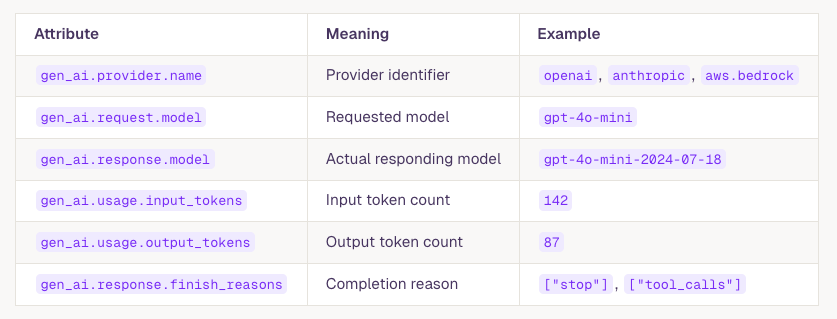
Here’s what this looks like in a trace viewer (Jaeger, Grafana Tempo, etc.):以下是在追踪查看器(Jaeger、Grafana Tempo 等)中的示例:
{
  "operationName": "chat gpt-4o-mini",
  "spanKind": "CLIENT",
  "duration": "1.23s",
  "attributes": {
    "gen_ai.operation.name":          "chat",
    "gen_ai.provider.name":           "openai",
    "gen_ai.request.model":           "gpt-4o-mini",
    "gen_ai.response.model":          "gpt-4o-mini-2024-07-18",
    "gen_ai.usage.input_tokens":      142,
    "gen_ai.usage.output_tokens":     87,
    "gen_ai.response.finish_reasons": ["stop"],
    "server.address":                 "api.openai.com",
    "server.port":                    443
  }
}
Note: This is a logical view for readability. The actual OTLP wire format uses
KeyValuearrays with typed values (stringValue,intValue, etc.) and nanosecond Unix timestamps.注意:这是为了可读性而做的逻辑视图。实际的 OTLP 线格式使用带类型值的 KeyValue 数组(stringValue、intValue 等)以及纳秒级 Unix 时间戳。
server.address and server.port are general networking attributes. They're not part of the GenAI spec, but instrumentation typically emits them anyway.server.address 和 server.port 是通用网络属性。它们不属于 GenAI 规范,但仪器库通常仍会发出这些属性。
provider.name and request.model are intentionally separate. The same model name can be accessed through different providers (Azure OpenAI and OpenAI direct both serve GPT-4o), and provider.name determines which provider-specific attributes apply.provider.name 与 request.model 故意分开。相同的模型名称可以通过不同的提供商访问(Azure OpenAI 与 OpenAI 直接均提供 GPT-4o),provider.name 决定使用哪套提供商特定属性。
request.model vs response.model matters in practice too: you request gpt-4o, but the response might come from gpt-4o-2024-08-06. For fine-tuned models, response.model should be more specific than the base name.request.model 与 response.model 在实际使用中也很重要:你请求的是 gpt-4o,但响应可能来自 gpt-4o-2024-08-06。对于微调模型,response.model 应该比基础名称更具体。
Embeddings and Retrievals嵌入和检索
Embeddings (gen_ai.operation.name=embeddings) cover vector embedding operations, with gen_ai.embeddings.dimension.count recording the vector dimension. Retrievals cover the retrieval step in RAG pipelines.嵌入(gen_ai.operation.name=embeddings)覆盖向量嵌入操作,使用 gen_ai.embeddings.dimension.count 记录向量维度。检索则覆盖 RAG 流水线中的检索步骤。
One-Line Integration一行集成
With Python + OpenAI SDK, instrumentation takes one line[11]:使用 Python + OpenAI SDK,仪器化只需一行代码[11]:
from opentelemetry.instrumentation.openai_v2 import OpenAIInstrumentor

OpenAIInstrumentor().instrument()
# OpenAI SDK calls will emit semconv-compliant spans and metrics.
# Prompt/completion events require content capture to be enabled explicitly.
client.chat.completions.create(model="gpt-4o-mini", messages=[...])
opentelemetry-instrumentation-openai-v2 is the most mature GenAI instrumentation. Anthropic, AWS Bedrock, and others are covered by community libraries.opentelemetry-instrumentation-openai-v2 是最成熟的 GenAI 仪器库。Anthropic、AWS Bedrock 等也有社区库支持。
Layer 2: Agent & Workflow Spans — Beyond Microservices层 2:代理与工作流 Span —— 超越微服务
This is where GenAI semantic conventions diverge most from traditional OTel. Distributed tracing has HTTP spans, RPC spans, and DB spans, but nothing for “agent invocation.” The GenAI spec introduces a new set of operation types[12].这是 GenAI 语义约定与传统 OTel 差异最大的地方。分布式追踪有 HTTP、RPC、DB Span,但没有“代理调用”。GenAI 规范引入了一套新的操作类型[12]。
create_agentcreate_agent
Describes agent creation, typically for remote agent services (OpenAI Assistants API, AWS Bedrock Agents). Span kind is CLIENT.描述代理创建,通常用于远程代理服务(OpenAI Assistants API、AWS Bedrock Agents)。Span 类型为 CLIENT。
Span: create_agent support-router
Kind: CLIENT
Attributes:
  gen_ai.operation.name = create_agent
  gen_ai.agent.name = support-router
gen_ai.provider.name = openaiinvoke_agentinvoke_agent
Invokes an agent to perform a task. v1.41 explicitly splits two scenarios[8:1]: CLIENT for remote calls, INTERNAL for local framework execution (e.g. LangGraph running agent logic in-process).调用代理执行任务。v1.41 明确区分两种场景[8:1]:远程调用为 CLIENT,本地框架执行(如 LangGraph 在进程内运行代理逻辑)为 INTERNAL。
invoke_workflowinvoke_workflow
Describes execution of a predefined workflow (added in v1.41[8:2]). Agents reason autonomously; workflows follow predetermined paths.描述预定义工作流的执行(在 v1.41[8:2] 中加入)。代理可以自主推理;工作流遵循预设路径。
execute_toolexecute_tool
Tool execution span, kind INTERNAL. Starting with v1.41, the tool name must appear in the span name (execute_tool {gen_ai.tool.name})[8:3]. gen_ai.tool.call.arguments and gen_ai.tool.call.result are recorded only when privacy policies permit.工具执行 Span,类型为 INTERNAL。从 v1.41 起,工具名称必须出现在 span 名称中(execute_tool {gen_ai.tool.name})[8:3]。只有在隐私策略允许时才记录 gen_ai.tool.call.arguments 和 gen_ai.tool.call.result。
Why These Span Types Matter为何这些 Span 类型重要
Our Agent Observability article discussed a core challenge: the agent’s reasoning process shows up as a black box in traces. Agent span conventions crack that open:我们的《代理可观测性》文章讨论了核心挑战:代理的推理过程在追踪中表现为黑盒。代理 Span 约定打开了这扇门:
invoke_agent research-assistant (INTERNAL)
├── chat gpt-4o (CLIENT)                ← Model decides to search
├── execute_tool web_search (INTERNAL)  ← Search executed
├── chat gpt-4o (CLIENT)               ← Continues reasoning with results
├── execute_tool summarize (INTERNAL)   ← Summarization
└── chat gpt-4o (CLIENT)               ← Generates final answer
Every step carries standardized attributes, and any compatible backend (Jaeger, Tempo, Datadog) can render the structure correctly.每一步都携带标准化属性,任何兼容的后端(Jaeger、Tempo、Datadog)都能正确渲染结构。
Layer 3: MCP Semantic Conventions — Fixing Broken Traces层 3:MCP 语义约定 —— 修复断裂的追踪
Model Context Protocol (MCP) spread fast in 2025, but brought an observability problem: traces from the agent side and the MCP server side are disconnected.Model Context Protocol(MCP)在 2025 年快速传播,但带来了可观测性问题:代理侧的 Trace A 与 MCP 服务器侧的 Trace B 之间缺乏上下文传播。
Glama’s analysis laid it out clearly[13]: the agent produces Trace A, the MCP server produces Trace B, no context propagation between them. The OTel MCP semantic conventions, introduced in v1.39[6:1], fix this[14].Glama 的分析清晰阐述了这一点[13]:代理产生 Trace A,MCP 服务器产生 Trace B,二者之间没有上下文传递。OTel MCP 语义约定在 v1.39[6:1] 中引入,解决了此问题[14]。
Core Design核心设计
MCP runs on JSON-RPC, but the spec recommends MCP conventions over generic RPC semantic conventions. MCP spans carry context that generic RPC conventions miss, such as session and tool call details.MCP 基于 JSON-RPC,但规范建议使用 MCP 约定而非通用 RPC 语义约定。MCP Span 携带的上下文是通用 RPC 约定所缺失的,例如会话和工具调用细节。
Client span example (stdio transport):客户端 Span 示例(stdio 传输):
Span: tools/call get-weather
Kind: CLIENT
Attributes:
  gen_ai.operation.name = execute_tool
  mcp.method.name = tools/call
  mcp.session.id = session-xyz
  mcp.protocol.version = 2025-03-26
  gen_ai.tool.name = get-weather
  jsonrpc.request.id = 42
  network.transport = pipe            # stdio maps to pipe
For HTTP transport, use network.transport = tcp (or quic) with network.protocol.name = http[14:1].对于 HTTP 传输,使用 network.transport = tcp(或 quic)并设置 network.protocol.name = http[14:1]。
When both sides propagate W3C Trace Context, the server span nests under the client span, and trace continuity is preserved across the protocol boundary.当双方都传播 W3C Trace Context 时,服务器 Span 会嵌套在客户端 Span 下,跨协议边界的追踪连续性得以保持。
Compatibility with execute_tool与 execute_tool 的兼容性
The spec handles deduplication: if MCP instrumentation detects that an outer GenAI instrumentation already tracks tool execution, it enriches the existing span with MCP-specific attributes (mcp.method.name, mcp.session.id, etc.) instead of creating a duplicate.规范处理去重:如果 MCP 仪器检测到外层 GenAI 仪器已经跟踪了工具执行,它会在现有 Span 上添加 MCP 特定属性(mcp.method.name、mcp.session.id 等),而不是创建重复的 Span。
A complete agent + MCP call chain[14:2]:完整的代理 + MCP 调用链[14:2]:
invoke_agent weather-forecast-agent (INTERNAL)
├── chat {model} (CLIENT)                          ← GenAI model
├── tools/call get-weather (CLIENT)                ← MCP client
│   └── tools/call get-weather (SERVER)            ← MCP server
└── chat {model} (CLIENT)                          ← GenAI model
MCP-Specific MetricsMCP 专属指标
Four MCP metrics: mcp.client.operation.duration / mcp.server.operation.duration (operation latency) and mcp.client.session.duration / mcp.server.session.duration (session lifetime).四个 MCP 指标:mcp.client.operation.duration / mcp.server.operation.duration(操作延迟)以及 mcp.client.session.duration / mcp.server.session.duration(会话时长)。
Layer 4: Events and Content Capture — Balancing Privacy and Observability层 4:事件与内容捕获 —— 平衡隐私与可观测性
Traditional OTel HTTP spans rarely need to worry about “should we record the request body?” LLM applications are different: prompt and completion content is both the most valuable debugging data and the most sensitive.传统 OTel HTTP Span 很少需要考虑“是否记录请求体”。LLM 应用不同:提示词和完成内容既是最有价值的调试数据,又是最敏感的信息。
Two Core Events两个核心事件
gen_ai.client.inference.operation.details (added in v1.37)[15]: records full input and output for a GenAI call. It's opt-in, and backends can process it as events/logs, decoupled from trace lifecycle and storage policies.gen_ai.client.inference.operation.details(在 v1.37 中加入)[15]:记录完整的输入输出。此事件为可选,后端可以将其作为事件/日志处理,独立于 trace 生命周期和存储策略。
gen_ai.evaluation.result: records quality evaluation results via gen_ai.evaluation.score.value and gen_ai.evaluation.score.label[15:1]. A relevancy evaluator might return score.value=0.85, score.label="relevant".gen_ai.evaluation.result:通过 gen_ai.evaluation.score.value 和 gen_ai.evaluation.score.label 记录质量评估结果[15:1]。例如相关性评估可能返回 score.value=0.85,score.label="relevant"。
Here’s the operation.details event with content capture enabled:以下是开启内容捕获的 operation.details 事件示例:
{
  "eventName": "gen_ai.client.inference.operation.details",
  "attributes": {
    "gen_ai.system_instructions": [
      {"type": "text", "content": "You are a helpful customer support agent."}
    ],
    "gen_ai.input.messages": [
      {
        "role": "user",
        "parts": [{"type": "text", "content": "Where is my order #12345?"}]
      }
    ],
    "gen_ai.output.messages": [
      {
        "role": "assistant",
        "parts": [{"type": "text", "content": "Your order #12345 shipped this morning and should arrive tomorrow."}],
        "finish_reason": "stop"
      }
    ]
  }
}
When recorded on the operation.details event, messages follow the spec's JSON schema in structured form[15:2]. On span attributes, where backends lack structured attribute support, serialized JSON strings work too.当记录在 operation.details 事件时,消息遵循规范的 JSON schema 结构化[15:2]。在 span 属性中,如果后端不支持结构化属性,也可以使用序列化的 JSON 字符串。
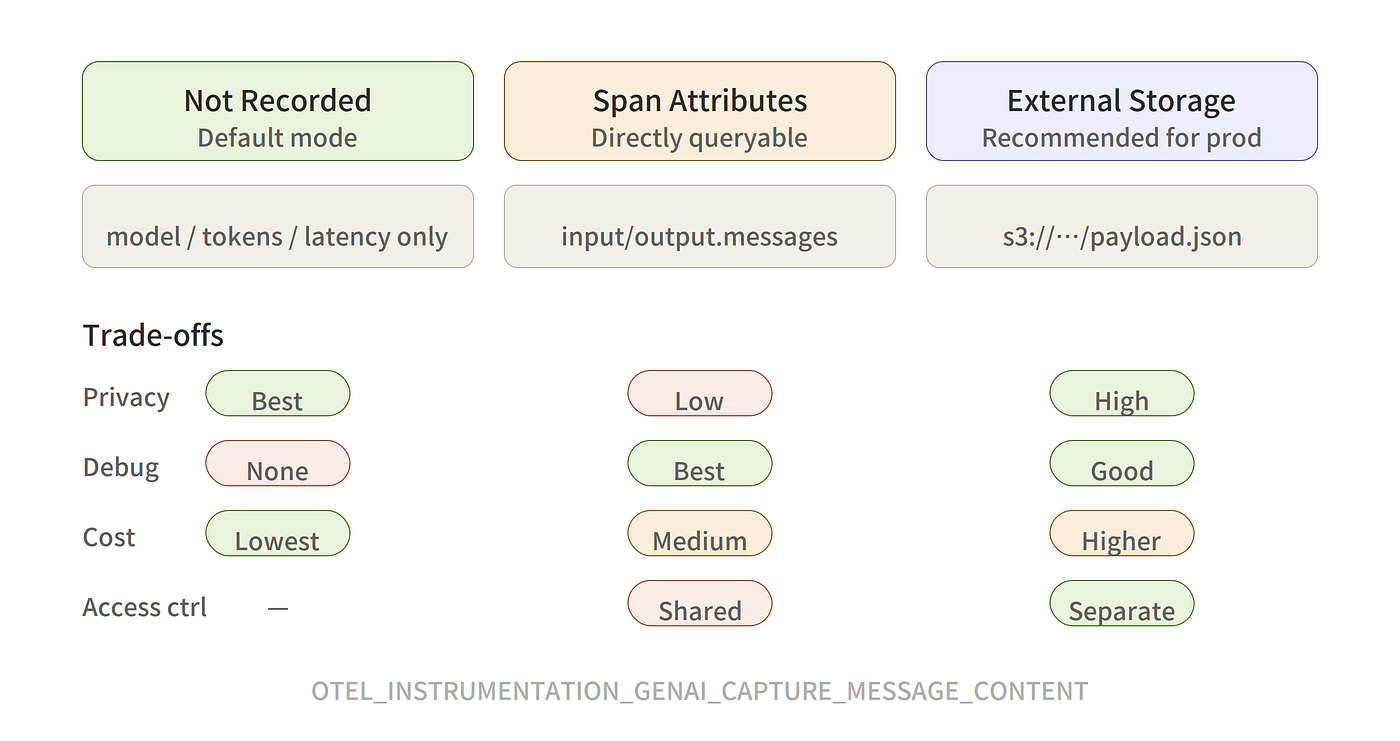
Content is absent by default. Many instrumentations gate it behind OTEL_INSTRUMENTATION_GENAI_CAPTURE_MESSAGE_CONTENT=true. In production, most teams end up on mode three: external storage with a reference URL on the span.默认情况下不捕获内容。许多仪器库通过 OTEL_INSTRUMENTATION_GENAI_CAPTURE_MESSAGE_CONTENT=true 来打开。生产环境中,大多数团队会采用模式三:将完整内容存储在外部系统,span 只保留引用 URL。
Three Content Recording Modes三种内容记录模式
The spec defines three approaches[10:1]:规范定义了三种方式[10:1]:
Not recorded (default). Content capture is off.不记录(默认)。关闭内容捕获。
On span attributes. gen_ai.input.messages and gen_ai.output.messages as span attributes. Convenient, but size-limited and visible to anyone with trace access.在 span 属性中记录。将 gen_ai.input.messages 与 gen_ai.output.messages 作为 span 属性。方便但受大小限制,且对拥有 trace 访问权限的任何人可见。
External storage + span reference. Full content in external storage (S3, GreptimeDB, etc.), span holds only a reference URL. Independent IAM and retention policies. The spec recommends this for production with significant telemetry volume or sensitive data[10:2].外部存储 + span 引用。将完整内容存放在外部存储(S3、GreptimeDB 等),span 仅保存引用 URL。可独立配置 IAM 与保留策略。规范建议在生产环境下、遥测量大或数据敏感时采用此方式[10:2]。
Layer 5: Metrics — The Two Essential Client Histograms层 5:指标 —— 两个关键的客户端直方图
The GenAI spec defines multiple metrics on both client and server sides. The two most used client histograms[16]:GenAI 规范在客户端和服务器端都定义了多种指标。最常用的两个客户端直方图[16]:
gen_ai.client.operation.durationgen_ai.client.operation.duration
End-to-end latency per GenAI operation, in seconds. Dimensions: gen_ai.operation.name, gen_ai.request.model, gen_ai.provider.name.每次 GenAI 操作的端到端延迟,单位为秒。维度包括:gen_ai.operation.name、gen_ai.request.model、gen_ai.provider.name。
gen_ai.client.token.usagegen_ai.client.token.usage
Token consumption per operation, unit {token}. Recommended bucket boundaries follow exponential growth: [1, 4, 16, 64, 256, 1024, 4096, 16384, 65536, 262144, 1048576, 4194304, 16777216, 67108864], covering 1 token to 67M tokens.每次操作的 token 消耗,单位为 token。推荐的桶边界采用指数增长:[1, 4, 16, 64, 256, 1024, 4096, 16384, 65536, 262144, 1048576, 4194304, 16777216, 67108864],覆盖 1 token 到 67M token。
Two counting rules worth knowing. When a provider reports both used and billable tokens, the instrumentation should report the billable count. When token counts can’t be obtained efficiently, the instrumentation should omit them rather than guess.有两条计数规则需要注意:当提供商同时报告使用 token 与计费 token 时,仪器库应上报计费 token;如果无法高效获取 token 数量,仪器库应省略而不是猜测。
These two metrics answer most operational questions: which model is most expensive, where latency is worst, how token consumption is trending. In our GenAI demo, they’re written to GreptimeDB via OTLP and queried with PromQL:这两个指标可以回答大多数运维问题:哪个模型最贵、延迟最差的环节、token 消耗趋势如何。在我们的 GenAI 演示中,这些指标通过 OTLP 写入 GreptimeDB,并使用 PromQL 查询:
# p95 token consumption
histogram_quantile(0.95,
  sum(rate(gen_ai_client_token_usage_bucket[5m])) by (le, gen_ai_token_type)
)
Layer 6: Provider-Specific Conventions — From Generic to Specialized层 6:提供商特定约定 —— 从通用到专用
Generic GenAI attributes cover common ground. Each provider has unique capabilities, handled through provider-specific conventions.通用 GenAI 属性覆盖公共部分。每个提供商都有独特能力,需要通过提供商特定约定来表达。
OpenAIOpenAI
OpenAI has the most detailed provider convention so far[17]. With gen_ai.provider.name set to openai, the spec adds:OpenAI 目前拥有最详细的提供商约定[17]。当 gen_ai.provider.name 设置为 openai 时,规范会额外加入:
gen_ai.usage.cache_read.input_tokens: tokens read from the provider's cachegen_ai.usage.cache_read.input_tokens:从提供商缓存读取的 token 数量gen_ai.usage.cache_creation.input_tokens: tokens written to the provider's cachegen_ai.usage.cache_creation.input_tokens:写入提供商缓存的 token 数量gen_ai.usage.reasoning.output_tokens: tokens consumed during reasoning (o1/o3 series, added in v1.41[8:4])gen_ai.usage.reasoning.output_tokens:推理过程中消耗的 token(o1/o3 系列,在 v1.41[8:4] 中加入)
Cached input is typically cheaper than regular input (exact discounts vary by model). Reasoning tokens are an additional cost specific to reasoning models.缓存输入通常比普通输入更便宜(具体折扣因模型而异)。推理 token 是针对推理模型的额外费用。
Anthropic, AWS Bedrock, Azure AI InferenceAnthropic、AWS Bedrock、Azure AI Inference
Anthropic (gen_ai.provider.name=anthropic) includes a calculation guide for gen_ai.usage.input_tokens[7:1], because its billing model differs from OpenAI's. AWS Bedrock (aws.bedrock) and Azure AI Inference (azure.ai.inference) extend platform-specific attributes.Anthropic(gen_ai.provider.name=anthropic)提供了 gen_ai.usage.input_tokens 的计费计算指南[7:1],因为其计费模型与 OpenAI 不同。AWS Bedrock(aws.bedrock)和 Azure AI Inference(azure.ai.inference)则扩展了平台特定属性。
Design principle: gen_ai.provider.name is the discriminator. It determines which provider-specific attributes should appear. An OpenAI span shouldn't carry aws.bedrock.* attributes, and vice versa.设计原则:gen_ai.provider.name 是判别器。它决定哪些提供商特定属性应出现。OpenAI 的 Span 不应携带 aws.bedrock.* 属性,反之亦然。
A Complete Trace完整追踪示例
Combining all six layers, here’s what a full trace looks like when an agent calls an external tool via MCP:结合全部六层,以下是代理通过 MCP 调用外部工具时的完整追踪示例:
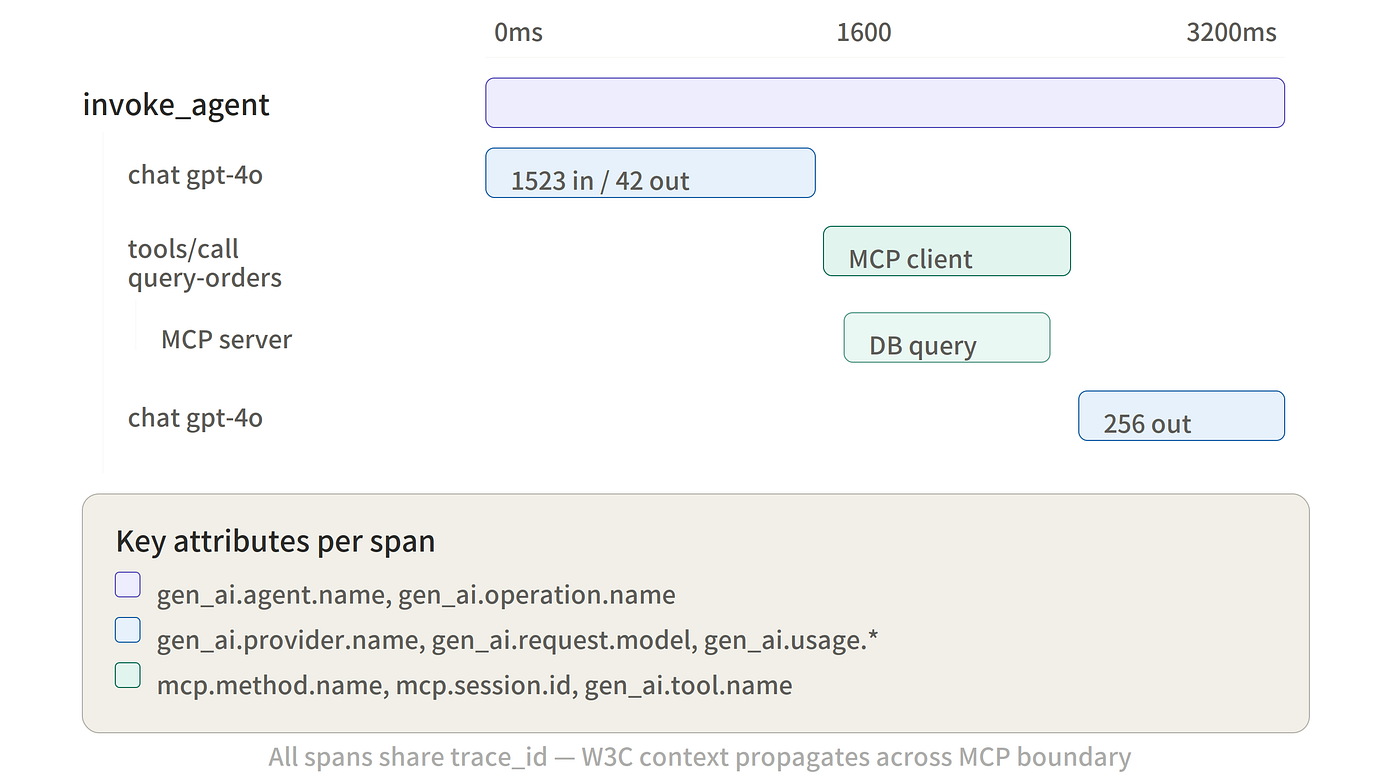
invoke_agent support-router (INTERNAL, trace=t1)
│
├── chat gpt-4o (CLIENT)
│     gen_ai.provider.name = openai
│     gen_ai.request.model = gpt-4o
│     gen_ai.usage.input_tokens = 1523
│     gen_ai.usage.output_tokens = 42
│     gen_ai.response.finish_reasons = ["tool_calls"]
│
├── tools/call query-orders (CLIENT)                  ← MCP client
│     mcp.method.name = tools/call
│     mcp.session.id = sess-abc
│     gen_ai.tool.name = query-orders
│   │
│   └── tools/call query-orders (SERVER)              ← MCP server
│
└── chat gpt-4o (CLIENT)
      gen_ai.usage.input_tokens = 2841
      gen_ai.usage.output_tokens = 256
      gen_ai.usage.cache_read.input_tokens = 1523     ← OpenAI-specific
      gen_ai.response.finish_reasons = ["stop"]

Metrics (same time window):
  gen_ai.client.operation.duration{model=gpt-4o}
  gen_ai.client.token.usage{model=gpt-4o, token_type=input}
  mcp.client.operation.duration{method=tools/call}
Events (opt-in):
  gen_ai.client.inference.operation.details → full prompt/completion
  gen_ai.evaluation.result → score.value=0.92, score.label="relevant"
Note: metrics use Prometheus-style shorthand ({model=...}). Actual attribute names are gen_ai.request.model, gen_ai.token.type, etc., exported to Prometheus as gen_ai_request_model, gen_ai_token_type. Prometheus 3.0 has since added native support for OpenTelemetry naming conventions, so cross-system alignment no longer requires manual conversion.注意:指标使用 Prometheus 风格的简写({model=...})。实际属性名为 gen_ai.request.model、gen_ai.token.type 等,导出到 Prometheus 时会转换为 gen_ai_request_model、gen_ai_token_type。Prometheus 3.0 已原生支持 OpenTelemetry 命名约定,跨系统对齐不再需要手动转换。
A single trace_id links the entire chain, from the agent's initial decision through the MCP server's execution to the final response.单个 trace_id 贯穿整个链路,从代理的初始决策、MCP 服务器的执行到最终响应。
Current Status and Adoption当前状态与采纳情况
The spec is still in Development status. v1.36 is the transition baseline: existing instrumentations default to the old attribute format, while OTEL_SEMCONV_STABILITY_OPT_IN=gen_ai_latest_experimental switches to the latest version[2:2].该规范仍处于 Development 状态。v1.36 为迁移基线:现有仪器库默认使用旧属性格式,而 OTEL_SEMCONV_STABILITY_OPT_IN=gen_ai_latest_experimental 可切换到最新版本[2:2]。
The OpenAI Python SDK instrumentation is the most mature[11:1]. Community libraries like OpenLLMetry[18] cover Anthropic, Cohere, and AWS Bedrock. Framework instrumentations for LangGraph and CrewAI are in progress.OpenAI Python SDK 的仪器化是最成熟的[11:1]。社区库如 OpenLLMetry[18] 覆盖了 Anthropic、Cohere 和 AWS Bedrock。LangGraph 与 CrewAI 的框架仪器化正在进行中。
Datadog was one of the first commercial platforms to natively support v1.37+ GenAI semantic conventions[19]. Elastic’s 2026 observability report finds that 85% of organizations use some form of GenAI for observability, and 89% of OTel production users rate vendor compliance as “critical” or “very important”[20].Datadog 是最早原生支持 v1.37+ GenAI 语义约定的商业平台之一[19]。Elastic 2026 年的可观测性报告显示,85% 的组织在可观测性中使用某种形式的 GenAI,89% 的 OTel 生产用户将供应商合规性评为“关键”或“非常重要”[20]。
We built a full LLM observability stack on this spec in our GenAI demo, with OTLP going straight to GreptimeDB and all three signal types in unified storage:我们在 GenAI 演示中基于该规范构建了完整的 LLM 可观测性栈,OTLP 直接写入 GreptimeDB,三类信号统一存储:
docker compose --profile load up -d
# Grafana: http://localhost:3000Wrap-Up总结
The six layers covered above (Client Spans, Agent Spans, MCP conventions, Events, Metrics, and Provider conventions) together span the full observability chain, from the initial model call to agent orchestration to tool execution.上述六层(客户端 Span、代理 Span、MCP 约定、事件、指标、提供商约定)共同覆盖了完整的可观测性链路,从最初的模型调用到代理编排再到工具执行。
The two pieces worth paying closest attention to today are Agent Spans and MCP conventions. Both are new to OTel, both target concrete problems (black-box agent reasoning and broken MCP traces), and both are likely to set the pattern for how the ecosystem instruments agents going forward. The three-mode design for content capture is the spec’s pragmatic answer to a real conflict between privacy and debuggability.目前最值得关注的两块是代理 Span 和 MCP 约定。它们都是 OTel 的新内容,针对具体问题(代理推理黑盒、MCP 追踪断裂),并可能为未来的代理仪器化设定模式。内容捕获的三模式设计是规范在隐私与可调试性冲突下的务实答案。
The spec itself is still moving fast. Every release from v1.37 to v1.41 has touched GenAI. For teams building LLM or agent systems, the easiest place to start is the OpenAI Python SDK instrumentation. From there, the spec docs and our demo show how the layers fit together in practice.规范本身仍在快速演进。从 v1.37 到 v1.41 的每一次发布都涉及 GenAI。对于构建 LLM 或代理系统的团队,最简单的起点是 OpenAI Python SDK 的仪器化。随后可以参考规范文档和我们的演示,了解各层在实际中的组合方式。
References参考文献
- OpenTelemetry GenAI SIG ↩︎OpenTelemetry GenAI SIG ↩︎
- Semantic Conventions for Generative AI Systems (docs v1.41.0, Development) ↩︎ ↩︎ ↩︎生成式 AI 系统的语义约定(文档 v1.41.0,Development)↩︎ ↩︎ ↩︎
- Semantic Conventions v1.41.1 ↩︎语义约定 v1.41.1 ↩︎
- v1.37.0 Release ↩︎ ↩︎v1.37.0 发布 ↩︎ ↩︎
- v1.38.0 Release ↩︎v1.38.0 发布 ↩︎
- v1.39.0 Release ↩︎ ↩︎v1.39.0 发布 ↩︎ ↩︎
- v1.40.0 Release ↩︎ ↩︎v1.40.0 发布 ↩︎ ↩︎
- v1.41.0 Release ↩︎ ↩︎ ↩︎ ↩︎ ↩︎v1.41.0 发布 ↩︎ ↩︎ ↩︎ ↩︎ ↩︎
- Semantic Conventions 2026 Roadmap ↩︎语义约定 2026 路线图 ↩︎
- GenAI Client Spans ↩︎ ↩︎ ↩︎GenAI 客户端 Span ↩︎ ↩︎ ↩︎
- opentelemetry-instrumentation-openai-v2 ↩︎ ↩︎opentelemetry-instrumentation-openai-v2 ↩︎ ↩︎
- GenAI Agent and Framework Spans ↩︎GenAI 代理与框架 Span ↩︎
- Glama: OpenTelemetry for MCP Analytics and Agent Observability ↩︎Glama:MCP 分析与代理可观测性 ↩︎
- MCP Semantic Conventions ↩︎ ↩︎ ↩︎MCP 语义约定 ↩︎ ↩︎ ↩︎
- GenAI Events ↩︎ ↩︎ ↩︎GenAI 事件 ↩︎ ↩︎ ↩︎
- GenAI Metrics ↩︎GenAI 指标 ↩︎
- OpenAI Semantic Conventions ↩︎OpenAI 语义约定 ↩︎
- OpenLLMetry project ↩︎OpenLLMetry 项目 ↩︎
- Datadog: LLM OTel Semantic Convention ↩︎Datadog:LLM OTel 语义约定 ↩︎
- Elastic: Observability trends for 2026 ↩︎Elastic:2026 年可观测性趋势 ↩︎