


Member-only story仅会员专属故事
Inside MAI-Thinking-1: How Microsoft Built a Reasoning Model From Scratch深入 MAI-Thinking-1:微软如何从零构建推理模型

A technical breakdown of Microsoft AI’s new model family, with a deep dive into the reasoning model, the training loop, and Frontier Tuning.对 Microsoft AI 新模型系列的技术拆解,深入探讨推理模型、训练循环以及 Frontier Tuning。

This article breaks down how Microsoft AI built its new family of models, with most of the attention on MAI-Thinking-1, its first reasoning model. I will walk through the architecture, the data pipeline, the reinforcement learning loop that teaches the model to reason, the safety training, the benchmark results, and how Frontier Tuning lets you adapt the model on your own data. The goal is simple: by the end, you will understand the actual design choices behind these models and be able to reason clearly about how to use or tune them yourself.本文分解了 Microsoft AI 如何构建其新模型系列,重点关注 MAI-Thinking-1——其首个推理模型。我将逐步讲解架构、数据管道、教会模型推理的强化学习循环、安全训练、基准测试结果,以及 Frontier Tuning 如何让你在自己的数据上微调模型。目标很简单:阅读完后,你将了解这些模型背后的实际设计选择,并能够清晰地推理如何使用或自行调优它们。
Reference here.此处参考。
The model family at a glance模型系列一览
Microsoft AI shipped seven models at once. They are not seven unrelated experiments; they share one training stack, one data lineage, and one infrastructure backbone. Here is the lineup.Microsoft AI 一次性发布了七个模型。它们并非七个无关的实验;共享同一训练堆栈、同一数据血统和同一基础设施骨干。以下是阵容。
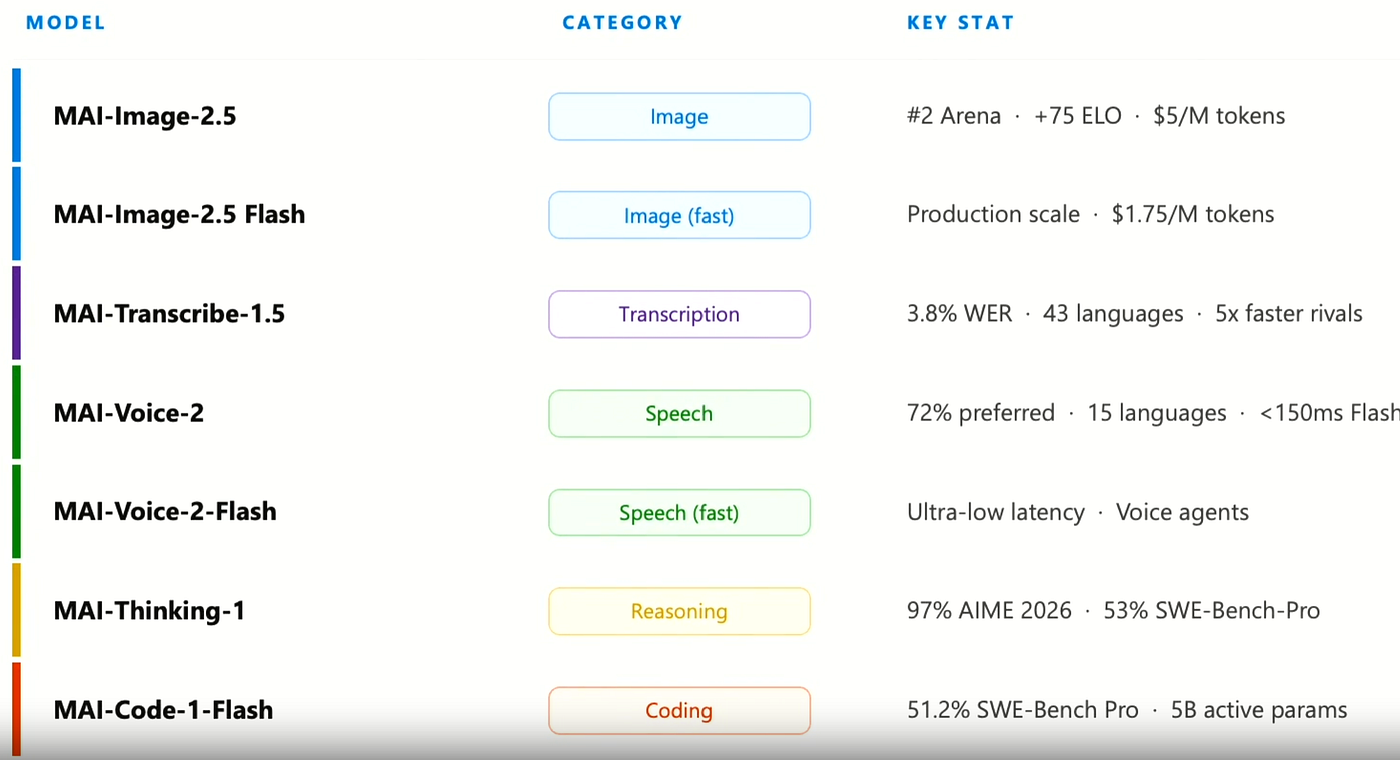
Notice the pattern: most categories ship a maximum quality model alongside a Flash variant tuned for throughput and cost per…注意模式:大多数类别都会同时发布一个最高质量模型以及一个针对吞吐量和成本进行调优的 Flash 变体……


