

Everything is Recorded Now万物皆被记录
The living context layer is being built inside companies right now, whether they're paying attention or not无论公司是否关注,活体语境层正在公司内部被构建中

America | Tech | Opinion | Culture | Charts美国 | 科技 | 观点 | 文化 | 图表

One of the biggest ways that AI is transforming work (and also one of the most taboo subjects inside companies at the moment) is that most work discussions are being recorded now by default. This wasn’t debated – it just happened. And you should probably assume that everything you say at work is getting recorded for here on out.AI 转变工作方式的一种最大途径(也是目前公司内部最禁忌的话题之一)是大部分工作讨论现在已经默认被记录。这并未经过辩论就已经发生了。你应该大概假设从此以后你在工作中说的每一句话都会被记录。
This naturally freaks a lot of people out. But I don’t think it’s a reversible trend. There are just too many bottom-up advantages for productive individuals, and too many top-down advantages for leaders, to put the genie back in the bottle.这自然会吓到很多人,但我不认为这是一个可逆转的趋势。对高效的个人而言有太多自下而上的优势,对领导者而言也有太多自上而下的优势,这使得我们难以将魔笛手放回瓶子里。
From a technology perspective, it’s clear that a new kind of system of record is going to get built out of this living company context, and we may as well get to that future as fast as we can.从技术角度来看,很显然将建立一种新型的记录系统,它源于公司内部的“活体语境层”,我们不妨尽早迈入这一未来。
The key insight is that you need to onboard AI like you would onboard employees. You don’t tell a new employee to pour over your existing CRM system or company wiki and expect them to get up to speed. You invite them to meetings and let them learn through osmosis. This is because meetings are where culture resides, where expectations live, where edge case handling gets done. The (previously) unwritten context for how a company actually operates. Turns out AI operates the exact same way, except it can attend every meeting, reason over every interaction and never get bored. Ultimately, this latent context is what is going to empower AI agents to do productive work across companies. And this promise of AI productivity is going to dramatically outweigh any fear / prior cultural norms.关键的洞察在于,你需要像招聘新员工一样上马 AI。你不会让新员工去死磕现有的 CRM 系统或公司维基,然后指望他们迅速上手。你会邀请他们参加所有会议,让他们通过潜移默化的方式学习。这是因为会议承载着文化的存在,寄托着预期的实现,也是处理边缘情况的地方。这是公司实际运作的(之前未曾书写的)语境。事实证明,AI 的运作方式正是如此,区别在于它可以参加每一场会议,分析每一次互动,且永远不会感到厌倦。最终,正是这种潜藏的语境将赋能 AI 代理在企业之间完成高效的工作。这种 AI 生产力带来的巨大收益将远远超过任何恐惧或既有的文化规范。
Bridgewater was ahead of its time here. Recording everything as institutional policy looked eccentric for years, and it turns out it was prescient. OpenAI now runs with essentially everything recorded, with agents standing in for senior leaders in meetings they can’t attend. The model that’s ingested two years of your company’s internal discussion is simply a better assistant than the one that only read your documentation. Granola is the clearest example I have: it has better context on a16z’s culture, our investments, and how we actually think than almost any other tool we use, because it’s been in the room.Bridgewater 在这一点上走在时代前列。多年来,将一切记录作为机构政策看起来特立独行,结果证明这是先见之明。OpenAI 现在实际上运行在几乎所有内容都被记录的基础上,代理在无法出席的会议中替代高级领导。仅仅摄入了两年公司内部讨论的模型,就比那些仅阅读过文档的模型更优秀。Granola 是最清晰的例子:它对我们 a16z 的文化、投资以及实际思考方式的掌握,远超我们使用的任何其他工具,因为它“在当场”(亲临现场)。
What’s emerging is a new category of enterprise software, organized around voice instead of text. The system of record today is structured data: CRM entries, tickets, docs. But the highest-value context lives in conversation: the nuance on a customer call, the real argument in a product review, the offhand comment in a leadership meeting that quietly changes the roadmap. LLMs are uniquely good at taking that unstructured voice data and making it structured, searchable, and queryable. That’s a large enterprise opportunity, and we’re still early in understanding what the software layer looks like and who owns it.正在兴起的是一类新的企业软件类别,它是围绕语音而非文本构建的。今天的记录系统主要存储结构化数据:CRM 记录、工单、文档。然而,最有价值的语境存在于对话之中:客户电话中的细微差别,产品评论中的真实争论,领导会议中那条悄然改变路线图的随手评论。大语言模型(LLM)在处理这种非结构化语音数据并将其转化为结构化、可搜索和可查询数据方面独具优势。这是一个巨大的企业级机遇,而我们对于软件层究竟是什么样以及由谁拥有,仍处于早期探索阶段。
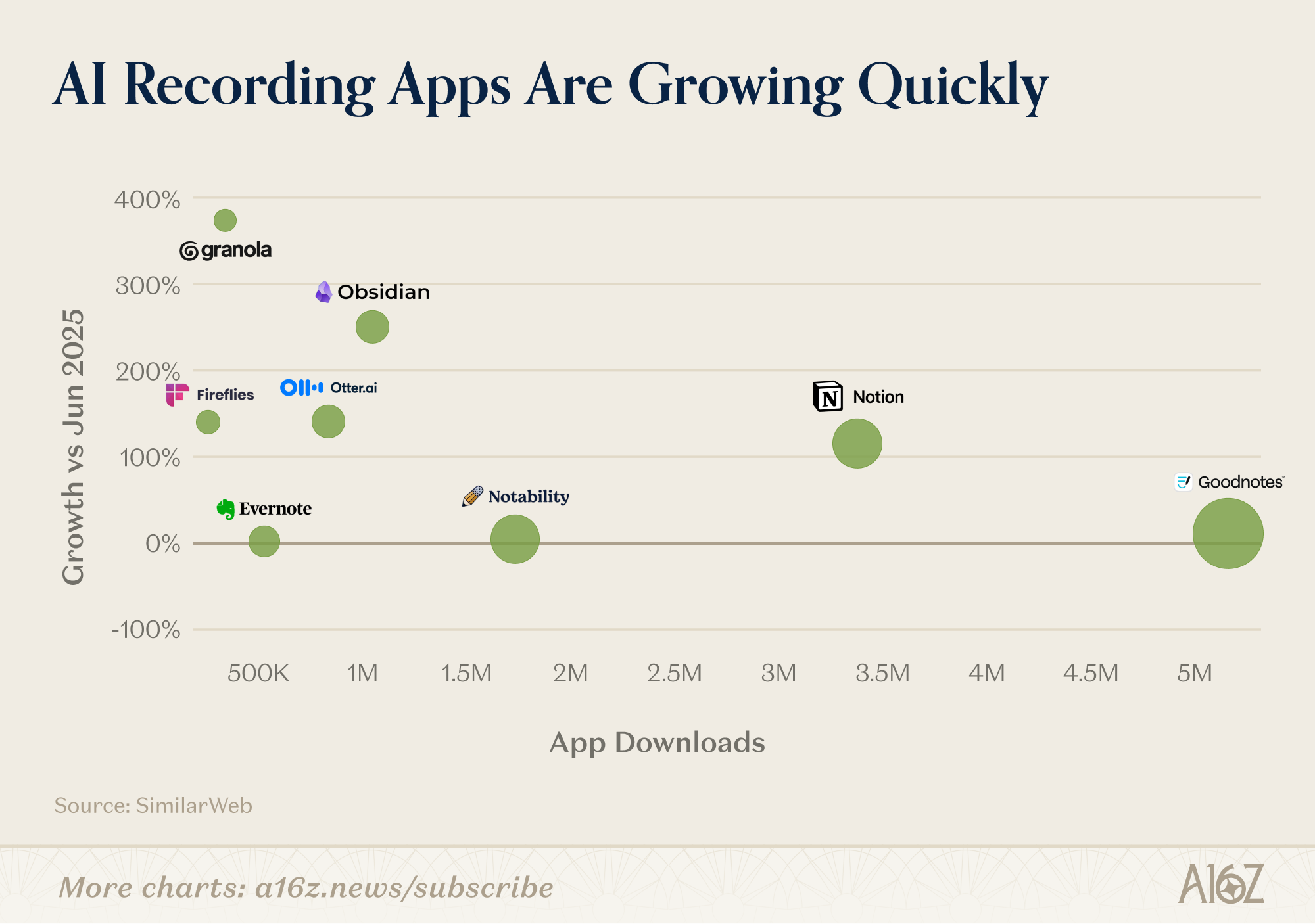
There are two advantages you give up by not recording. The first is bottoms-up: an AI that knows the full company context is a force multiplier for the ICs who can see how to make the company better. Everyone gets this one. The second gets discussed less but matters just as much: top-down oversight. AI might make your best ICs 10x more productive, but it doesn’t solve the alignment problem inside a company, and un-shipping something is far more expensive than shipping it. Execs need a handle on what’s getting built, and the obvious mechanism is to have their AI present in the meetings they can’t make, flagging what matters. Both advantages compound. Every recorded meeting makes the system smarter.不记录意味着你放弃了两个优势。第一个是自下而上的优势:一个了解全公司语境的 AI 是那些能看到如何改进公司的个人贡献者(IC)的放大器。这一点大家都很清楚。第二个优势讨论较少,但同样重要:自上而下的监督。AI 可能会让你的最佳个人贡献者提高 10 倍的效率,但它无法解决公司内部的“对齐”问题,而且废止某事比推出某事昂贵得多。高管需要掌控正在建设的内容,很明显,机制就是在他们无法出席的会议上让他们的 AI 出席,并标记出重要的事项。这两个优势都会相互叠加。每一次被记录的会议都会提升系统的智能水平。
There’s a cultural dimension I don’t think gets enough attention. Companies cluster into verbal cultures and written cultures. Verbal cultures, the Shopifys and OpenAIs, have a compounding advantage in an AI-native world, where written cultures like Stripe or Anthropic already capture most of their context by construction. The historical bottleneck for verbal cultures was that the important context happened in conversation and then evaporated. When AI can attend every meeting and synthesize what happened, verbal culture finally scales. That’s not to say that written culture companies won’t benefit too: giving AI access to thoughtful writing is obviously also a good way to get it up to speed on what matters in the company. But, overall, I think AI is going to promote and enhance verbal culture disproportionately.我认为有一个文化维度尚未得到足够重视。公司会分化为“口语文化”和“书面文化”。口语文化公司,如 Shopify 和 OpenAI,在 AI 原生世界中拥有复合优势,因为像 Stripe 或 Anthropic 这样的书面文化公司早已通过其架构捕获了绝大部分的语境。口语文化的历史瓶颈在于重要的语境存在于对话中,随后便烟消云散。当 AI 能够参加每一场会议并综合发生的事情时,口语文化终于实现了规模化。这并非说书面文化公司不会受益:让 AI 访问经过深思熟虑的文字,显然也是让其快速了解公司重要事务的好方法。但总体而言,我认为 AI 将不成比例地促进和增强口语文化。
This is where the inevitability comes from. The default is going to flip, from “don’t record unless you opt in” to “assume you’re being recorded unless a meeting is explicitly designated otherwise.” I’d bet this is far less contested six months from now than it is today. The deeper reason is that the old principle already applies to everything else: never put anything in writing you wouldn’t want made public. Screenshots get forwarded. Emails get subpoenaed. Slack messages end up in discovery. Most professionals already operate on that assumption for text. Meeting recording is the same principle, applied to conversation.这就是必然性的来源。默认设置将会发生翻转,从“除非选择加入,否则不进行记录”转变为“除非会议被明确标注为其他情况,否则假设你正在被记录”。我敢打赌,六个月后,这会比今天少受到很多争议。更深层次的原因在于,旧的原则早就适用于其他一切:永远不要写下任何你不想公开的内容。截图会被转发,邮件会被公开传唤,Slack 消息最终会被卷入取证。大多数专业人士已经在处理文本时遵循这一原则。会议记录是将这一原则应用在对话上的体现。
That makes recording a decisive wedge between smaller, AI-native companies, for whom it’s the obvious default, and incumbents that have to overcome the inertia of not doing it. When I raise this with people at big companies, they ask some version of “have you ever been sued before?” Which is fair. But the cost of not doing it, measured in competitive advantage forgone, is enormous. We’ll probably land on special designations for sensitive meetings, HR and legal, something like “AC Priv”: don’t record, and if you do, that’s a violation. It’ll be gameable, the way these things always are. My bet is that widespread recording simply happens, because it’s too hard to stop, and the controls get retrofitted on top.这使得“记录”成为了区分 AI 原生小公司和必须克服“不记录”惯性的既有公司的一把利刃。当我向大公司的人提出这个问题时,他们问的版本大概是“你以前被起诉过吗?”这确实公平。但不做的代价——以放弃的竞争优势来衡量——是巨大的。我们很可能最终在敏感会议、人力资源和法务方面有特殊 Label,比如“AC Priv”(不要记录,如果记录了,则违反规定)。这会被钻空子,就像以往的事情一样。但我赌的是广泛的记录最终会发生,因为它实在太难阻止,而控制机制只能在此基础上进行改装。
It’s a great time to be an operator and an investor here, and an interesting time to be a board member. The big tradeoffs around how, and how much, a company records itself are exactly the kind of problem a board should help with. The living context layer is being built inside companies right now, whether they’re paying attention or not. The question isn’t whether this happens. It’s whether you get there first, and build the right governance around it while you still have the advantage of choosing.现在对运营者和投资者来说是一个绝佳时机,对董事会成员来说也是一个有趣的时机。关于一家公司如何以及记录多少,这些巨大的权衡正是董事会应当协助解决的问题。活体语境层正在公司内部被构建,无论公司是否关注。问题不在于这件事是否会发生,而在于你能否率先达成,并在你依然拥有选择权优势时,建立起适当的治理体系。



This newsletter is provided for informational purposes only, and should not be relied upon as legal, business, investment, or tax advice. Furthermore, this content is not investment advice, nor is it intended for use by any investors or prospective investors in any a16z funds. This newsletter may link to other websites or contain other information obtained from third-party sources - a16z has not independently verified nor makes any representations about the current or enduring accuracy of such information. If this content includes third-party advertisements, a16z has not reviewed such advertisements and does not endorse any advertising content or related companies contained therein. Any investments or portfolio companies mentioned, referred to, or described are not representative of all investments in vehicles managed by a16z; visit https://a16z.com/investment-list/ for a full list of investments. Other important information can be found at a16z.com/disclosures. You’re receiving this newsletter since you opted in earlier; if you would like to opt out of future newsletters you may unsubscribe immediately.本简报仅供信息参考,不应作为法律、商业、投资或税务建议的依据。此外,本内容不是投资建议,也不旨在供任何 a16z 基金的投资者或潜在投资者使用。本简报可能会链接到其他网站或包含从第三方来源获取的信息——a16z 未经独立核实,也未就此类信息的准确性或持久性做任何陈述。如果本内容包含第三方广告,a16z 未对其审查,也不认可其中包含的任何广告内容或相关公司。提及、引用或描述的任何投资或投资组合公司均不代表 a16z 管理的所有投资;请访问 https://a16z.com/investment-list/ 查看完整的投资列表。其他重要信息可以在 a16z.com/disclosures 找到。您收到本简报是因为您之前选择订阅;如果您希望取消后续简报,可以立即取消订阅。
The piece I'd push on is candor. Once people assume every meeting is recorded and queryable by their boss's agent, the messy, half-formed thinking that actually produces good decisions tends to migrate to the hallway and the DM. You capture more context, but a thinner, more performed version of it.
Not record itself only, transform recorded contents and distribute as well as align to pointed team is new way of “team aligning”, its expected to see SOP and more standard push within organization happens along with the development of enterprise-level agent, and that’s how agent maximize organization efficiency.